Key Takeaways From the 2026 Artificial Intelligence Summit
Co-authored with Gabriella DeCesare

- Federal officials and industry experts discussed the challenges and opportunities shaping artificial intelligence adoption at the 2026 Artificial Intelligence Summit
- Participants focused on the real-world challenges shaping adoption—from data readiness and agentic AI to governance, workforce transformation and acquisition speed
- Continue the conversation on federal AI initiatives at the 2026 Digital Transformation Summit on April 22. Sign up today!
The 2026 Artificial Intelligence Summit brought together senior federal officials and industry leaders for a timely discussion on one of the government’s most pressing priorities: how to operationalize AI at scale. Hosted by Potomac Officers Club, the event convened chief AI officers, technologists and executives from across defense, intelligence and civilian agencies alongside leading GovCon innovators to explore the evolving AI landscape.
As agencies move beyond experimentation into deployment, summit participants focused on the real-world challenges shaping adoption—from data readiness and agentic AI to governance, workforce transformation and acquisition speed. Across keynote remarks and panel discussions, speakers shared practical insights on how organizations are aligning technology with mission needs while navigating complexity, risk and rapid change.
Looking ahead, Potomac Officers Club will continue the conversation at the 2026 Digital Transformation Summit on April 22. Hear top officials from the Department of War and Customs and Border Protection, and leading contractors like MTSI and Oddball examine how emerging technologies are driving mission outcomes across agencies.
Don’t miss this opportunity to engage with federal decision-makers and gain insight into the next phase of digital innovation—register now to secure your spot!
How Are Agencies Approaching Agentic AI?
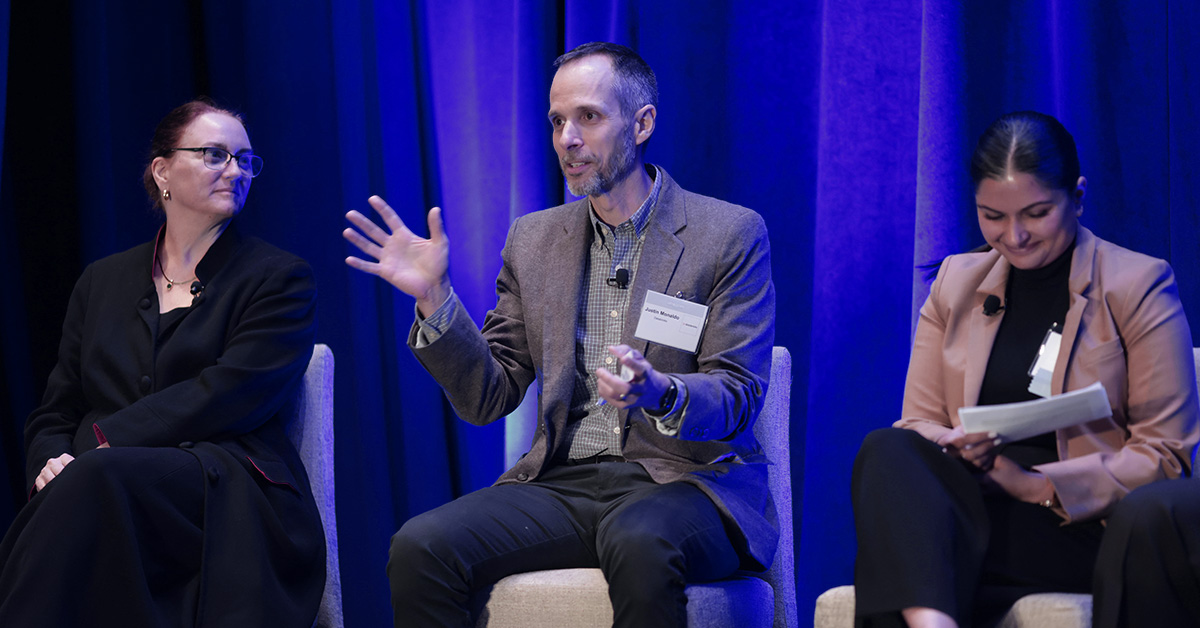
At the 2026 Artificial Intelligence Summit, federal and industry leaders discussed how agencies should approach the rapid evolution and deployment of agentic AI, particularly as these systems begin operating across diverse mission environments. The discussion underscored two critical considerations for federal leaders: selecting the right models for specific operational contexts and developing reliable frameworks to evaluate agent performance at scale.
Speakers discussed the use of agentic AI in their technology ecosystems as agentic AI matures and is proliferated across diverse networks.
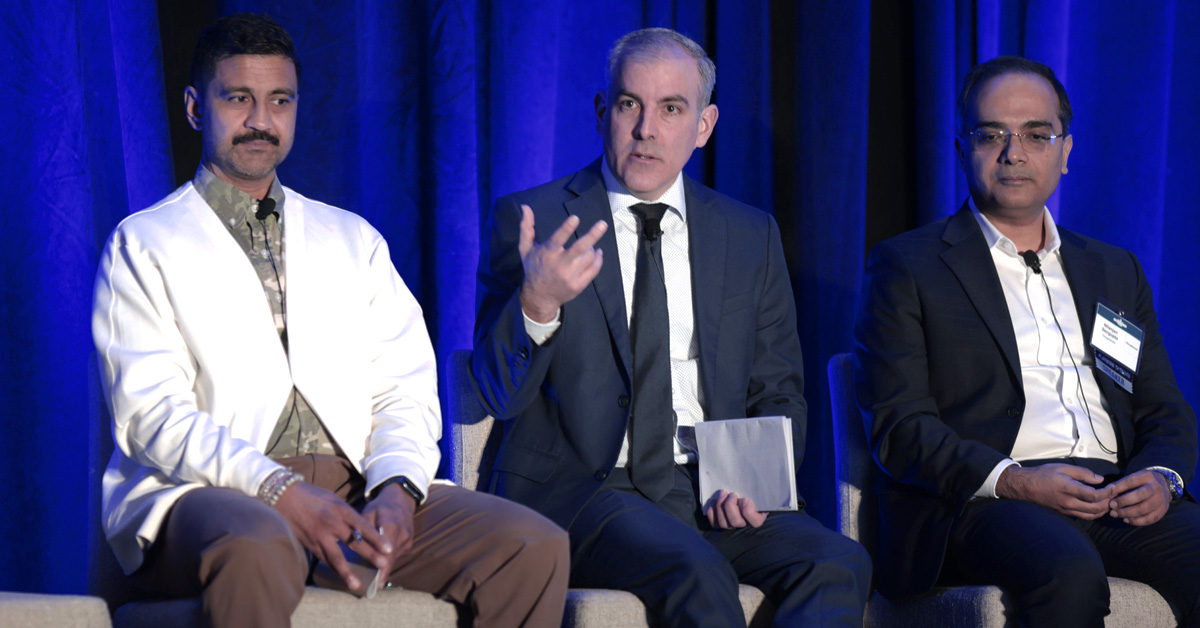
Ben Needles, U.S. Indo-Pacific Command J2 chief technology officer, said large language model applications have become overgeneralized, with organizations quick to apply them to many workstreams rather than matching the right AI capabilities to each use case.
“For us, there’s been this panacea approach of how we can take large language models and apply them to everything,” Needles said. “A large language model probably isn’t what I need. I probably need small language models that are built specifically for the context.”
Needles’ remarks highlighted a shift toward more targeted and mission-specific AI architectures.
“The big piece here, for me, when it comes to agentic AI, is: context, context, context” — Justin Needles, U.S. Indo-Pacific Command J2 CTO
Justin Monaldo, Databricks lead specialist solutions architect for generative AI and machine learning, expanded the discussion by addressing a related challenge: evaluating agent performance. He said traditional metrics fall short as agents move beyond experimentation into operational deployment.
“It’s really hard to measure the quality of agents in models because it’s not deterministic,” Monaldo said. “I like to relate it to the fact that I can walk into a museum and look at paintings. This one is amazing and I can barely draw a stick figure. Where we talk about agent evaluation is how, at scale, I can use large language models to track and maintain how well an agent is performing, both before deployment, and monitoring once that agent is out there and doing work.”
Are Traditional Data Strategies Limiting AI’s Full Potential?
Across government, data challenges remain a hurdle to unlocking AI’s full potential, with leaders acknowledging that traditional approaches to data management have fallen short. Katie Noyes, FBI CAIO, pointed to the limitations of past strategies.
“We’ve tried the centralization, we’ve tried the massive data lake, we have tried referencing,” she said. “The real power behind AI [is] being able to explore and discover the data.”
Noyes said challenges in data infrastructure raise risks inherent in data fragmentation, such as data match. This refers to matching entries on the same entity from disparate sources to produce a complete record, understand linkages and reduce duplication
“One of our major risks is data match,” Noyes said. “I think what we are starting to see [is] that therein lies the rub and therein lies the AI.”
Noyes also highlighted a persistent concern across the intelligence and law enforcement communities.
“What we’re most afraid of is that we have the right data, but don’t have a way to discover the threat within our data” — Katie Noyes, FBI CAIO
Operational use cases are already demonstrating how AI can close that gap. Quentin Noreiga, SOSi AIMS program manager, described a scenario in which analysts previously spent days or weeks aggregating and correlating data across classification levels.
“I have a situation where analysts are pulling disparate data sources globally from multiple classification ranges. When something happens, they have to pull, correlate that info and put it in a centralized database and begin analysis,” he said. “By taking AI, in this case, machine learning, we were able to take that pre-analysis time down from days and weeks, to a few hours. When that analyst shows up in the morning, they open the computer, there’s a dashboard there and that information is ready.”
Noreiga added that AI-driven workflows have significantly improved data efficiency and clarity.
“Pulling information into centralized databases, making sure information from Event 1 and Event 2 are separated so they know which data refers to which event…We have cut processing time down from days to minutes,” he said.
Are you a GovCon technology professional? Then you cannot afford to miss the Potomac Officers Club 2026 Digital Transformation Summit. It’s curated just for you! Get actionable business intelligence from Kirsten Davies, Pentagon CIO and 2026 Wash100 Award winner during her insightful keynote address. Sign up today!
How Are Agencies Driving Organizational Change for AI Adoption?
Beyond technology, federal leaders emphasized that successful AI adoption depends on organizational alignment, workforce enablement and leadership mindset. Agencies are increasingly turning to internal networks and cultural transformation efforts to accelerate adoption at scale.
The discussion underscored that scaling AI is not solely a technical challenge—it requires empowered champions, shared talent models and leadership-driven focus on measurable, mission-aligned outcomes.
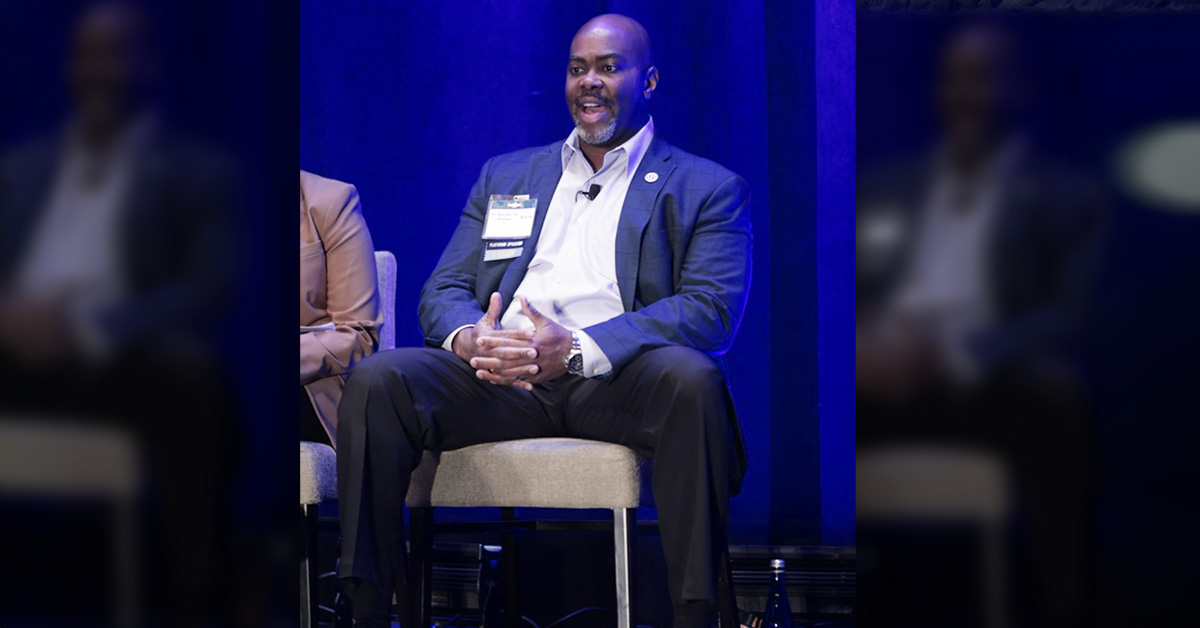
Sridhar Mantha, Food and Drug Administration acting CIO, highlighted the importance of building grassroots expertise through structured programs.
“We have created a program called Champions that we work with. We have a team of 30 to 40 people that work together, then they go to their respective centers and evangelize AI,” he said. “We also have peer networks to exchange ideas.”
Mantha added that scaling this approach across government agencies could further strengthen collaboration.
“What I would like to see from the Office of Personnel Management’s perspective is creating a government-wide position that has some sort of common capabilities so it’s easier to exchange the talent.”
At the leadership level, Christopher Gordon, BigBear.ai vice president, stressed that cultural change must begin with clear priorities and achievable outcomes. He advised how agency leaders can balance pressure for results with governance requirements.
“I would say [leadership needs] a mind shift,” he said.“Come up with clear goals, come up with quick wins, [find out] where the lowest hanging fruits are [and] go tackle what’s going to enhance the lives and the jobs of your people.”
How Are Federal Agencies Encouraging Responsible AI Use?
The 2026 Artificial Intelligence Summit was full of discussion about how federal agencies and leading contractors are using the technology in advanced ways to achieve their missions faster, smarter and more effectively. But panelists also encouraged the responsible use of AI and shared examples.
Matha said the FDA is not using agentic AI in the true sense, with autonomous decision making, because there is too much at stake.
“The FDA is about 20 percent of our (national) gross domestic product. We don’t want AI making decisions on products that are going to millions of people,” he said. “I’d like to say the FDA is crushing it with AI…but in terms of the strategies, we’re really emphasizing human-in-the-loop.”
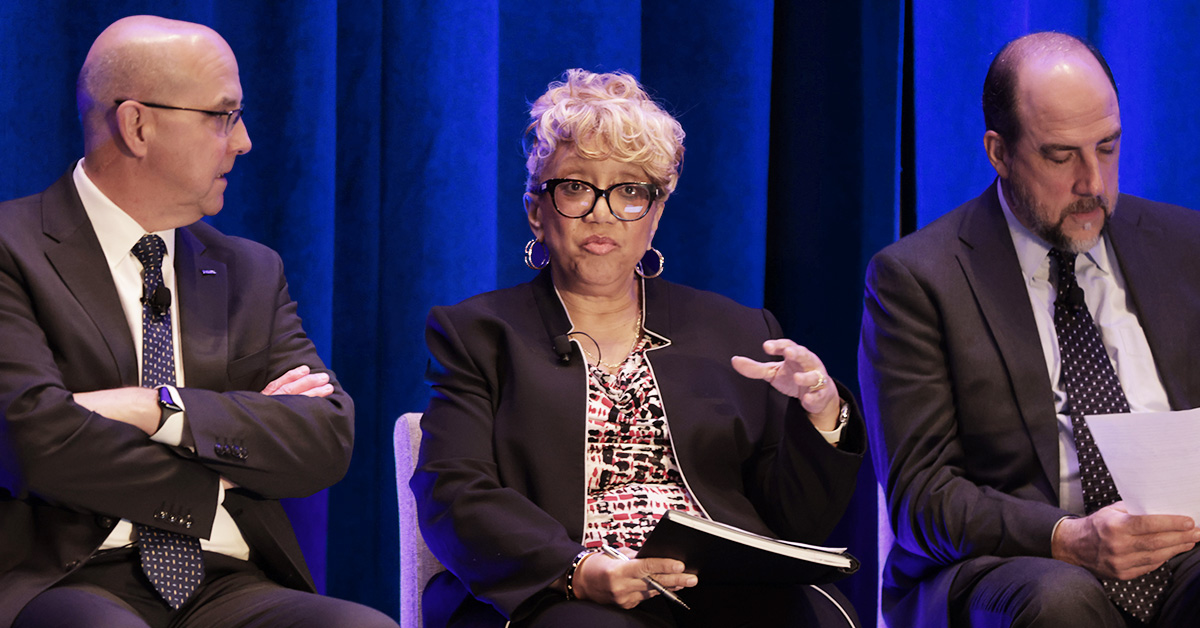
Jesus Caban, Defense Health Agency CDAO, is also encouraging healthcare providers to serve as humans-in-the-loop when using AI to ensure accountability.
“You are accountable for this. If there is malpractice, it’s not the AI, it’s the provider,” Caban said during the Does Your AI Play Well With Others panel. “[That is one thing] that we are doing to make sure we go beyond these buzzwords of AI and objective AI into something practical that we understand how to use safely and responsibly.”
How Are Federal Agencies and Contractors Moving Fast?
One of the hottest topics at the 2026 Artificial Intelligence Summit was how the DOW is moving fast to get emerging technologies into warfighters’ hands as fast as possible. The department in November of last year issued a revolutionary Acquisition Transformation Strategy that seeks to rapidly transform what it calls an antiquated acquisition system and revitalize the defense industrial base by prioritizing speed, flexibility and rigorous execution.
One federal official said that her division is considering how it can adopt a top-down framework using AI.
“Instead of an experiment with years of planning and designing, we’re getting after those framework capabilities,” said Germaine Forbes, Navy PEO Digital deputy director for future capabilities. “With software-defined hardware, there are risks. We’re keeping ourselves open for adoption while avoiding vendor lock-in. We’re not failing fast, but deploying and learning.”
The CEO of a leading technology integrator said that risk is an inherent tradeoff with speed. The faster you go, the more risk is involved in the capability you deliver. The trick is finding the balance.
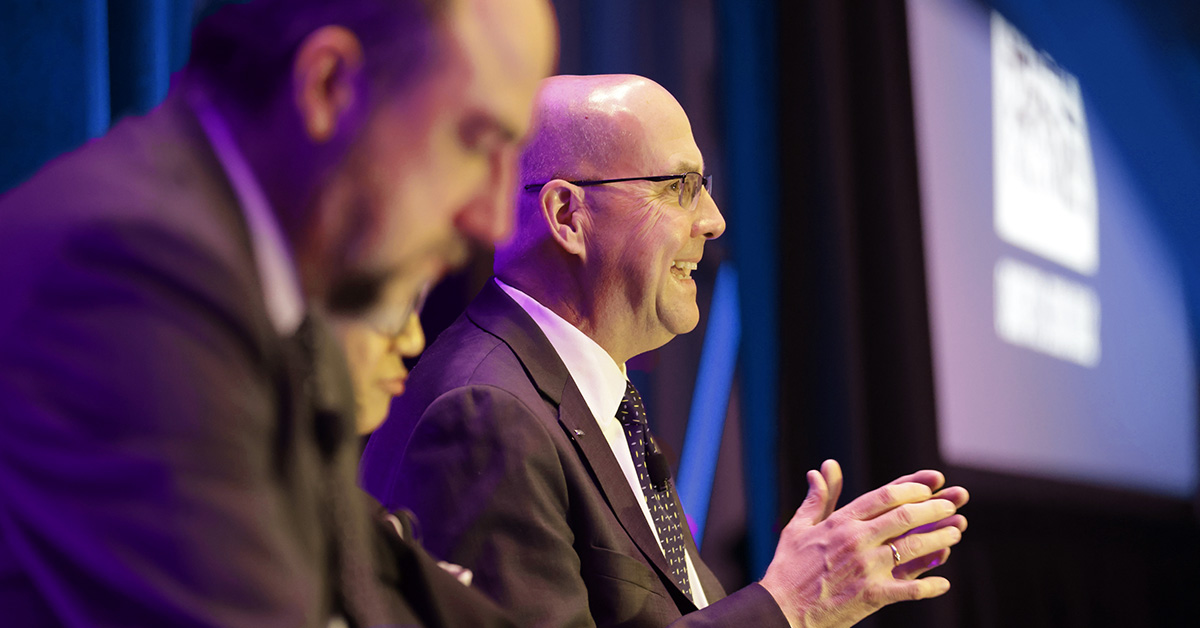
“We know as the defense industrial base [that] government labs can build exquisite risk tolerance, or risk proof, if you invest years or decades,” said Peter LaMontagne, SMX CEO and two-time Wash100 Award winner. “However, U.S. Indo-Pacific Command chief [and fellow 2026 Wash100 Award winner] Adm. Samuel Paparo has said speed matters right now…We need the benefits of strategic new capability but we need it at a speed of much less technology insertion.
Look, [there’s] no easy answer,” LaMontagne concluded.


Category: Articles