
All About the DOW’s Unexpected, Novel Consortium Model for Golden Dome C2
- The Pentagon is utilizing a unique performance-based consortium model for developing Golden Dome’s C2 layer, where teams of contractors can vote subperforming members off the program
- This innovative approach to emerging technology development could spread throughout Pentagon acquisition due to the department’s emphasis on fielding critical technologies faster
- Learn more about innovative contracting practices with Golden Dome and other programs at Potomac Officers Club’s Summer Series of DOW service-focused GovCon events!
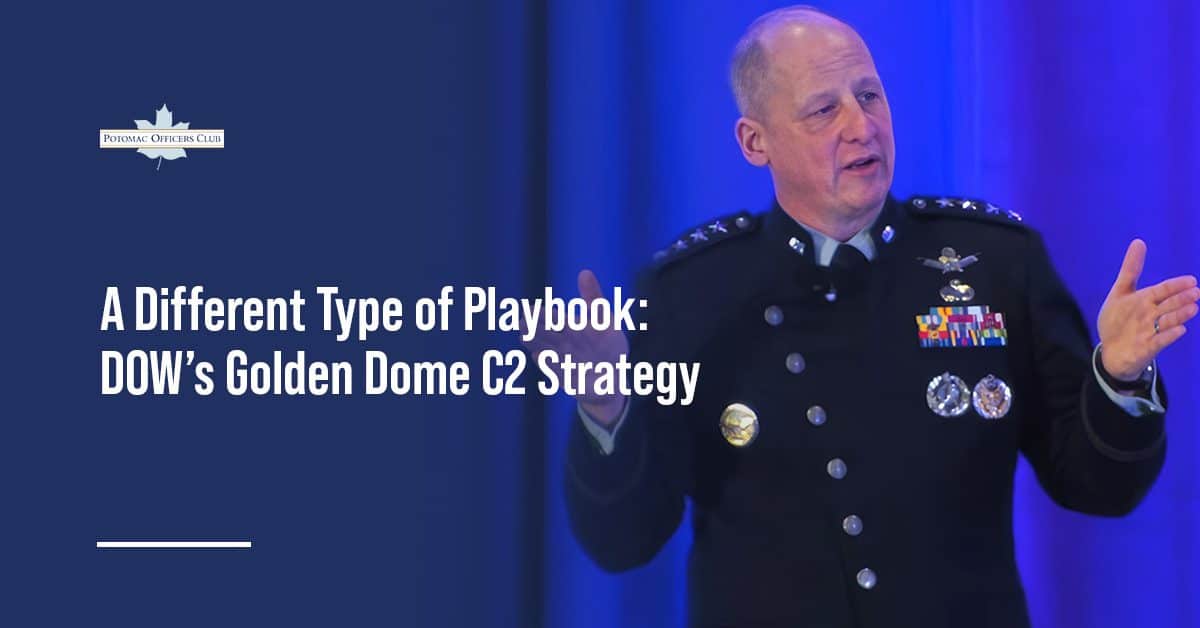
The Department of War is using a unique performance-based consortium model to develop its Golden Dome command and control layer where prime contractors and their subcontractors can vote members of their individual teams off the program for poor performance.

Gen. Michael Guetlein, Golden Dome director and a two-time Wash100 Award winner, said at the McAleese Defense Programs Conference that six contractors early on in the program told him none of them could individually deliver what he needed for the C2 layer. But they could if all of them worked together.
These teams are independent contractors operating as a unit, Gen. Guetlein said. They decide what they’re going to build, when and how they will build it, and which company among them is the “best athlete” to build it.
These teams hold themselves accountable on a weekly or biweekly basis. Gen. Guetlein said they brief him on Thursdays on what they accomplished during the week. If any of them did not perform up to standards, he said, they can vote that company off the effort.
The Golden Dome enterprise, not just the C2 layer, was designed for open systems architectures.
At any point, I can unplug one provider and plug in a new [one] as a new athlete comes to the table with something better. [This is so] we are not stovepiped into a technology, or a single vendor, for perpetuity. — Gen. Michael Guetlein
Dig into the latest partnership opportunities and spending priorities at the Potomac Officers Club’s Summer Series of DOW service-focused GovCon conferences! The 2026 Army Summit kicks things off on June 18, the 2026 Air and Space Summit follows on July 30 and the 2026 Navy Summit concludes the series on Aug. 27. Hear directly from top service officials and connect with peers across the defense industrial base. Sign up today!
How Important is Golden Dome’s C2 Layer?
The C2 layer is an essential part of Golden Dome, the massive homeland missile defense shield that is one of President Trump’s signature projects. Gen. Guetlein called the C2 system the “glue layer” that unites C2 systems individually developed by other Department of War agencies. These include the Missile Defense Agency’s Command and Control Battle Management Communications, aka C2BMC; the Army’s Integrated Battle Command System, or IBCS; and the Air Force’s Command, Control, Communications and Battle Management, aka C3BM.
Which Companies Are Working on Golden Dome’s C2 Layer?
A Pentagon spokesperson said Aalyria, Scale, Anduril, Palantir, Swoop, Lockheed Martin, Raytheon and Northrop Grumman are among the industry partners involved in the Golden Dome C2 consortium. A spokesperson for Aalyria declined to comment.
A key objective for this year is for the C2 consortium to demonstrate critical progress in system integration. Specifically, it is to show that the C2 system can receive data from different sources, process that information, make decisions at relevant speed and take action. This is a crucial step in building the system’s integrated and layered defense, the spokesperson said.
A missile defense expert said though he hasn’t heard of an approach like this before in Pentagon technology development, it’s a worthwhile strategy as the department has a poor track record of building C2 systems that communicate with each other. Todd Harrison, senior fellow at the American Enterprise Institute think tank, told Potomac Officers Club that the traditional model is building “stovepiped” systems unique to each agency that don’t communicate with each other before trying to connect them and realizing it’s too difficult.
This unique model for Golden Dome C2 development would help incentivize interoperability from the start, Harrison said, so the program doesn’t end up with many proprietary interfaces. It also establishes common formats and data standards, preventing a company from demanding payment for integration.
How Much Will Golden Dome Cost?
Gen. Guetlein estimated Golden Dome’s cost at $185 billion for the objective architecture which would be delivered around 2035. This is later than Trump’s goal of having the program fully operational by the end of his term, or by Jan. 20, 2029. The program has already received a $25 billion down payment from Congress, which the program is using to build Golden Dome’s foundation.
Harrison assessed Golden Dome’s progress almost one year into development as not having made key architectural decisions. Gen. Guetlein’s $185 billion estimate is pretty similar to an architecture from one of Harrison’s six different cost estimates, he said, which was for an architecture that could “knock out a few missiles or warheads,” or maybe a rogue or one-off attack. But not something that could defeat a strategic level attack on the U.S.
More money won’t accelerate Golden Dome, according to Harrison. Instead, the program needs to start making, and executing on, decisions, he said.
Which Other Companies Are Trying to Join Golden Dome?
One industry executive said his firm is actively trying to join a Golden Dome C2 layer team and has a teaming agreement with one of them. Sean DuGuay, Aretum chief growth officer and a 4×24 Leadership Program member, told Potomac Officers Club that the company is offering Autonomous Information Mapping, an artificial intelligence product specifically designed for Golden Dome that finds and correlates difficult to locate information and allows a human in-the-loop to make a decision.
Are you a GovCon technology executive? Then you cannot afford to miss the Potomac Officers Club’s Summer Series of DOW service-focused GovCon events. They are strategically tailored to boost your business! The 2026 Army Summit begins the series on June 18, the 2026 Air and Space Summit takes place on July 30 and the 2026 Navy Summit wraps the summer up on Aug. 27. Explore how Pentagon leaders are strategizing to leverage advanced technologies and maintain an advantage in combat. Secure your seat now!
Why Is This Performance-Based Consortium Model Important?
DuGuay said the performance-based consortium model for Golden Dome’s C2 layer signals a fundamental shift in how the Pentagon may expect industry to behave on large scale architectures. It’s the right move from a concept and a competitiveness standpoint, he said, because the U.S. can’t afford to wait and execute a traditional acquisition strategy with a five-year plan for a technology to be delivered in five years.
The Pentagon has placed a major emphasis on accelerating emerging technology acquisition to get essential capabilities into warfighters’ hands faster. DuGuay said this performance-based consortium model is not as much of a “win the contract and execute” type, as it is a continuous competition inside the contract.
This is definitely not a traditional contract type. If somebody isn’t holding their end of the bargain, then there’s immediate consequences that are going to come into play. — Aretum Chief Growth Officer Sean DuGuay
DuGuay said Aretum is approaching the Golden Dome C2 layer development as one where new teams aren’t locked out from the program. Instead, Aretum believes it, and other firms, could start their own teams and develop offerings.
DuGuay expects the Pentagon to apply this performance-based consortium model to not only other Golden Dome technologies but throughout the Pentagon, depending on its level of success with the C2 layer. This is because its progressive and forward-thinking approach meshes well with the Pentagon’s emphasis on accelerating emerging technology procurement.
What Are Concerns With the Performance-Based Consortium Model?
DuGuay has a few concerns with this performance-based consortium model. He said some contractors may have an agenda that impacts whether they vote certain teammates off a program. He also said there should be a full governance process that allows for disputes, voting mechanisms and performance criteria.
Aretum subsidiary Miracle Systems has been awarded a position on the Missile Defense Agency’s potential $151 billion Scalable Homeland Innovative Enterprise Layered Defense, or SHIELD, contract, which supports Golden Dome. DuGuay believes that contractors will have to be on SHIELD in order to compete for Golden Dome’s C2 layer.
Why Should Companies Team With Aretum?
Aretum is an attractive potential partner for the C2 system, according to DuGuay. One reason is that the company has depth and breadth across all federal civilian, homeland security, national security and Pentagon programs. It also has a great cadre of veterans within the company, most of whom have served in some sort of combat and understand mission-focused work.
“Every day, we’re talking to new veterans who either retire out of the military, or are fresh out of the military, and we ask them directly: what are the challenges,” DuGuay said. “What are you dealing with today? We try to formulate technologies that will address those challenges.”
Category: Articles