How Can GovCons Help the Government Fight Healthcare Fraud?
- Opportunities are growing for GovCons to support fighting healthcare fraud
- The Trump administration seeks new technologies to reduce healthcare fraud
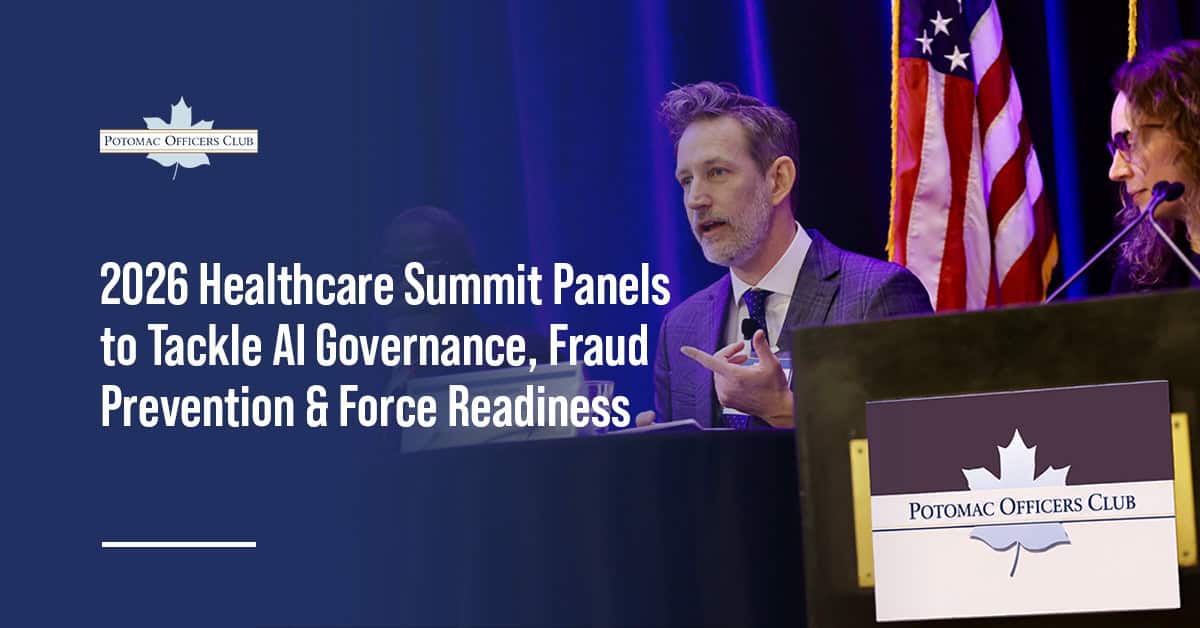
- Hear from top NIH and FDA officials on using AI to fight healthcare fraud at the 2026 Healthcare Summit!
Reducing fraud, waste and abuse in federal healthcare is a major Trump administration initiative. The Centers for Medicare and Medicaid Services are pursuing an effort that could save nearly $90 billion over 10 years by reducing fraud across Medicare, Medicaid, the Children’s Health Insurance Program and the Health Insurance Marketplace.
As a result, opportunities are growing for GovCons to not only shape potential future policy but also offer sophisticated technology services to support this top executive branch priority. Below, dive into five ways contractors can help the federal government fight healthcare fraud.
Potomac Officers Club’s 2026 Healthcare Summit on Dec. 3 will explore how federal healthcare agencies are using AI and advanced analytics to fight fraud, waste and abuse. At the AI Governance and the Role of Policy Expertise panel, federal officials will discuss how they’re bringing policy, program integrity and technical expertise together as AI moves from retrospective analysis into payment, oversight and enforcement decisions. Top officials from the National Institutes of Health, the Pentagon’s Joint Trauma System, and the Food and Drug Administration will provide actionable business intelligence. Sign up today!
How Can GovCons Help the Government Fight Healthcare Fraud?
1. Stop Questionable Billing Activity Earlier
Contractors may be asked to focus more on identifying and stopping questionable billing activity earlier in the payment cycle under a new CMS approach to Medicare fraud enforcement. As part of a new draft contractor model, CMS would take command over which suppliers and providers are targeted for Medicare fraud investigations, slashing the typical lead-generation role of Unified Program Integrity Contractors or UPICs, according to the McDermott Will & Schulte law firm.
CMS on Oct. 5 released a RFI on future fraud defense contracts, which also came with a statement of objectives. The agency is considering multiple other reforms to how contractors perform fraud investigations, including:
- Having contractors focused on specific provider sectors, such as hospice, home health or durable medical equipment suppliers, among others, handle certain investigations.
- Contractors’ roles would not end at the conclusion of an investigation. Instead, they could support the government through rebuttals, appeals and other court procedures.
- Eliminating silos in investigations. Contractors could be required to assist the transfer of active investigations, developing administrative actions and case files when contracts transition.
2. Enhance Payment Integrity
A pair of companies are finalists for a seven-year contract to deliver new software for adjudicating and processing Medicare claims. HealthEdge and Peraton will demonstrate and perform experiments with their prototypes for the new ClaimsCore systems through a series of challenges.
CMS seeks to replace four legacy COBOL-based processing systems. The ClaimsCore program intends to acquire a commercial off-the-shelf, configurable and interoperable claims processing platform. An initial proof-of-concept period ran through Nov. 4.
Federal healthcare officials are already looking toward 2027, making the Potomac Officers Club’s 2026 Healthcare Summit on Dec. 3 the perfect opportunity to get a headstart on the year. It features keynotes by two of the most influential officials in the shaping of healthcare policy: Dr. Erica Schwartz (new!), Centers for Disease Control and Prevention director, and Kimberly Brandt, Centers for Medicare and Medicaid Services deputy administrator and chief operating officer. Get their exclusive insights into where healthcare technology procurement is headed in 2027. Sign up now!
3. Use AI to Tackle Documentation Issues
CMS is considering using technology like AI and machine learning to reduce fraud, specifically through documentation issues. Brandt said incorrect documentation, or a lack of documentation, is a major driver of improper payments, according to NextGov/FCW.
“If we can reduce that documentation improper payment, that would drop our entire improper payment rate down by, at least in Medicare, as much as two percentage points, which is huge,” she said.
CMS’ new ClaimsCore system would provide “real-time payments” to providers as well as “real-time fraud review tools,” Brandt said. The agency in March 2025 stood up its Fraud Defense Operations Center to more proactively tackle fraud. This facility leverages AI to sort through thousands of Medicare claims and deliver a report of frequently billed services and items.
4. Improve Identity Proofing and Data-Matching Services
Contractors could be tapped for improved identity proofing and data-matching services as part of CMS’ proposed new verification requirements. Under a proposed rule issued Oct. 23, consumers seeking advanced payments of the premium tax credit or income-based cost-sharing reductions must first pass eligibility before receiving subsidies.
The Exchange Pre-Eligibility Verification Notice of Proposed Rulemaking would generally require consumers seeking financial assistance through the CMS exchanges to have certain eligibility criteria verified before receiving financial assistance beginning with 2028 health plans. CMS also proposes that currently enrolled consumers would only be automatically re-enrolled in coverage with ongoing financial assistance if they return to the Exchange to confirm certain eligibility criteria annually and have it re-verified by the Exchange.
5. Modernize Data Analytic Systems
Modern data analytic systems would allow CMS to quickly ingest and synthesize large amounts of data and information, and convert it into actionable intelligence in near real-time. The Comprehensive Regulations to Uncover Suspicious Healthcare, or CRUSH, proposed rule, issued Monday, said Medicaid program integrity reporting requirements no longer provide CMS with enough information to hold states accountable for lacking program integrity operations.
Specifically, CMS said existing reporting requirements don’t consistently provide information necessary to support national trend analysis, identify emerging fraud schemes, evaluate investigative outcomes or coordinate oversight activities among federal and state partners. CMS said in the CRUSH proposed rule that it, and other stakeholders, routinely coordinate activities involving provider investigations and administrative actions, and more detailed and standardized reporting would meaningfully strengthen these efforts.

Category: Articles