How Is DEM&S Adoption Shaping the Future of Digital Engineering?
As federal agencies accelerate digital transformation efforts, digital engineering, modeling and simulation, or DEM&S, is emerging as a critical aspect of modernizing mission execution, improving interoperability and enabling data-driven decision-making. Leaders across the Department of War are increasingly focused on how to operationalize these capabilities at scale, balancing innovation with legacy systems, workforce constraints and evolving mission needs.

What Is DEM&S?
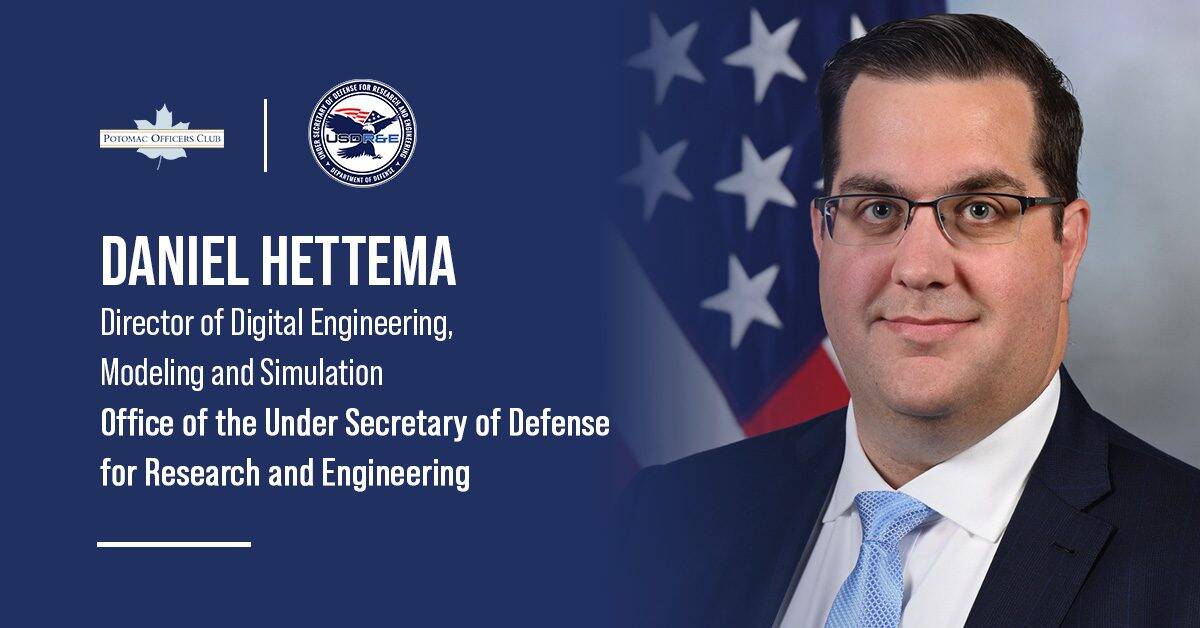
Digital engineering along with modeling and simulation improves efficiency by transforming how systems are designed, developed and integrated within collaborative, data-driven environments such as a digital engineering ecosystem. DEM&S Director Daniel Hettema, of the Office of the Under Secretary of Defense for Research and Engineering, founded the five principles for DEM&S adoption to provide a framework for advancing the field of digital engineering, modeling and simulation.
In an exclusive interview with the Potomac Officers Club ahead of his 2026 Digital Transformation Summit panel appearance, Hettema explained that his framework was created to support engineers and innovators in balancing human input with technology.
“We developed these five foundational principles to really help communicate where you should be doing the trade-off.” For example, Hettema continued, “I always find it weird when an organization says their number one priority is safety. But safety at what cost? The most safe system is one that doesn’t have a human person doing it, so there’s a context to it.”
 Professionals across government and industry are set to convene at the 2026 Digital Transformation Summit on April 22, where leaders including Hettema will explore the evolving landscape of digital engineering, mission integration and federal modernization. Attendees will gain firsthand insight into the principles driving DEM&S adoption across the Department of War and beyond. Register now to hear directly from practitioners shaping the future of digital transformation.
What Are the Five Foundational Principles of DEM&S Adoption?
Hettema outlined his five core principles designed to guide organizations through digital engineering transitions. These principles emphasize practical execution, data-centric thinking and collaborative culture as key drivers of success.
1. Doing Over Planning
The first principle reflects a broader shift in how organizations approach digital transformation, moving away from prolonged planning cycles and toward rapid experimentation and iterative development. In fast-evolving technological environments, rigid, long-term strategies can quickly become outdated, making it essential for teams to adopt a more agile, hands-on approach.
Hettema encourages engineers to begin implementing solutions, learning through execution, prioritizing action over planning: “The pace of technology sometimes dictates that we need to try things, we need to experiment, we need to get our hands dirty… If all we’re doing is talking about it in PowerPoint, we’re not actually doing digital engineering.”
By prioritizing action, teams can validate concepts more quickly, uncover challenges earlier in the process and adapt in real time. This approach encourages testing ideas, building prototypes and gaining practical experience, ensuring that digital engineering efforts are grounded in tangible application rather than theoretical planning alone.
2. Focus on Foundational Data
Effective digital engineering requires prioritizing the structure and quality of data above rigid processes. With many systems built around rigid documentation requirements, often prioritizing compliance with specific formats over the actual value of the information being produced, there can be an overreliance on legacy tools and processes that slows innovation and limits ability to fully leverage digital capabilities. As organizations transition to more modern, data-driven approaches, there is a growing need to rethink these conventions and focus on the underlying data itself.
Hettema pointed to the need for organizations to move beyond simply digitizing existing processes and instead rethink how data is structured and used: “Step two is about how we focus on the foundational pieces of the data… We’re trying to push people to think at the next level up, rather than driving into the existing process.”
Hettema’s principle opens the door for more flexible, outcome-driven approaches: “We don’t have to follow the letter of the process. We can achieve the spirit of that process by showing you can find other ways of accelerating and meeting [the outcomes].”
Instead of replicating outdated documentation like decade-old Excel matrices, the focus should be on achieving the intent of the process and unlocking actionable insights from data. By focusing on actionable data instead of rigid process adherence, organizations can unlock insights and create sustainable efficiencies.
3. Upskilling Over Future Hiring
Often, organizations focus on recruiting a candidate with the exact qualifications they need, which often restricts the pool of candidates so much so that they cannot hire for the role. Hettema argued that organizations should develop their current workforce rather than searching for “perfect” candidates:
“We have a workforce, they have the breadth of knowledge, but it’s imperative on us to actually spend the time upskilling them.”
Upskilling involves both technical training and soft skills development, equipping employees to contribute effectively to digital transformation initiatives. With a growing number of engineers in government and industry, the field already has access to the personnel, but training and upskilling are essential.
Investing in current employees ensures they have the skills and mindset needed to navigate digital transitions successfully.
4. Interoperability Over Tool Verticals
While acquiring an end-to-end ecosystem might be the fastest solution for one workflow, the Department of War runs extensive operations which require interoperability and data-sharing. The DEM&S director underscored that interoperability is a foundational requirement for sustaining digital engineering efforts across the department’s vast and complex ecosystem:
“An end-to-end solution from a vendor is not the best solution for the organization because that’s going to put you in a vendor lock that’s then going to be hard to exchange. It’s not the best answer for the longevity of a program.”
With multiple stakeholders—-from government program offices to prime contractors and subcontractors—working across different tools, platforms and classification levels, the ability to seamlessly exchange data is essential. Without it, the DOW risks creating fragmented systems that slow innovation and limit long-term scalability. As Hettema explained:
“We need to unlock our data… We need that kind of tool interoperability.”
By prioritizing interoperability, organizations can move away from siloed, vendor-dependent solutions and instead build flexible, open architectures. This approach enables government, contractors and partners to share models and data more efficiently, supporting more agile, scalable and mission-ready digital engineering solutions.
5. Information Sharing Over Organizational Silos
Breaking down information silos is a persistent challenge across large, complex organizations, particularly within government environments where teams are often structured around specialized missions and areas of expertise. While these “silos of excellence” can drive deep domain knowledge, they can also unintentionally limit visibility, collaboration and the ability to leverage work happening elsewhere across the enterprise. As digital engineering efforts expand, the need to connect these pockets of expertise becomes increasingly important to avoid redundant work and unlock greater value from existing data and models.
As Hettema explains, “We love our silos of excellence, they’re what we are built around, but in order for us to find the benefit, we have to find places where we’re doing similar things and recognize opportunities to share them better.”
By identifying overlaps and encouraging collaboration across organizational boundaries, agencies can better align efforts, reuse existing models and insights, and build a more cohesive digital engineering ecosystem. This kind of information-sharing not only improves efficiency and reduces duplication, but also accelerates problem-solving by enabling teams to build on each other’s work rather than starting from scratch.
Who Is Daniel Hettema?
Daniel Hettema serves as the director of digital engineering, modeling and simulation within the Office of the Under Secretary of War for Research and Engineering. In this role, he advises senior leaders and leads efforts to advance policy, guidance and foundational research that support the Department of War’s digital engineering transformation.
Hettema has played a key role in accelerating adoption across the department, including driving the development of DoDI 5000.97 and significantly expanding participation in initiatives such as the Digital Engineering Body of Knowledge and the Community of Practice. He also established a federal government-wide knowledge exchange event focused on digital engineering.
With experience spanning both government and industry, including work with the Department of Energy and the National Reconnaissance Office, Hettema is focused on equipping the workforce with the tools, training and frameworks needed to successfully implement digital engineering at scale. He holds degrees in systems and space systems engineering and is a certified Systems Engineering Professional and advanced SysML modeler.
What Can Attendees Expect From the 2026 Digital Transformation Summit?
Hettema will discuss emerging priorities such as mission engineering, digital ecosystems, and newly released guidance, including:
- The new mission engineering charter, released April 1st
- Digital engineering standards like MIL Handbook 539
- Investment in open standards and modeling frameworks
The summit will explore a range of critical topics shaping the future of digital transformation, including:
- Mission engineering: translating digital transformation into operational outcomes
- Operationalizing AI in classified, regulated and mission-critical environments; government frameworks, zero trust, risk management and data readiness
- From backlogs to better outcomes: how modern case management, data and AI power mission delivery
- How agencies use advanced technologies to tackle complex challenges
The 2026 Digital Transformation Summit offers a unique opportunity to hear directly from Daniel Hettema and other digital leaders such as DOW CIO Kirsten Davies and Department of Transportation Chief Digital and Information Officer Pavan Pidugu, two Wash100 winners actively shaping digital policy and implementation. From interoperability strategies to workforce transformation, attendees will gain actionable insights into DEM&S adoption and its real-world impact.
Don’t miss this chance to engage with top government and industry experts—secure your spot today and be part of the conversation driving the future of digital transformation.


Category: Articles