

The Air Force’s Vision for a Modular MQ-9 UAS Successor
- A modular MQ-9 Next UAS would make it adjustable for new mission requirements
- The USAF could update it almost like a cellphone, said Gen. John Lamontagne
- Hear directly from Lamontagne during a keynote at the 2026 Air and Space Summit!
Hardware and software modularity for the U.S. Air Force’s MQ-9 Reaper unmanned aircraft system successor would make it more adjustable for novel and evolving mission requirements, according to The War Zone.
“We could change it and put whatever kind of apps on it, and change the speed of warfare,” said Gen. John Lamontagne, USAF vice chief of staff and a keynote speaker at the Potomac Officers Club’s 2026 Air and Space Summit on July 30. “We own it, we control it and we can also change it very quickly.”
Get the latest business opportunities in UAS and other next-generation aircraft systems directly from Lamontagne during his keynote address at the Potomac Officers Club’s 2026 Air and Space Summit on July 30! Get your burning questions answered during his Q&A session. Use the general’s exclusive investment insights for increased contracting success in FY 2027. Secure your seat today!
What Would a Modular MQ-9 Next Design Provide the Air Force?
A modular setup would allow the service to make changes to the MQ-9 follow-on platform, a.k.a. MQ-9 Next, almost like a cell phone. Lamontagne said the service could use this modularity to operate intelligence, surveillance and reconnaissance, or ISR, sensors and weapons or with additional fuel for the new aircraft.
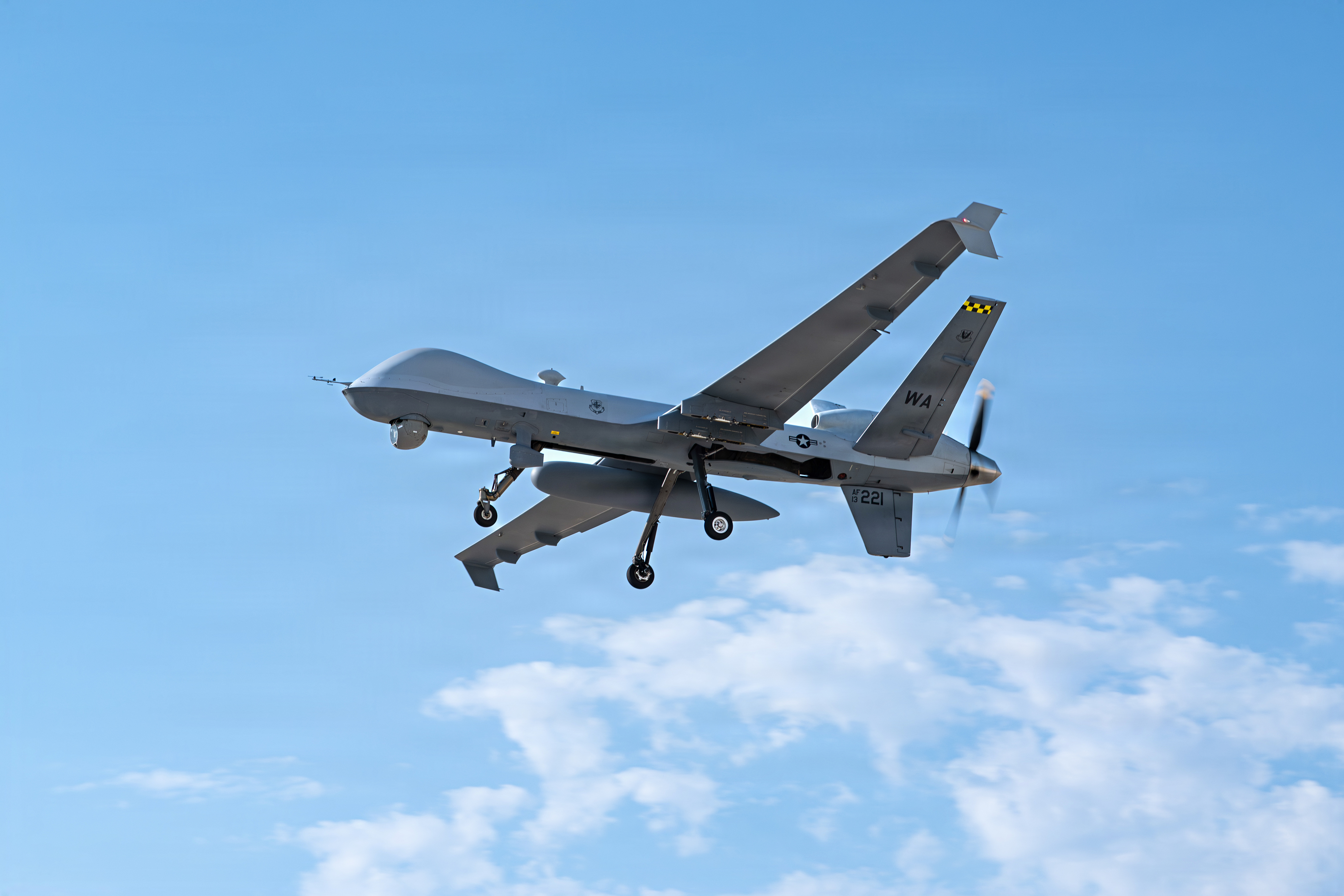
This modularity would allow the service to keep costs down by competing additional portions of the platform for upgrades and services. Spreading investment among additional portions of the defense industrial base can also help the USAF broaden production of essential subcomponents and systems.
The USAF is putting together new requirements for MQ-9 Next after previously issuing a blueprint for the aircraft, which included a lower price and the ability to operate in extremely contested environments. Lamontagne said he’d like additional range to be one of these new requirements.
Lamontagne said MQ-9 Next requirement development was more fluid than requirements for the Collaborative Combat Aircraft, one of the service’s most high-profile aircraft development efforts.
“We’re just going through some early work, our Air Force Futures team, to figure out exactly how we want to tackle that going forward [on MQ-9 Next],” Lamontagne said.
Are you a GovCon business executive? You can’t afford to miss the Potomac Officers Club’s 2026 Air and Space Summit on July 30. Examine scaling advanced military capabilities at operational speed and balancing innovation, cost and mission effectiveness from our all-star panel of top officials during our Speed of Military Technology Advancement panel discussion, featuring:
- Dr. Robert Antypas, Air Force Research Laboratory space access, mobility and logistics mission area lead
- Dr. GP Sandhoo, Space Development Agency director
- Jacob Glassman, deputy assistant secretary of war for science and technology
- Ron Fritzmeier, Intel Government Technologies director of mission solutions
- Chris Jones, Nightwing chief technology officer
The USAF is seeking improved performance of medium altitude, long endurance UAS like the MQ-9 as they suffered significant losses during Operation Epic Fury in Iran. The Pentagon lost 24 MQ-9s during the mission, according to the Congressional Research Service. This is the equivalent of $2 billion in vanquished platforms as the MQ-9 with a robust sensor package can cost as much as $84 million each in 2026 dollars, according to the USAF.
We own it, we control it and we can also change it very quickly. — Gen. John Lamontagne, USAF vice chief of staff, on the benefits modularity would bring to the service on the MQ-9 Next UAS
What Is the MQ-9?
The MQ-9 Reaper is a UAS developed by General Atomics-Aeronautical Systems that first flew in 2001. It has more than 27 hours’ endurance and speeds of 240 knots true airspeed. The platform can operate at altitudes as high as 50,000 ft and can carry 3,850 lbs in payload, including 3,000 lbs of external storage.
Why Is Modularity Important in UAS?
Modularity is important in UAS because typical design approaches using bespoke-designed components and subsystems are too slow to leverage today’s cutting-edge technologies, according to Military Embedded Systems. Creating common architectures and standards like those found in Future Airborne Capability Environment, or FACE, and Sensor Open Systems Architecture, aka SOSA, would allow the Pentagon to quickly acquire best-of-breed capabilities on the open market without having to pay the original equipment manufacturer to supply these technologies at higher cost.
What Missions Would the MQ-9 Next Perform?
The MQ-9 Next platform would perform similar missions to the MQ-9, such as strike, coordination and reconnaissance. These missions benefit from the MQ-9’s long loiter time, wide-range sensors, multi-mode communications suite and precision weapons. The MQ-9 Next would also perform missions like close air support, combat search and rescue, route clearance, target development and terminal air guidance.


Category: Articles