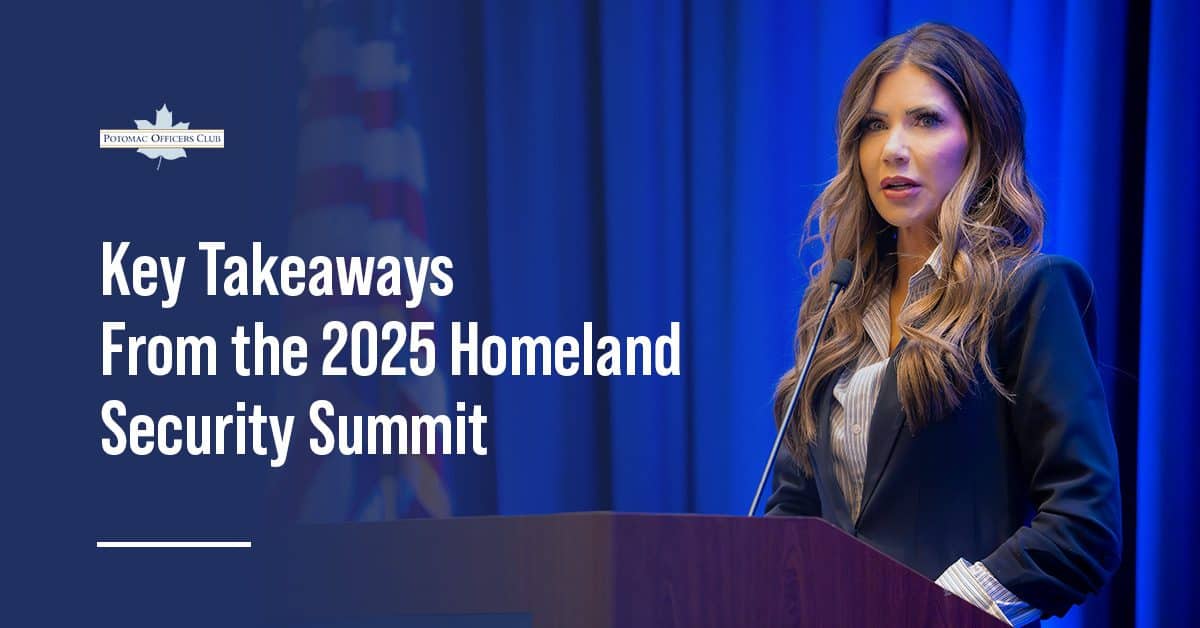
Photo: DHS / Tia Dufour
Key Takeaways From the 2025 Homeland Security Summit
Co-authored with Pat Host
Event at a Glance
- NAME: 2025 Homeland Security Summit
- DATE: November 12, 2025
- LOCATION: Reston, VA
- HEADLINE SPEAKERS:
- Kristi Noem, Department of Homeland Security secretary
- Joseph Edlow, Citizenship and Immigration Services director
- Dr. Madhu Gottumukkala, Cybersecurity and Infrastructure Security Agency acting director
- Gary Owen, Drug Enforcement Agency associate administrator
- ATTENDANCE: Hundreds
Key Takeaways
- DHS is re-emboldened under President Trump
- Strong focus on modernizing legacy IT systems
- Agencies strengthening national security by slashing bureaucracy
Homeland Security Secretary and Wash100 Award winner Kristi Noem opened the Potomac Officers Club’s 2025 Homeland Security Summit on Nov. 12 before a capacity-level audience at the Hyatt Regency Reston, setting a forceful tone around rebuilding DHS capability, modernizing mission systems and accelerating reform across the homeland enterprise. Through keynotes and panels, speakers emphasized renewed authority, rapid modernization and a workforce that is increasingly tech fluent.
This recap covers POC’s Nov. 12, 2025 Homeland Security Summit.
If you want more in-depth GovCon insights like these, don’t miss our first event of 2026: the Defense R&D Summit. Held on Jan. 29 in Tysons Corner, Virginia, the event will gather top Department of Defense technologists to discuss AI, quantum, 5G and much more with industry partners like you. Register here now!
“[We’re looking at] what we can cut, what we can renegotiate, and what the short, medium and long-term return on investment is” —USCIS Director Joseph Edlow
What Were the Major Themes of the 2025 Homeland Security Summit?
How Is DHS Re-Emboldened Under Trump?
Kristi Noem, Homeland Security secretary, said DHS is regaining mission focus after years of drift.
“I will tell you that when I came into the department, there was a lot of neglect. People who were not allowed to do their jobs, people and agencies that were off mission… And now we’ve gotten them back on course and back on mission and making sure that they’re accountable as well,” Noem said.
In his subsequent morning keynote, Cybersecurity and Infrastructure Security Agency Acting Director Madhu Gottumukkala reinforced that message and stressed that CISA’s mandate has not changed. Gottumukkala said he and Noem are working to return CISA to the role Congress intended when it created the agency in 2018: protecting financial systems, safeguarding pipelines and ensuring that digital and physical infrastructure remain resilient.
“Our mission has not changed and commitments have not wavered,” he said.

How Is DHS Pursuing Digital Transformation?
In his afternoon keynote, U.S. Citizenship and Immigration Services Director Joseph Edlow emphasized the scale of legacy challenges his agency must overcome. He cited “archaic methods of filing most things via paper, endless waiting for receipts, reek of inefficiency.”
After spending time in the private sector, Edlow returned to government service inspired.
“Once I came back, I was resolved to make changes…I have no problem cutting through red tape to get results,” Edlow said.
Michael Prado, director of the Cyber Crimes Center at DHS and part of Homeland Security Investigations, said on the Finding the Balance Between Innovation and the Law Enforcement Mission panel that modernization isn’t stalled by workforce capability but by acquisition speed and legal requirements.
The Cyber Crimes Center, he said, is fortunate that most of its new personnel have grown up with emerging technologies.
“They’re very comfortable with it,” Prado said. “The issue for us is acquiring those technologies and finding that balance… that there is that transparency… [and] auditing trail… absolutely essential for taking cases to court.”

How Is DHS Tackling the Workforce Tech Gap?
On Prado’s panel, James McCament, of U.S. Customs and Border Protection chief digital transformation officer, outlined the coexistence of four distinct workforce types: digital natives, early adopters, skeptics and traditionalists.
Digital natives, he said, expect processes that match how they already live and work.
“If we send them to a checkpoint and tell them, ‘I know that you do most of your life on your phone, but here we do it [analog] in an Excel spreadsheet,’ this is jarring,” McCament said.
He warned agency leaders to understand and bridge these differences.
“You probably are going to have those four types sitting side by side or working together…It’s our role as leadership to help translate that and bring it to this new space with the technology,” McCament said.
How Is DHS Rethinking Contracting?
Edlow, USCIS director, is conducting a sweeping review of contracts to determine what to cut and renegotiate and short, medium and long-term return on investments to ensure security and accountability for every dollar spent.
He said USCIS is finally executing the technology-driven reforms it has long promoted.
“USCIS has been talking about using technology to drive process changes for more than a decade and I’m pleased to share with you that we are finally actually doing it,” Edlow said.
Noem, the Homeland Security secretary, echoed this push.
“We’re cutting through a lot of the bureaucracy,” she said. “If you’ve had some kind of an idea or technology or service that you have not been able to deploy at the federal level…it’s a new day.”
She is also personally reviewing all DHS contracts over $100,000.
How Are Agencies Working Together to Strengthen National Security?
The summit featured case studies and panel discussions focused on reducing bureaucracy, coordinating across jurisdictions and scaling emerging technologies such as AI across the homeland security enterprise.
How Is DHS Cutting Through Bureaucracy?
Another constant theme throughout the 2025 Homeland Security Summit was reducing bureaucracy. Noem said she wants to make it easier for industry to do business with DHS.
“The way you interact with the department is changing,” she said. “We want to do business with you, but we will also hold you accountable to make sure taxpayer dollars are spent wisely and efficiently.”
Noem also highlighted how the Trump administration created the Homeland Security Task Forces to slash excessive staffing and roles to help better tackle DHS missions in a more streamlined way.
“[We eliminated] over 1,000 different bureaucratic government task forces and consolidated them into a streamlined Homeland Security Task Forces that interact and interdict [undocumented immigrants] in a streamlined way,” she said. “[It] helps us tackle terrorism in a way no longer bogged down with red tape,” Noem said.
Jody Hardin, CBP executive director for planning, program analysis and evaluation, reinforced Noem’s call for operational efficiency during the Balancing Law Enforcement With Innovation panel.
“We need to run like a business and we’re used to running like a government agency,” she said. “We’re building a whole new organization and really are looking for that.”

How are Federal Agencies Cooperating on Mega-Events?
Multiple panels at the summit discussed how inter-agency cooperation, both federally and among state and local governments, is crucial to homeland safety and security. This is especially when involving mega events like the 2028 Olympics in Los Angeles.
Matt Pierce, State Department Bureau of Consular Affairs acting principal deputy assistant secretary, said it’s important for the White House to take the lead and bring together federal, state and local governments.
“It’s really important that the White House take a leadership role in bringing these folks together,” he said. “We have a White House task force on discussing these issues, like drone threats, to the games themselves, and facilitating travel. We’re not looking at these as distinct lines of effort, but a whole picture.”
Our mission has not changed and commitments have not wavered — CISA Acting Director Madhu Gottumukkala
Another panelist, Chief Robert Tracy, St. Louis Metropolitan Police commissioner, said interagency cooperation is not optional.
“Two years out [from the 2028 Olympics], there’s already planning in progress,” he said. “It’s about the cooperation. Some people say feds, state and local [governments] have problem trusting each other. They have to trust each other.”
Wes Wheeler, a strategic advisor and former FBI agent, said successful interagency cooperation starts with people who have extensive expertise in security operations.
“This is not a ‘break glass’ thing, you want well integrated teams who have handled ground balls together,” Wheeler said. “If you’re picking teams, you want the guy who has been playing since he was a kid.”
How are Federal Agencies Using AI?
AI was a hot topic at the 2025 Homeland Security Summit, as it always is at Potomac Officers Club summits. Speakers from various panels discussed how they’re using AI in their jobs.
One constant theme was homeland security professionals using AI to sort through overwhelming amounts of data and reduce people hours spent on rudimentary tasks.
“AI is important in the visa adjudication process,” Pierce said. “[It’s a] tool to bring different data points together [and] prevent officers from doing a manual review of data.”
Wheeler said there were plenty of scenarios where AI could help FBI agents.
“One challenge for the FBI has been when a specific event happens and the need to ingest massive amount of data, like from cell phone video,” he said. “That can crash what you’re dealing with quickly. One application I could be optimistic about is making sense of a massive amount of data.”
Eric Jensen, T-Mobile senior director for cybersecurity, said AI has been a “force multiplier” for the company. It helps it take large amounts of data and frees up resources to be spent on more important tasks.
“No more pouring over intelligence,” he said. “On the system side, we use it in our network to find things that aren’t right, that stand out from the rest.”
What This Means for GovCons
- Show how DHS and other homeland security agencies can better achieve their missions
- Don’t lead with PowerPoints, be ready to demonstrate
- Watch the DHS Acquisition Planning Forecast System, or APFS, for new opportunities
This article, originally published on Nov. 21, 2025, was updated with new information by a member of Executive Mosaic’s editorial team.


Category: Articles