
Top 5 Army Tech Priorities Transforming How the Service Fights & Operates
The modern battlefield is rapidly evolving, forcing the U.S. Army to keep pace by adopting new strategies and technologies to meet emerging threats. In response to these changes, the Department of War’s largest component is also transforming how it spends its funding and directing its investments in capabilities to ensure it maintains superiority over adversaries today and in the future.
Find out how industry can support the Army’s transformation at the Potomac Officers Club’s 2026 Army Summit on June 18. The event will convene the top defense officials who are shaping the future of the Army. Katie Thompson, deputy executive director of the Army Contracting Command-Aberdeen Proving Ground, will deliver the morning keynote. Officials overseeing autonomy, command and control, and other capabilities will also be present. Tickets are available here.
Below, you will find the top five technology priorities of the Army to remain the world’s most powerful fighting force.
How Is the Army Advancing Drone and Counter-Drone Capabilities?
The Army’s increased prioritization of unmanned aerial systems is reflected in President Trump’s fiscal 2027 budget request, which allocates $876.43 million in research, development, testing and evaluation funding for UAS-launched effects, Breaking Defense reported.
As part of its drone efforts, the Army has updated its operational doctrine to incorporate lessons learned from real-world conflicts, including the Russo-Ukrainian War, and achieve drone dominance.
The service has also launched the Company-Level Directed Requirement, or CoLvl DR, Small Uncrewed Aircraft System program to accelerate the development and deployment of commercially available small-UAS capabilities to support urgent operational needs. AeroVironment already secured a $14.6 million production contract for the VAPOR Compact Long Endurance UAS under the CoLvl DR program.
Drone warfare means adversaries are also utilizing UAS to attack. The Army is making investments to counter enemy UAS, with the president’s budget request dedicating $542 million in RDT&E funding for counter-drone technology.
The request also provides $461 million for the development of Maneuver Short Range Air Defenses, or M-SHORAD, a platform that can shoot down enemy drones and other airborne threats.
Additionally, the Army-led Joint Interagency Task Force 401, which oversees counter-drone efforts across the Pentagon, will receive $580.35 million in RDT&E funding under the proposed budget.
As part of its mission, JIATF 401 established a counter-UAS marketplace, where DOW components and interagency partners can browse, compare and purchase systems that meet their needs. The marketplace, which reached initial operating capacity in February, offers over 1,600 items.
Army Efforts to Modernize Software & IT Systems
Eliminating Outdated Systems
The transition from legacy systems to modern IT architectures continues to be a priority at the Army. At a February event, Leonel Garciga, the service’s chief information officer and a two-time Wash100 winner, described legacy business systems as an “Achilles heel,” and the Army is accelerating efforts to eliminate outdated technology.
The Army shut down 100 systems over two quarters as part of its modernization campaign, Garciga shared.

Garciga delivered a keynote address at the Potomac Officers Club’s 2025 Army Summit. Hear from speakers of the same caliber at the 2026 Army Summit on June 18. Secure your tickets today!
Modernizing Software Procurement
The service is also making changes to its software procurement process in line with its modernization effort. In January, the Army announced an update to its software directive that eliminated existing policies that had traditionally held back software projects, Federal News Network reported.
The update is meant to provide greater flexibility in how the Army uses operations and maintenance, procurement, and research, development, testing and evaluation funds to procure software.
The Army’s Software Engineering Center, which is responsible for maintaining legacy software, has rebranded as the Army Software & Innovation Center, or ASIC. Garrett Shoemaker, the center’s director, told Breaking Defense that, aside from the name change, ASIC will also evolve how it provides software.
Instead of waiting for Congress to fund software programs, ASIC will adopt what it calls a customer-funded ‘software-as-a-service’ model and pitch its own services to Army agencies.
The Army has also redesignated the Program Executive Office Enterprise as Capability Program Executive Enterprise Software and Services, or CPE ES2, in line with its procurement overhaul. One of CPE ES2’s first initiatives since its redesignation is the launch of the Marketplace for Acquisition of Professional Services, or MAPS, contract vehicle for professional and IT services.
Upgrading the OIB
Brig. Gen. Gail Atkins, deputy chief of staff for logistics and operations at the Army Materiel Command, also identified the modernization of the service’s organic industrial base, or OIB, to increase efficiency and enhance personnel safety.
The Army requested $4 billion to modernize 23 OIB sites, Star and Stripes reported.
How Is the Army Leveraging AI & Automation?
In line with a Pentagon-wide strategy to build an AI-enabled fighting force, the Army is accelerating its adoption of AI and automation to support operations and various missions. The service, in January, awarded a 10-year indefinite delivery/indefinite quantity contract valued at $5.6 billion to Salesforce for agentic AI to enhance operational efficiency and a $500 million enterprise agreement to Appian for AI-powered process automation to support modernization.
The Army also recently launched Project ARIA, or Army Rapid Implementation of Artificial Intelligence, an initiative to speed up the development and delivery of AI tools to warfighters for improved decision-making and reduced workloads.
In March, the service selected Carlyle and CyrusOne as preferred partners for the construction and operation of commercial hyperscale data centers at military sites. The hyperscalers will support AI deployments, which Army Secretary Dan Driscoll, a 2026 Wash100 winner, said will serve as a force multiplier and will enable the service’s future transformation and requirements.
On the battlefield, the Army is also planning to use automation to detect hazardous materials. In a notice published on SAM.gov in early April, the Army’s Capability Program Executive Ammunition and Energetics said it is seeking algorithms and sensors for detecting, classifying and identifying various threats, including anti-tank and anti-personnel mines or improvised explosive devices, on the front lines. The goal is to reduce operator workload and lower false alarm rates.
Transformation Into a Data-Centric Force
To become a data-centric force, the Army is making investments in technologies that harness its vast data resources and deliver actionable intelligence to commanders and warfighters.
As part of the effort, the XVIII Airborne Corps tested the combination of commercial and battlefield data at the latest iteration of the Scarlet Dragon exercise in March, Breaking Defense reported. The corps determined, based on its work in Ukraine during the start of Russia’s invasion, that commercial data is critical to combat operations.
The corps will explore ways to unify the data collected from all directorates into a predictive logistics dashboard and visualization for commanders in future iterations of Scarlet Dragon.
The Army also launched a Data Operations Center pilot program in April to address data connectivity and latency challenges in operational environments. Brig. Gen. Michael Kaloostian, director of the Command and Control Future Capability Directorate, said the program will connect units to the systems and tools they need.
The pilot will run for 180 days.
Additionally, the Army is experimenting with commercial internet at multiple locations to ensure data access, DefenseScoop revealed. The service intends to replace the Non-classified Internet Protocol Router, or NIPR, which Pentagon personnel use to access commercial browsers and email. NIPR is owned by the military.
The Army Office of the Chief Information Officer is also evaluating commercial connectivity options at Impact Level 5, which covers controlled unclassified information.
What Are the Army’s Plans for Transforming Command and Control?
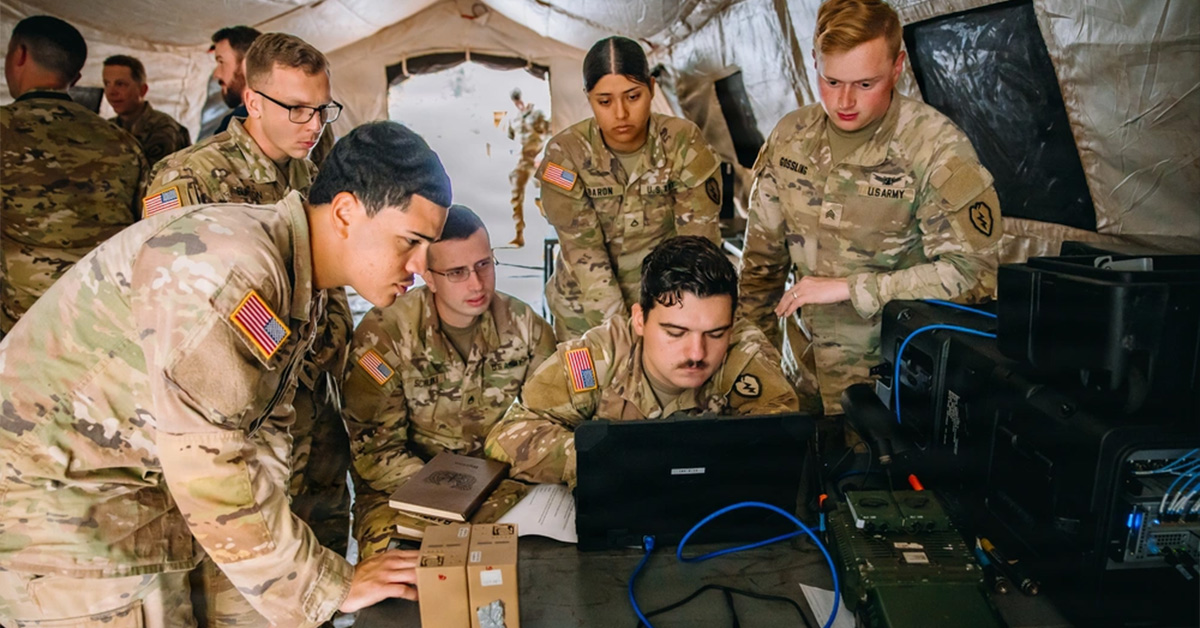
One of the Army’s biggest modernization initiatives over the past years is the Next Generation Command and Control, or NGC2, which aims to provide commanders and units with critical data to enable rapid decision-making on the battlefield. Janes reported that the Army requested $3.7 billion in procurement and investment funding for NGC2 in the Pentagon’s budget proposal.
The service has also made organizational changes, restructuring its Program Executive Office for Command, Control, Communications and Network, or PEO C3N, to a new organization called Capability Program Executive Command, Control, Communications and Network, or CPE C3N, to accelerate NGC2 objectives. According to the Army, the move will enable faster commercial technology integration and upgrades into C2 systems.
Additionally, the Army is planning the deployment of a production NGC2 ecosystem in fiscal 2027, according to a Breaking Defense report. Currently, two divisions — the 4th Infantry Division and the 25th Infantry Division — are fielding NGC2 ecosystems developed by vendor teams led by Anduril Industries and Lockheed Martin.
“From a prototyping into production FY27 you’ll see, the Army’s working through right now identifying the next division beyond 25th and 4th and that would be a production representative full stack of capability,” shared Brig. Gen. Shane Taylor, head of CPE C3N.
Align your strategies with Army priorities at the Potomac Officers Club’s 2026 Army Summit on June 18. Top Army leaders will discuss not just service priorities, but challenges that it encounters as it transforms into a force ready to counter emerging threats. The event will also feature opportunities to forge partnerships that will deliver next-generation capabilities to warfighters. Register today.

Category: Articles