DHS Unmanned Systems: Answers to Common Questions on Drone & Counter-Drone Programs
- DHS and its components deploy aerial, surface and underwater autonomous platforms
- Agencies also utilize counter-UAS capabilities to detect, mitigate and neutralize drone threats
- Drone and counter-drone tech can help safeguard borders, critical infrastructure and major events
The rapid evolution of unmanned systems, or UxS, represents a double-edged sword for homeland security. The technology offers an opportunity to strengthen national security at the border and during major events, but low-cost drones also pose significant security challenges.
The Department of Homeland Security and its components are addressing both the promise and peril of the technology, harnessing autonomous platforms to support their missions and deploying counter-unmanned aerial systems capabilities to neutralize threats.
Below are some of the most frequently asked questions on how DHS uses unmanned systems and counter-drone technologies.

Gain a better understanding of how DHS selects, tests and deploys unmanned systems at the Potomac Officers Club’s 2026 Homeland Security Summit on Nov. 10. Steven Willoughby, executive director of the Unmanned Aircraft Systems and Counter-UAS Program Office, and Anthony C. Crane, executive director of Customs and Border Protection’s C-UAS Defense Capability Group, will be present to answer questions during panels. DHS Deputy Secretary Troy Edgar will also be present to discuss agency priorities during his keynote. Secure your tickets today!
How does Customs and Border Protection use drones along the U.S. southern and northern borders?
U.S. Customs and Border Protection’s Air and Marine Operations uses drones to support a broad range of missions along and across terrestrial and maritime environments on national borders.
In a notice posted on SAM.gov, CBP said it operates UAS to augment crewed air and ground interdiction agents and maritime assets.
Which specific drone models does CBP operate?
CBP flies the MQ-9 Predator B remotely piloted aircraft and the maritime MQ-9 variant SeaGuardian to support its mission.
MQ-9, manufactured by General Atomics, is equipped with electro-optical/infrared sensors, SeaVue marine search radar and the Vehicle and Dismount Exploitation Radar, or VADER, to detect, identify, classify and track illicit activities.
AMO deploys the UAS to secure the border, enforce laws and aid in disaster relief and emergency response.
Can CBP drones use thermal imaging, facial recognition or synthetic aperture radar?
Yes, CBP drones use thermal imaging and synthetic aperture radar, or SAR, but not real-time facial recognition.
According to a General Atomics press release, the standard payload configuration on Predator B includes a high-definition optical infrared video system and a high-resolution SAR.
CBP, on its website, explicitly said that AMO does not use facial recognition technology on any of its aircraft and does not own any facial recognition algorithms or software.
What is the range, flight altitude and loiter time of DHS long-range surveillance drones?
General Atomics’ product page lists MQ-9A Predator B’s endurance at over 27 hours, with speeds of 240 knots true airspeed and an operating ceiling of 50,000 feet. The extended-range version with wing fuel pods raises endurance to 34 hours.
How are unmanned systems integrated into Coast Guard cutters?
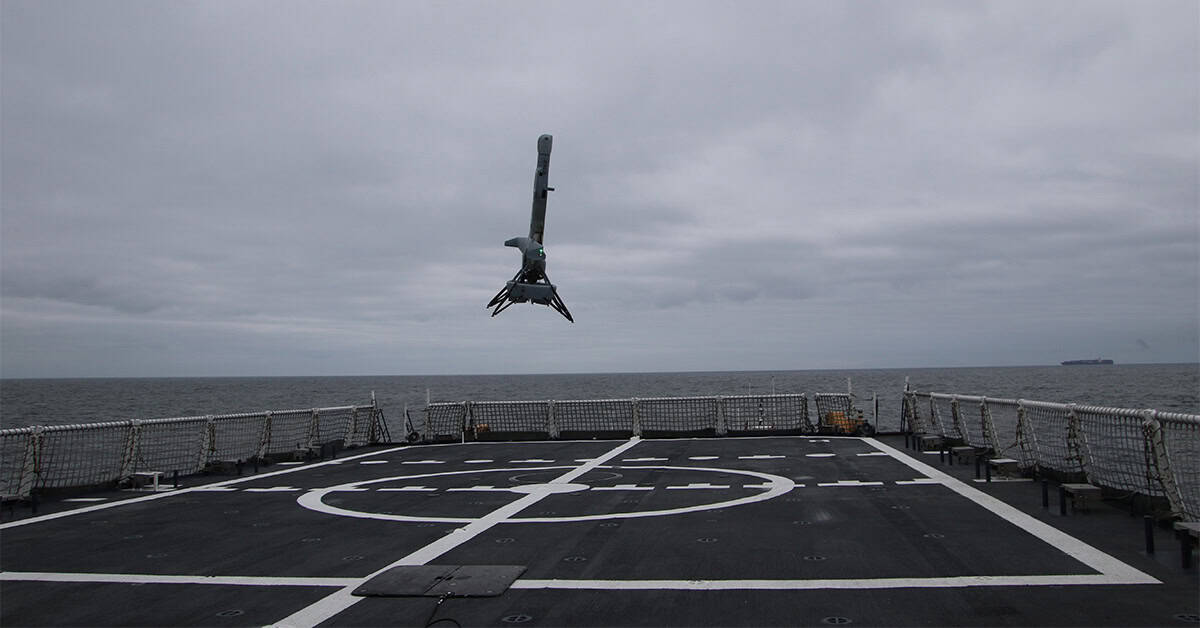
The U.S. Coast Guard deploys the Shield AI V-BAT vertical takeoff and landing, or VTOL, system from its national security cutters for persistent airborne surveillance, under a contractor-operated surveillance services agreement awarded in July 2024.
Under the agreement, Shield AI provides the equipment, personnel and support needed for the installation, operation and deinstallation of the V-BAT.
The Coast Guard said it plans to explore the use of V-BAT on other cutter classes with smaller or no flight decks.
Does the Coast Guard use unmanned surface vessels or underwater drones for port security?
The Coast Guard uses both, but only the underwater drones are tied directly to port security.
The service operates the Saildrone unmanned surface vessel, or USV. The solar-powered technology is deployed to enhance maritime domain awareness.
The Coast Guard is also fielding tethered remotely operated vehicles, or ROVs, a form of unmanned underwater vessels. ROVs are intended to support various missions, including coastal, waterway and port security.
How do drones assist USCG in counter-narcotics and illegal maritime migration missions?
The U.S. Coast Guard uses drones to collect intelligence to support counternarcotics and illegal maritime migration interdictions, according to the service’s Unmanned Systems Strategic Plan.
Join Coast Guard leaders at the 2026 Homeland Security Summit on Nov. 10. Adm. Kevin E. Lunday, commandant of the Coast Guard, will keynote the event, while Scott St. Pierre, assistant commandant and program executive officer for CG-C5I and the service’s chief information officer, and Capt. Chad R. Brick of the CG-RAPTOR, will join panels on modernizing edge capabilities and tech validation. Limited tickets still available here!
Does DHS need a warrant to operate surveillance drones over private property or U.S. citizens?
DHS does not need a warrant to operate drones over U.S. citizens or private property. Although the Supreme Court has not made rulings on drone surveillance specifically, previous cases on manned aircraft addressed warrantless observation from public airspace. The CATO Institute said that the Supreme Court held that manned aerial surveillance without a warrant does not violate the Fourth Amendment.
CBP said its use of manned and unmanned aircraft for aerial observation is consistent with its authorities and obligations. The agency added that in instances where one of its aircraft is flying over private residences in support of operations, the risk of a person’s privacy being unintentionally violated is minimal, as images captured are not personally identifiable.
What limits exist on DHS drone surveillance within the 100-mile border zone?
AMO is authorized to operate aircraft and vessels without any geographic limitation to support federal, state, local, tribal and international law enforcement agencies. CBP dispelled the myth that AMO is restricted to operating within 100 miles of the border.
How long does DHS/CBP retain aerial imagery and video captured by UxS?
According to CBP, raw video, images and radar data collected by unmanned systems are shared with the Office of Intelligence, which is responsible for managing data to monitor cross-border or maritime traffic trends. The OI may retain the data for up to 10 years.
On the UAS, data will remain on the recording device until overwritten by subsequent mission data.
What privacy protections apply to nontargeted individuals caught in drone feeds?
CBP’s drone privacy policy released to the Electronic Privacy Information Center states that video and images captured by UAS do not clearly identify individuals on the ground.
What legal authority gives DHS and CISA the right to detect and mitigate rogue drones?
The Preventing Emerging Threats Act of 2018 grants DHS the authority to counter UAS threats to covered facilities or assets. DHS personnel are authorized to take six specific actions:
- Detect, identify, monitor and track UAS
- Warn the UAS operator
- Disrupt UAS control
- Seize UAS control
- Confiscate the UAS
- Use reasonable force to disable, damage or destroy the UAS
How does DHS protect critical infrastructure such as stadiums, airports and power plants from illegal drone flights?
DHS protection from illegal drones varies.
DHS and its components can deploy counter-drone technology to safeguard major events designated as covered facilities. For the FIFA World Cup, for example, DHS and the Federal Emergency Management Agency provided funding to host states and the National Capital Region for the purchase of C-UAS.
DHS also works with the Federal Aviation Administration to establish airspace restrictions over covered facilities to prevent unauthorized UAS flights. During the World Cup, FAA prohibited aircraft operations and UAS activities in the vicinity of matches and sponsored events.
DHS and FAA also share responsibility for airport drone incidents. All airports are required to have an FAA-approved UAS response plan that must be coordinated with the Transportation Security Administration, air traffic control and law enforcement.
CISA provides guidance to critical infrastructure owners on mitigating drone threats.
Bobby Thompson, CISA’s acting associate director for threat hunting, is expected to discuss the agency’s role in protecting federal networks and critical infrastructure at the 2026 Homeland Security Summit on Nov. 10. CISA’s Daryle Hernandez, director of the Interagency Security Committee, and Dr. Lauren Wind, deputy chief technology officer, will also be present to bring insights into building trustworthy homeland security tech and federated data during panels. Get your tickets here!
Does DHS use electronic jamming, spoofing or kinetic interception for C-UAS?
DHS has used jamming and directed energy to disrupt illegal drone activities.
In April, CBP personnel conducted C-UAS training with Army soldiers assigned to the Joint Task Force-Southern Border. During the training, the task force demonstrated the use of wearable drone-jamming technology, known as Wingman and Pitbull, which stuns UAS to disrupt the drone operator’s video feed.
In February, a U.S. official told NPR that the Department of War gave CBP permission to use a high-energy laser to bring down a drone believed to be operated by a Mexican drug cartel, WXPR reported.
DHS is also looking into the use of kinetic UAS mitigation technologies, including Global Navigation Satellite System denial and nonnuclear electromagnetic pulse, based on market research the agency posted on SAM.gov in June.
Does DHS follow the Blue UAS cleared list for small drone acquisitions?
Yes, DHS follows the Blue UAS list, now managed by the Defense Contract Management Agency, and has used it as a benchmark to guide drone acquisition.
In a 2023 Technology Note, DHS Science and Technology Directorate described the Blue UAS list as the “de facto standard for selection of UAS due to their requirements for obtaining an [authority to operate] being similar to the Department of War’s.”
Are foreign-made drones like DJI banned from being used by DHS agencies?
Yes, with exceptions. Executive agencies, including DHS, have been barred from buying or operating drones made by designated “covered foreign entities” under Federal Acquisition Regulation subpart 40.202. Exemptions may be granted for purchases and operations required in the national interest.
DJI, one of the world’s biggest drone makers, is among the American Security Drone Act-covered foreign entities. The Chinese company has also been added to the Federal Communications Commission’s national security covered list, preventing importation and sale of drones and components in the United States, in December 2025, The Verge reported.
How do FAA Part 107 or beyond visual line of sight waivers apply to DHS public aircraft operations?
DHS components do not need Part 107 waivers for public aircraft operations. As a federal agency performing government functions — such as national defense, law enforcement, firefighting, search and rescue, and intelligence missions — DHS flies with public aircraft status.
Part 107 waivers are issued for certain operational deviations, such as flying beyond visual line of sight, or BVLOS, as long as the operator can demonstrate that they can fly a UAS safely using alternative methods.
How does DHS’ Science and Technology Directorate test and evaluate emerging UxS tech?
The DHS Science and Technology Directorate tests and evaluates emerging UxS in laboratory and real-world settings.
S&T operates the National Urban Security Technology Laboratory, a federal laboratory that supports the development, evaluation and deployment of homeland security technologies, including drones. In one experiment, S&T, through NUSTL, assessed the reliability and performance of six Blue UAS platforms in rural, urban and complex urban environments.
S&T also manages the Richmond Counter-UAS Testbed, which helps DHS components identify which C-UAS systems to purchase.
How does FEMA deploy sUAS for natural disaster impact assessments?
FEMA uses drones for damage assessment. According to a 2020 DHS Privacy Impact Assessment, FEMA may seek assistance from another federal agency to collect imagery using UAS.
The Civil Air Patrol has previously deployed drones to collect aerial imagery to assist FEMA in assessing damage from tornadoes in Iowa in 2024.
How do drones support search and rescue missions during hurricane or wildfire recovery?
Drones can support search-and-rescue missions by providing first responders with imagery and live video feeds of people and the landscape to inform planning.
During the 2024 hurricane season, the White House said drones can support search and rescue and damage assessment by providing real-time video, imagery and sensor data.
After Hurricanes Helene and Milton, local officials and first responders flew drones with thermal cameras that helped rescue teams detect the heat signatures of people trapped under debris, Popular Science reported. A volunteer team also deployed drones to search for missing pets following a mudslide in Asheville, North Carolina.
In wildfires, drones can enable firefighters to continue operations through dense smoke and provide situational awareness to incident commanders.
Drone use will be one of the key topics at the Potomac Officers Club’s 2026 Homeland Security Summit on Nov. 10. The event features two panels, Safeguarding the Homeland: Coordination for Counter-UAS Operations and Code and Drones: DHS’s Parallel Fights to Build Cyber Talent and Field Unmanned Systems, dedicated to exploring how drones are changing how DHS and its components are securing the homeland from increasingly technologically advanced threats. Sign up here to join the conversation!


Category: Acquisition & Procurement