Photo by CoFii / Shutterstock
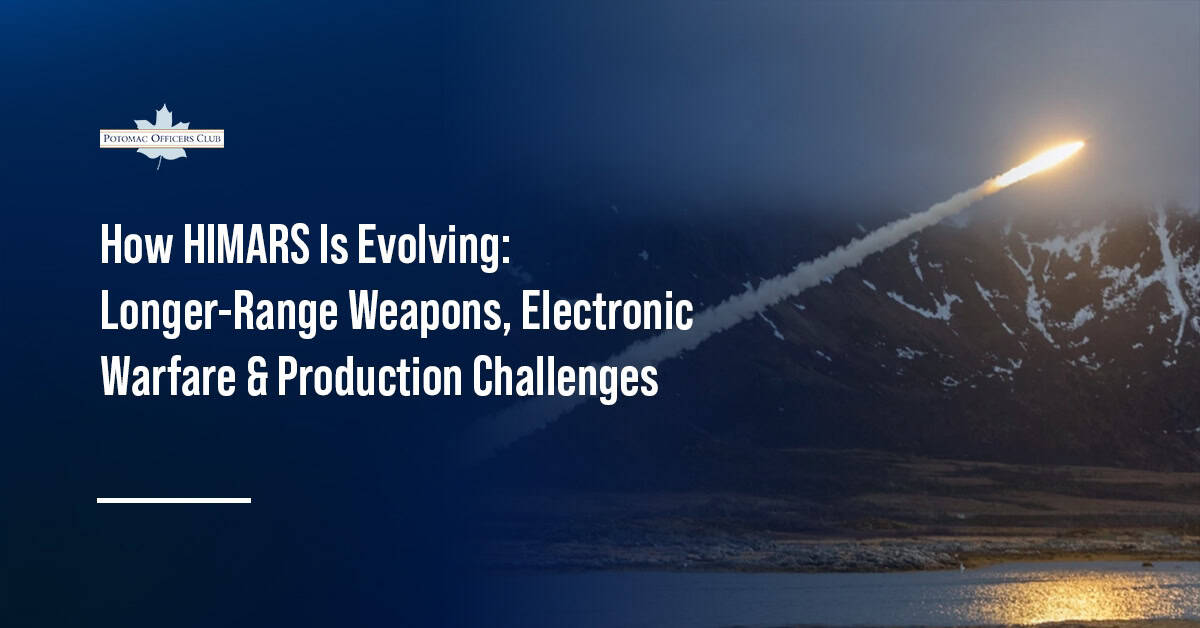
How HIMARS Is Evolving: Longer-Range Weapons, Electronic Warfare & Production Challenges
HIMARS, or the M142 High Mobility Artillery Rocket System, has been a crucial weapon and defense system against attacks since its debut. The rocket launcher system’s might has been tested and proven effective, with the U.S. government sending multiple units as military aid to foreign allies, and efforts are ongoing to continue expanding the weapon’s capabilities.
The Precision Strike Missile, or PrSM, represents an upgrade to the HIMARS. PrSM, developed by Lockheed Martin to replace the aging Army Tactical Missile System, is a long-range precision-strike missile with a range of 60 km to over 499 km. According to the U.S. Army, PrSM also doubles the payload capacity of HIMARS.
During Exercise Talisman Sabre 2025, the Australian Army conducted its first live firing PrSM using a HIMARS launcher, striking a target located 300 km away.
In July 2025, PrSM Increment 1 achieved Milestone C approval, marking the system’s transition into production and deployment.
HIMARS: A Powerful Rocket Artillery System

The origin of HIMARS dates back to the 1980s. Back then, the M270 Multiple Launch Rocket System, MLRS, was the prime armored self-propelled rocket system of the U.S. Army. It wasn’t until after the Gulf War that the Army proposed to design a new, more lightweight and more advanced rocket launcher that would surpass the M270 in terms of structure, warfare capabilities and cost efficiency.
After a decade, Loral Vought System, now known as Lockheed Martin Missiles and Fire Control, began developing HIMARS as a private venture, with the first prototype introduced in 1993. After a long development period and several contract awards from the U.S. Army Missile Command, it debuted officially in 1996.
That said, the rocket launcher system underwent several testing, evaluation and refinement phases before being integrated into the Marine Corps units for training exercises in 2005 and finally entering service in 2010.
HIMARS’s reputation as a formidable rocket launcher system was further solidified as it aids in defending foreign allies. Outlined below are the countries that have experienced the might of the artillery rocket system:
Ukraine
The M142 gained the spotlight when the U.S. Army supplied the artillery rocket system to Ukraine in June 2022. As of January 2024, the US has sent 39 units to further Ukraine’s defense against Russian attacks.
Through HIMARS, the Ukrainian military was able to block the Russian forces from taking the City of Kherson. They enabled Ukraine to destroy the bridges that connected Kherson to other parts of Ukraine, thus disabling Russian troops from restocking their supplies and getting reinforcements.
The U.S. also quietly sent long-range missiles to Kyiv as part of a $300 million military aid package approved by then-President Joe Biden in March 2024, Reuters reported. A U.S. official said the missiles were launched against a Russian airfield in Crimea and Russian forces in Southern Ukraine.
Related article: DOD Expanding Defense Weapons Production Capacity for Ukraine
Afghanistan
One of the first missions of HIMARS, when it debuted in 2010, was Operation Moshtarak in Afghanistan. The International Security Assistance Force suspended its use when it received a report that 12 civilians were implicated during the operation.
However, HIMARS was redeemed when a later report indicated that the civilians were used as human shields by the Taliban. With that, it resumed its activities in Afghanistan with its deployment to aid the NATO offensive against the Taliban at Kandahar.
Philippines
While the U.S. Army has yet to approve sales of HIMARS units to the Philippines, the rocket artillery system demonstrated its efficiency and potential significance in defending the Philippine seas and borders.
In April 2023, two launchers underwent testing for shore-based firing as part of the Balikatan troops’ drill and training at San Antonio, Zambales. During the exercise, HIMARS fired six times, yet failed to hit its targets.
On a brighter note, the training helped troops sense incoming ships, identify enemy fleets, and disseminate information to military officers and weapons in the Philippines and the U.S.
HIMARS and its Limitations

Despite HIMARS’ success in empowering troops and aiding foreign military forces in eliminating terrorist attacks, the system also has its disadvantages.
Below are some limitations that bar it from succeeding in some of its missions and being the prime artillery rocket system of the U.S. Armed Forces:
Cost
HIMARS is one of the most expensive weapon systems of the U.S. Army. In 2014, a single unit–including the carrier and launcher– was priced at $3.5 million. In 2022, the launchers were valued at nearly $170,000, increasing the total price to $4.3 million per model.
Exporting HIMARS outside of the U.S. is also quite expensive. Transportation costs of the missiles and launchers can cost up to $434,000, totaling the shipping costs at around$19 million to $20 million per unit.
With the hefty production costs and the U.S. government increasing its budget proposals encompassing aid to Ukraine, some members of the U.S. Congress proposed to drop financial support to foreign allies and instead focus on strengthening American borders. Amid this, Democrats are eyeing to salvage Ukraine’s support even after the proposed $118 billion bipartisan bill to help Kyiv was rejected in February 2024.
Related article: Government Shutdown: What Happens During a Temporary Shutdown Aversion?
Production Capacity
As demand for long-range precision fire capability grows domestically and internationally, work is underway to expand production of the HIMARS launcher and its missiles.
Lockheed Martin said in 2025 that it has expanded production of HIMARS launchers from 48 to 96 launchers annually. The company has also scaled its operations to achieve a 14,000-unit annual ramp capacity for the Guided Multiple‑Launch Rocket System, a GPS/INS-guided precision rocket that serves as the primary munition for the M142 HIMARS.
However, the Army wants to further increase GMLRS production to 133,014 rockets by 2034, according to a request for information posted on SAM.gov in August. The first batch of rockets is expected to be delivered beginning in 2030, DefenseNews reported.
Shorter firing range
HIMARS has helped Ukraine defend its borders from Russian forces successfully. However, Ukraine was only able to sustain its win on certain fronts; months of the ongoing conflict exposed that the rocket launcher has a shorter firing range than other rocket artillery setups.
According to Business Insider, the U.S. Army modified a roster of HIMARS units to have a shorter firing range before sending them to Ukraine; many of these rocket launcher units were incapable of launching more than 200 miles.
On the bright side, the altered HIMARS units still play a seminal role in staving off a direct war between the U.S. and Russia. The Ukrainian military is able to fire at enemy supply lines within or near Ukraine’s borders and destroy bridges or paths for enemy reinforcements.
The U.S. Army, in partnership with Lockheed Martin, is also developing the Extended‑Range Guided Multiple‑Launch Rocket System, or ER-GMLRS. The new variant extends the range of the GMLRS to 150 km in all weather conditions, according to Lockheed Martin.
In December 2025, the U.S. Army conducted a flight test of the next‑generation munition. The ER GMLRS, launched from a HIMARS launcher, engaged an area target 112 km away, demonstrating its precision and lethality.
Vulnerability
Another limitation of HIMARS that the Ukraine-Russia conflict exposed was its vulnerability to electronic jamming devices. The rockets are designed to be nearly undetectable, yet the Russian military developed software that tracked and blocked missiles from hitting their targets.
On March 5, 2024, the Russian military successfully destroyed a HIMARS unit with a reconnaissance drone and an Iskander battery. While only one unit was damaged, this defeat brought to light more significant vulnerabilities of the US-made rocket artillery system.
Moreover, the high mobility of the rocket launcher ironically makes it vulnerable to assault. If not shielded, the units are potentially easy targets for foes seeking to weaken ground-based defense systems.

HIMARS may have been a dominant player in countering enemy invasions. However, it still has flaws that expose it to retaliatory attacks and pave the way for enemies to adapt and gain a warfare advantage.
The issues surrounding HIMARS set the stage for the U.S. government to strengthen these weaknesses and bolster its capabilities to protect its territories.
You might also want to read: LGM-35A Sentinel: Breaking Down the Basic Functionalities of Ground-Based Strategic Deterrent
This article, originally published on March 8, 2024, was updated by a member of Executive Mosaic’s editorial staff.

Category: Articles