Key Takeaways From the 2026 Intel Summit
Co-authored with Pat Host
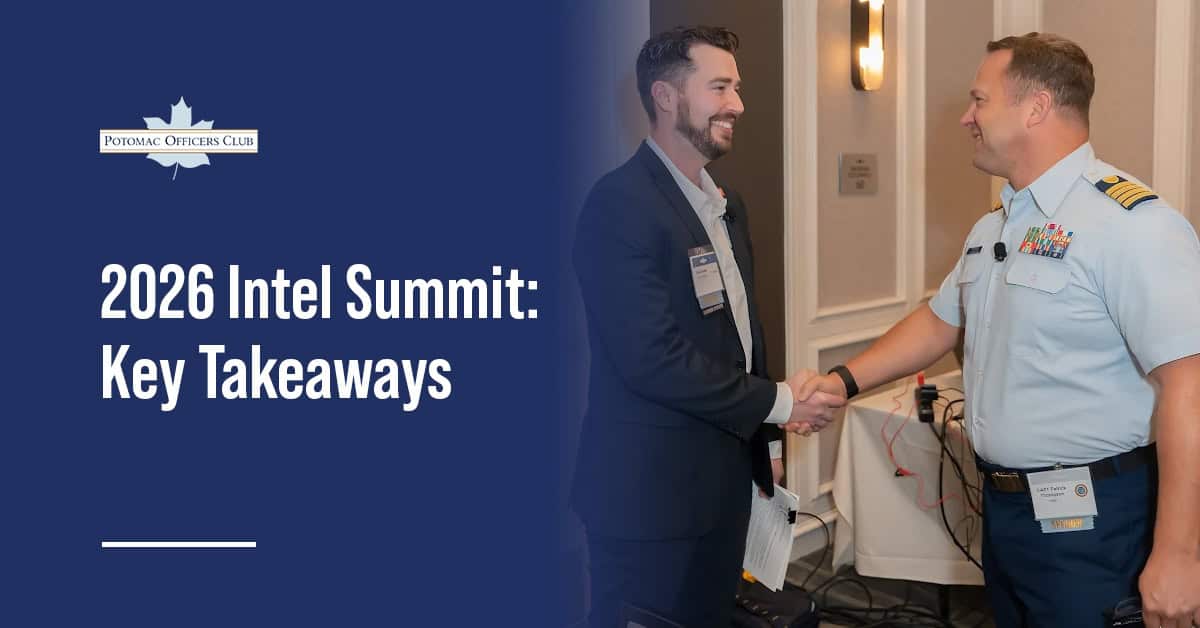
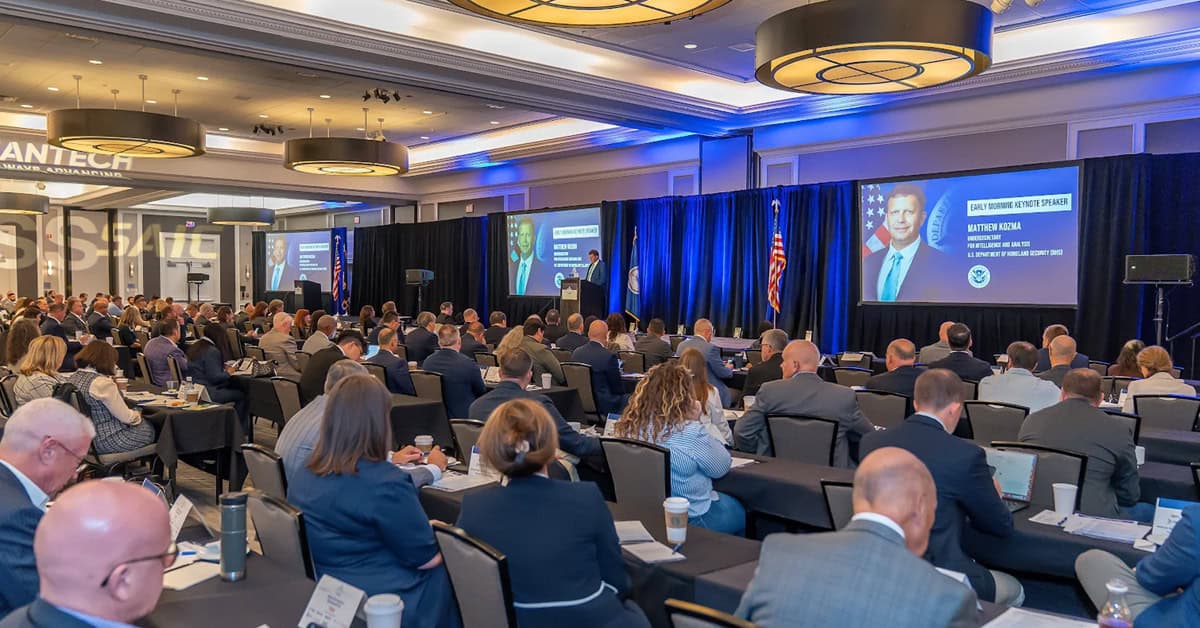
Top leadership from the CIA, the National Security Agency, the National Reconnaissance Office, the FBI and more convened with industry members for Potomac Officers Club’s 2026 Intel Summit on Sept. 24. The GovCon networking conference featured seven keynotes and seven panel discussions on critical topics like agentic AI, foreign entity of concern regulations and cybersecurity.
The event is one of POC’s longest running traditions, stretching back over a decade annually, and 2026 was one of the most informative and comprehensive editions yet. Take a look at the highlights below.
POC has saved some of its most anticipated events of the year for Q4: the 2026 FedCiv Summit is next on Oct. 29, gathering CIOs and agency leaders from top federal civilian agencies; the 2026 Homeland Security Summit, set for Nov. 10, will feature a keynote from Deputy Secretary Troy Edgar and panels on edge capabilities for the border and unmanned systems; and to close out the year, the 2026 Healthcare Summit will provide vital updates on the innovative tech needs of HHS, the VA and the rest of the American health enterprise on Dec. 3.
Notable Statistics
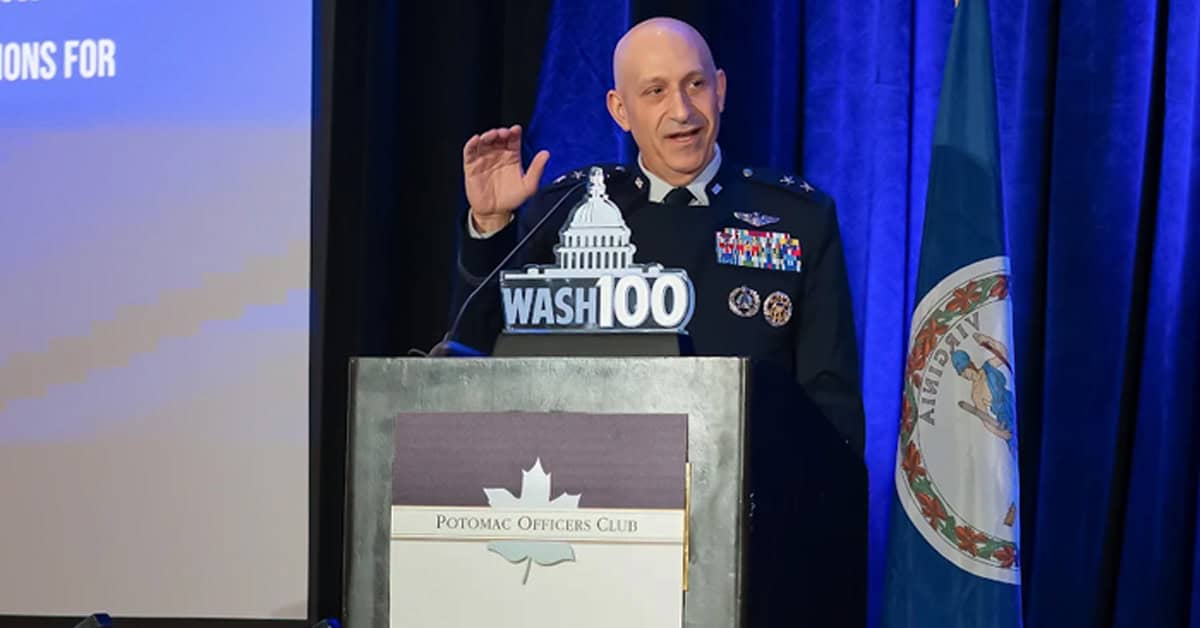
48,000—The amount of space objects that the U.S. Space Force continually tracks, according to Maj. Gen. Brian Sidari, Space Force deputy chief of space operations for intelligence
$5 million—The contract value for which contractors and subcontractors that are performing, or wish to perform, on unclassified, non-commercial DOW contracts must report Foreign Entity of Concern issues, according to Michele Iversen, Chertoff Group president for geopolitical risk
68 percent—The amount of the 34 active shooter incidents designated by the FBI in 21 states and DC in 2025 that involved some degree of planning and preparation, according to Matthew Fodor, FBI operations director for national security
42 percent—The growth in FBI designated active shooter incidents from the 24 in 2024 to 34 in 2025, according to Fodor
Nearly 1,000—The number of tips received by the FBI in two days about the Jan. 1, 2025, New Orleans truck attack, according to Fodor
9—The approximate number of reports per hour on forensic information on drug samples being created by DEA intelligence agents using AI, according to Carrie Thompson, Drug Enforcement Administration deputy assistant administrator for intelligence programs.
What Were the Key Takeaways From the 2026 Intel Summit?
Proper AI Governance Is Crucial
Echoes of “AI governance” rang out across the 2026 Intel Summit, coming up in almost every session. SAP NS2 Director of Customer Success Merrill Cook took a stand against those who view governance as a barrier or dull.
“Governance gets a bad rap. It’s not fair because people look at governance and say, ‘oh my gosh…it’s like watching paint dry,’ right? But it’s actually really exciting stuff because even though people perceive that it’s spreadsheets and it slows things down, governance is fundamentally about making sure data and AI are being used the right way with clear rules and accountability… that’s the foundation,” she said during the No Mission AI Without the Data panel.
She went on to say that access controls are needed to make sure the right people have the right permissions and access. Governance should be an accelerator and not a burden, a dilemma and balancing act, Cook argued, that is a key aspect of figuring out how to properly roll out and situate it.
“Governance can and should be automated,” Cook stated. “Not all of it, but there’s a way to map automation to risk profile in government…No one’s doing repeatable, low-risk tasks and spreadsheets, right? We don’t need to do audit-logging manually. We don’t need to be doing monitoring and evidence collection manually. So it’s a matching thing, right? How do we pick out the elements of governance that are causing most manual labor and the most time sensitive, the most costly with the lowest risk where there are repeatable business rules that we put in place to automate that.”
Rebecca King, MANTECH senior director and data and AI adoption services lead, spent over two decades in federal service with the intelligence and defense communities. She said during the Cybersecurity in the Age of Agentic AI panel discussion that boundaries are essential for intelligence professionals to maximize their use of AI technology.
“The heart of what this panel is talking about is the balance between what we need to do for cybersecurity and how we protect it,” she said. “Both using agentic AI to our benefit and making sure that we’re not letting those agents run rampant and do the things that we don’t want them to do. Finding that balance is so difficult and to me that is still the big risk that we’re facing.” —Charles Lyons-Burt & Pat Host
GovCons Need to Be Comfortable Deleting Data
Intelligence agencies have more data available to them than ever before. Dr. Colin McKinty, Everfox senior sales director for federal civilian, said during the Agentic AI and Quantum Risk lunch panel that GovCon professionals need to delete data to protect it from leakage.
“We’ve been generating terabyte after terabyte of data, training ourselves to collect all this data, store it and encrypt it, believing that it is all going to be safe. Well, it’s not safe,” McKinty said. “We have to revisit our approaches to actually look at the data to say ‘what do we actually need and what should we be deleting?’” —Pat Host
AI Can’t Replace Humans
A preeminent theme during the event was how AI cannot replace humans for a variety of roles and tasks. Leo Alvarez, Baker Tilly principal for government contractor solutions, said during the Navigating the Foreign Entities of Concern Frontier panel discussion that while AI can help investigate FEOCs in supply chain tiers, it can’t replace performing an investigation.
“If you’re talking about exposure, you have to think about the criticality of a particular supplier,” he said. “That’s probably where you want to be dedicating your time and resources.”
Another industry executive, Jarrod Gack, SAIC senior program manager, said during the Power of OSINT in Counterespionage of Intellectual Property Secrets panel discussion that there is room for both advanced emerging technologies and manual processes in intelligence tradecraft as those manual processes still work well.
“You’re going to hear AI, agentic and automation, or some combination thereof,” Gack said. “I think there is some room for both. I think we shouldn’t be discounting conventional evaluation, counterintelligence insights and counterespionage activities when we look toward this brave new world of agentic AI.”
A third prominent industry official, Jason Porter, Kentro chief innovation architect, said during the Agentic AI and Quantum Risk lunch panel that AI is evolving so fast to where it is essential that humans remain in control.
“We’re getting dependent on the technology to defend us against the technology. It’s a fascinating quandary that we’re heading down,” he said. “People joke about Skynet from “Terminator,” but the reality is that AI is getting closer and closer to making decisions that we need to keep people on.”
GP Sandhoo, Space Development Agency director, said during the Cyber in the Age of Agentic AI panel discussion that AI should be used to augment human knowledge when it comes to proliferated satellite architectures.
“We have gone from what I used to call the ‘big juicy targets,’ … to proliferated architectures where we have hundreds of satellites,” he said. “How do we augment the human analyst knowledge to be able to discriminate those things? I don’t think the algorithms are quite there yet to be able to do that on their own.” —Pat Host
Building Trust Around AI Is Critical for Widespread Adoption
Speakers wrestled with how to promote trust in AI technology both in teams at federal and military agencies and in the general populace.
SAP NS2’s Merrill Cook said the two things people need to know before adopting AI are whether it adds value and whether they can trust it.
In terms of how to measure the trustworthiness of AI systems, Transportation Security Administration Chief Information Officer Matt Gilkeson shared that testing it in an operational context is crucial.
“With regard to any adoption of technology…you keep the operator at the forefront. If you have the operational context about what you’re looking to perform…then you have the parameters of it about which you can judge the trustworthiness of that performance.
“For us at TSA, he continued, “it’s reduced false alarms, it’s reduced processing time, reduced manual burden, increased workforce productivity, stronger security and privacy [and] better informed leadership decisions. You have to establish those measures at the front end of the conversation so that you understand what you’re going to see the performance to.”
Cook went on to say that, “One of the things that I think will build trust, maybe the most important thing, is having that data and governance foundation. We have to have end-to-end linkage and a usable audit trail. No black boxes.”
She added that it’s important to understand how, what and where an agent is using data from every angle. — “what it considered, when it took action,” as well as “who else took action based on that action.”
“We have to have that level of visibility and level of transparency in order to build the kind of trust that is going to lead to widespread adoption because I think there is still a lot of skepticism around how we govern this,” Cook stated, noting that another thing that will build trust are “success stories” with AI.
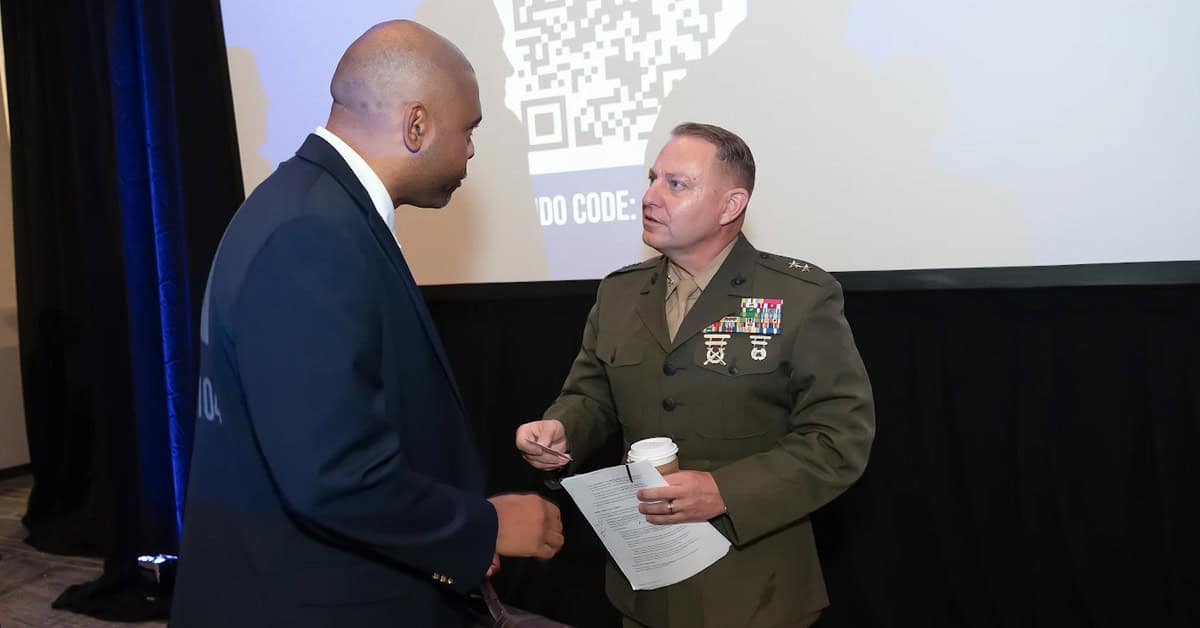
Cook’s fellow panelist, U.S. Marine Corps Assistant Deputy Commandant for Information Maj. Gen. Mark Cunningham, offered the insight that in the U.S. military, “we trust our people. We don’t trust AI.” American military leaders, he said, are wont to slow down the technology’s progress and fastidiously make sure there’s always a human in the loop. But this is difficult when dealing with adversaries who operate in the reverse: they don’t trust their personnel nearly as much as their AI. If they’re more willing to use it than we are, that puts America at a disadvantage, Cunningham reasoned. —Charles Lyons-Burt
Emerging Technologies Can Help With Supply Chain Insights
Mitigating FEOC issues in supply chains isn’t as easy as picking companies with U.S. subsidiaries. Michele Iversen, Chertoff Group principal for geopolitical risk, said during the Navigating the FEOC Frontier panel discussion that AI can help GovCons get a good start on investigating suppliers in their supply chains.
“With AI today, there’s no reason not to do basic due diligence,” she said. “Look at who your partners [and] suppliers are…Start with maturity level zero and use basic AI tools and things to start doing the basic analysis.”
A top government official said that GovCons need to triage which programs truly require high levels of risk tolerance when evaluating their supply chains. Rebecca McWhite, National Institute of Standards and Technology technical lead for cybersecurity supply chain risk management, said during the Navigating the FEOC Frontier panel discussion that GovCons will run into a conundrum as they look deeper into their supply chains where everything is risk, which makes nothing risky.
“The missing piece there was the criticality analysis. Figuring out which of my programs were the most important where I couldn’t tolerate that level of risk,” she said. “I need to do that deeper dive and then I need to look at all of my risk response options. That’s an appropriate response to these high-level programs.” —Pat Host

Stand-Out Quotes
“As technology transforms the world, it’s reshaping every aspect of CIA’s mission. That’s why Director Ratcliffe has made harnessing technology one of our agency’s top priorities.” —Dustin Gard-Weiss, executive director, CIA
“We don’t view the private sector or those outside our walls as just vendors. We recognize each of you contribute to us and with us as valued partners that are absolutely critical to the success of our mission.” —Gard-Weiss
“I talk about insider threat because we can actually monitor China going after us in cyber a lot easier than we can the insider threat. There is a reason why LinkedIn is the only Western social media available in China. It is the greatest recruiting tool the Chinese have…Americans put incredible amounts of information out there and the Chinese go after it.” — Dennis Wilder, Georgetown University senior fellow, Texas A&M Bush School of Government visiting professor, and former CIA deputy assistant director for East Asia and the Pacific
“Comparative to other intelligence methods, OSINT as a tool for analytic inference for counterintelligence allows analysts to garner insights through actor behavior, not just the nature of their identities. Because national and regional cultures are so different, the way people engage with the digital ecosystem and social media are different, which inherently heightens the risk of mirroring and implicit bias on both sides.” – Jason Lee, Moody’s senior director for intelligence and investigation tradecraft
“We have this misperception sometimes that for data to be of value, it has to be of immediate value. We have all kinds of examples where data not of immediate value becomes valuable later. It’s not of value later if you don’t have it. This is a good example: Abbottabad [Pakistan] became a very important place, but for years, we didn’t think it was [important]. But thankfully we had some data so that we weren’t starting from ground zero.” – (Ret.) Vice Adm. Robert Sharp, Windward US chief maritime officer
“The evolving threat of cyber actors underscores the persistent need to maintain resilient network architecture to implement robust cybersecurity measures and of course protect sensitive data. Cyber criminals, particularly ransomware actors who remain a persistent threat to US critical infrastructures, are leveraging AI to enhance the scale and efficiency of their operations while lowering barriers to entry. These actors often operate with agility and targeting high-profile entities that deliver essential services for our customers and for American people. Their efforts must be thwarted.” – Matthew Kozma, DHS under secretary for intelligence and analysis
“In certain respects, these AI tools that we’re now using aren’t making less work. They’re actually making more work in many respects for us, because now, instead of doing the manual process of writing the report, I have an agent that can write the report, and that analyst has 15 of those reports to go through in the morning when he comes through to quality control and make sure he gets out the door.
“So essentially that non-supervisory analyst has now become a supervisory analyst of 10 agents. It isn’t necessarily making his workload less, it’s just making his work different. So that’s what we’ve tried to think about as we re-imagine our processes using these tools. It isn’t necessarily that anyone’s going to be able to go home any earlier in the day.” — Carrie Thompson, Drug Enforcement Administration deputy assistant administrator for intelligence
“Accelerating responsible adoption of advanced AI, ensuring access to cutting edge commercial technology, developing a resilient technology base and maintaining American technological advantage over our strategic competitors. For you all, there is an important message embedded in this approach: we need capabilities. We need the ability to acquire and integrate technology more rapidly. We need secure computing. We need better tools for managing and exploiting data. We need AI that can operate in sensitive environments. We need tools that help analysts discover relationships and vast quantities of information while preserving them and the integration reliability of that information. And we need people who understand both the technology and the mission.” — Matthew Fodor, FBI operations director for national security



Category: Articles