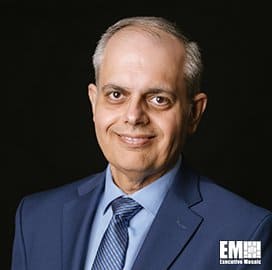
Member Profile: Vir Thanvi
Vir Thanvi is senior vice president for integrated solutions at Entarian. He has more than 25 years in service at NASA, including serving as deputy program manager at NASA Goddard Space Flight Centers’ exploration and space communications projects division.
There, he oversaw the portfolio with an annual budget of more than $200 million and a combined civil servants and contractor staff of over 700. Earlier in his career, Thanvi held a variety of key engineering and management roles across NASA and the National Oceanic and Atmospheric Administration where he led full lifecycle efforts for complex systems.
Thanvi spoke with Potomac Officers Club about adapting in an evolving federal landscape, why he went into federal service, core values to building a great team and underdiscussed challenges on the business side of innovation.
Potomac Officers Club: What can you tell us about your background and how you’ve been able to adapt to the ever-changing challenges of the federal landscape over the course of your career?
Vir Thanvi: I’ve spent nearly three decades working across the federal space and aerospace domain. Much of my career has focused on mission operations and developing the space exploration, and space communications infrastructure and capabilities that enable human spaceflight and robotic missions. At NASA, I had the opportunity to help lead the Near Space Network and work across government and industry to advance commercial services and strategic partnerships.
One of the biggest lessons I’ve learned is that the mission remains constant, but the way we deliver it must continually evolve. Whether you’re navigating changing priorities, dynamic budgets, acquisition reforms or emerging technologies, you have to stay focused on mission outcomes while being willing to challenge conventional approaches. At Entarian, I’m applying that experience to help bridge government mission needs with commercial innovation, integrated solutions and stronger industry partnerships. I believe adaptability comes from listening to the customer, understanding the operational challenges and building teams that can turn complex problems into practical and executable solutions.
POC: When did you decide to pursue a career in the federal landscape and what were the key tasks that you wanted to complete? Any bigger goals you still want to accomplish?
Thanvi: For me, it has always been about realizing bold visions, solving the challenges that matter and contributing to missions that have a meaningful impact. Space communications and exploration offer a unique opportunity to combine technology, engineering and public service in ways that expand our capabilities and benefit society. Throughout my career, I wanted to help build and modernize the systems that make ambitious missions possible, while bringing together the people, technologies and partnerships needed to deliver them.
At NASA, that meant helping advance communications and navigation capabilities for missions ranging from Earth orbit to lunar exploration to discoveries at Lagrange, including finding ways to leverage commercial services and create more flexible, sustainable approaches to mission support. Moving into industry has given me another avenue to pursue those objectives by helping translate government requirements into integrated and commercially-enabled solutions.
Looking ahead, my bigger goal is to help transform how government and industry work together to deliver mission capabilities. I want to see us move beyond traditional and program-by-program approaches toward more scalable, resilient and commercially-sustainable architectures. Ultimately, success means enabling our government customers to achieve more, move faster and maintain mission assurance while ensuring national interest and benefiting humankind.
POC: What are the core values that you believe are essential to build a great team and establish a foundation to drive success in such a competitive industry?
Thanvi: I would put shared commitment to the mission at the top of the list and fulfilling that with integrity, accountability and collaboration. In the federal contracting environment, trust is everything. Our customers need to know we will be transparent, deliver on our commitments and raise challenges early, rather than wait until they become bigger problems.
I also believe great teams are built on empowerment and respect for diverse perspectives. The most complex mission challenges rarely have a single right answer, so you need people who are willing to question assumptions, share ideas and work across organizational boundaries. Leaders must create an environment where people feel accountable for results but also have the support and authority to innovate.
Finally, I believe in a culture of continuous learning. Technology, customer expectations and the
competitive landscape are constantly changing and our teams have to evolve with them. At Entarian, the goal is to bring the right people and capabilities together around the customer’s mission. When you combine a strong strategic foundation with technical excellence, a collaborative culture and a genuine sense of ownership, you create a team that can deliver consistently—even in the most demanding environments.
POC: With emerging technology increasingly influencing the federal government and industry, what are some of the challenges on the business side of innovation that aren’t discussed as often as they should?
Thanvi: I think one of the biggest challenges is that having access to innovative technology is not the same as being able to turn it into an operational capability. We spend a lot of time discussing AI, automation, cloud computing and advanced space technologies, but less time discussing the business, acquisition and organizational changes required to implement them successfully.
First, there is the challenge of moving from a successful demonstration to sustained operational use. Innovation needs a clear mission requirement, a viable acquisition pathway and funding beyond the initial pilot. It also needs a plan for long-term operations, maintenance, cybersecurity and sustainment. Without those elements, even promising technologies can struggle to deliver lasting value.
Second, we need to do a better job aligning incentives and managing risk. Government customers need reliable, secure and accountable solutions, while commercial providers need predictable demand, reasonable returns and a clear understanding of how their investments can be sustained. Contract structures, procurement timelines and funding models don’t always move at the same pace as technology.
Third, integration is often underestimated. New capabilities must work with legacy systems, existing workflows, data standards and the people responsible for operating them. The cost of integration, workforce readiness and organizational change can be just as significant as the technology itself.
I believe the way forward is to focus on measurable mission outcomes, engage government and industry early, and structure partnerships that support iterative delivery and long-term value. The real measure of innovation isn’t how advanced the technology is; it’s whether we can acquire it, integrate it, sustain it and translate it into a meaningful advantage for the mission.

Category: Executive Profiles