Golden Fleet’s Biggest Risk, According to Navy Installations Command IT Officer
- Shery Thomas warns industry against pitching “stovepipe solutions” that solve one problem without integrating into Navy’s broader baseline
- Golden Fleet’s power demands will be unprecedented for the shore enterprise, requiring a “better linkage” between government and industry on the art of the possible
- Zero trust, modular open architecture and vendor accountability across DOW customers anchor his approach to the initiative
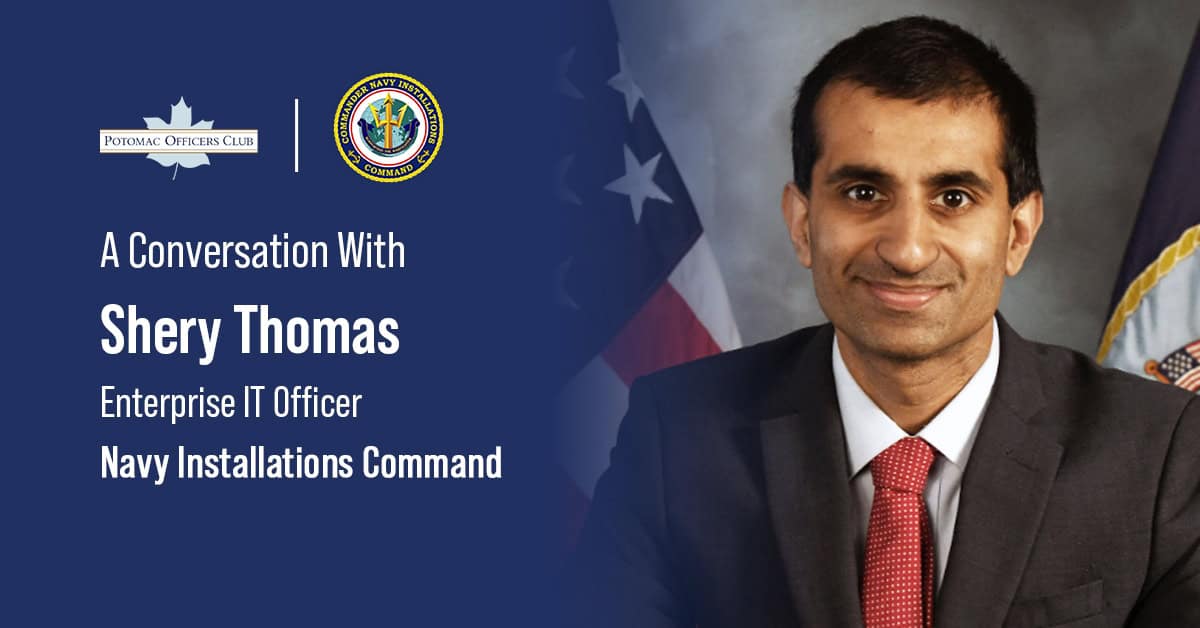
Shery Thomas, enterprise IT officer at Navy Installations Command, or CNIC, says the biggest risk facing the Golden Fleet initiative isn’t a lack of vendor interest — it’s vendors solving for their own lab environment while ignoring the 71 installations that will actually have to run whatever they build.
“Providing stovepipe solutions — things that they test and they do risk reduction within their own terrain, but it’s not cross-cutting with other things that we currently have” is the most common misstep Thomas sees from industry, he told Potomac Officers Club ahead of his appearance on the Building the Golden Fleet with Software: AI, Digital Engineering, and the New Shipbuilding Stack panel at the 2026 Navy Summit. The event is coming up fast this Thursday—Aug. 27 at the Falls Church Marriott Fairview Park. Registration is still open, but limited.
Thomas leads enterprise IT for the command responsible for keeping every Navy installation, from gate entry to morale and recreation services, operational day to day. That shore-side vantage point puts him in a position to see where ambitious modernization efforts either integrate cleanly or collide with three decades of existing baseline systems.
What Does Navy Installations Command Actually Do?
CNIC functions as the Navy’s shore enterprise, and Thomas describes the scope in plain terms: “We are the shore enterprise command, providing to all of the 10 regions and the 71 installations across the Navy. Everything for the shore enterprise, from gate entry to base operation support, facilities and environment, and morale, welfare, recreation, fleet family support services.”
That mandate puts CNIC in near-constant contact with contractors, though not typically through scheduled industry days.
“We provide for the fleet, fighter and family. The Navy’s combat power and readiness originate ashore. We make sure everything from an industrial product is working, and at the same time, always modernized,” Thomas said. “If there are any issues — if the cell phone signal goes out, if some kind of telephony services goes out, if some kind of gate entry system goes out, it impacts critical mission such as ports, dry docks and sailor housing, and we need to reach out to those appropriate contractors and have built-in resiliency.”
For contractors unfamiliar with the command, Thomas pointed to a more accessible starting point than most GovCons might expect: CNIC’s public website.

“Each one of these codes that I mentioned, for operations or facilities or for economy support services, there’s appropriate delineations within that webpage,” he said. “There’s call for proposals, call for different initiatives that we have, where if something fits in within a contractor’s base, then it can reach out back to the public affairs office.”
“From industry, we need long-term, modular and sustainable solutions,” Thomas added.
What Is Navy Installations Command’s Role in Golden Fleet?
Where the Golden Fleet gets its firepower on the water, Thomas’ command supplies what keeps it running on land.
“This Golden Fleet initiative needs to be out there, but then it still requires energy, power, wastewater, water. These things, when the ships come back, they need to still operate,” Thomas said. “We provide that shore infrastructure and the base operations to enable all that.”
He reached for an everyday analogy to make the stakes concrete: “You have your computer today, you have your machine. The software is allowing us to talk. The hardware is allowing us to get some audio and the video. But we still need power. It’s going to go out if you don’t have that power or the internet connection, or some kind of cooling.” Scale that up, he said, to “a lot of racks and servers and everything. It’s very hot. It needs to dissipate that. The shore infrastructure provides that.”
That infrastructure burden is about to grow.
“It will be higher,” Thomas said of Golden Fleet’s power demands compared to anything CNIC has supported before. “This is where we’re looking at industry partners and with our portfolio acquisition executive customers on what the requirements are from the maritime side, and then what we can provide.”
He’s asking industry to think past the obvious.
“It’s not just providing to the Golden Fleet, but what about the battery, the power generation? It might be renewable energy, but also other ways that we can provide extra that is not there today. We need both a government and an industry better linkage on what is the art of the possible,” Thomas stated.
What Will Mr. Thomas Discuss on the Golden Fleet Panel?
During the Golden Fleet panel, attendees of the 2026 Navy Summit can expect Thomas to speak to:
- IT’s role as the “connection point for command and control” within Golden Fleet, including resilience and redundancy across fleet communications and cybersecurity posture
- Why stovepipe solutions tested in isolation often fail once measured against 71 installations spanning different U.S. and OCONUS conditions
- How zero trust access controls eliminate “lowest point of entry” vulnerabilities across Golden Fleet systems
- Where small businesses fit into a modular open systems architecture built around open APIs and standards
- How CNIC balances fielding speed against the risk of vendor lock-in
How Is Cybersecurity Built Into Golden Fleet’s Shore Infrastructure?
Thomas’ background is cyber-focused, and it shows in how he frames the AI conversation around Golden Fleet. Artificial intelligence, he said, is “supposed to be supporting and augmenting human intelligence, and lessening the burden of the mundane or the recurring tasks that humans are taking.”
But he immediately pivots to what that requires in exchange: protecting both the vendor’s product and whatever it touches downstream.
“How that product, if there are second order vulnerabilities to that, how it reaches out to everything else that occurs within the Navy installation” is the real test, Thomas said, pointing to something as unglamorous as a water system as an example of second-order exposure to both facilities and the people relying on them.
Applied to Golden Fleet specifically, that means zero trust “across all of the pillars,” Thomas said, “to figure out and to eliminate lowest point of entry and the lateral movement associated with that.”
That architecture work falls largely to David Voelker, zero trust architecture lead for the Department of the Navy, who will join Thomas on the Navy Summit’s Golden Fleet panel. The nightmare scenario Thomas is guarding against is mundane infrastructure becoming an operational chokepoint: “We don’t want, like, an HVAC system or a power energy system to be held hostage, and that becomes a limiting factor to enable fleet operations in the Golden Fleet.”
A software update that quietly drains battery life, he noted, could turn a system built to run for days into one that lasts 30 minutes; “there’s nothing from a cybersecurity angle” that should be allowed to create that kind of second-order risk.
Is There Room for Small Businesses in Golden Fleet?
Thomas was direct on this point: “There is absolutely avenue for smalls and subprimes. Just need to figure out how that ties into the existing architecture.” CNIC’s goal is a modular open systems architecture, he said, “so it has the ability for any kind of solution, but at the same time, it has to be plug and play. Open APIs, and open source information that is readily switchable is what we’re trying to get to where I’m not stuck on some kind of product and then that product update for the next five, 10 or more years.”
On the contracting mechanism itself, Thomas expects a mix of traditional and faster pathways but deferred specifics to the acquisition side of the house: “That will be a combination, but I will defer that to the acquisition community, the portfolio acquisition executives that are going to be setting down that acquisition model.”
Asked how CNIC avoids vendor lock while still moving quickly, Thomas pointed back to acquisition rigor rather than any shortcut.
“These are things that are gonna be high on our bars when we check — is this a capable, valid, useful technology, versus is it something so specific that I can’t get off of that?” he posed.
Why Should GovCons Attend the Navy Summit’s Golden Fleet Panel?
Golden Fleet’s technical ambitions don’t exist apart from the people the Navy is building it for, and Thomas closed on that note. CNIC’s mandate includes morale, welfare and recreation responsibilities alongside base operations, treating installations as functioning small cities.
“I’ve got to make sure all of that is consistently operational and redundant,” he said, adding that industry engagement on quality-of-life and quality-of-service improvements is as much a part of the Golden Fleet conversation as command-and-control architecture.
For contractors weighing whether this is worth their attention, Thomas’ closing message doubles as a preview of what he’ll press panel attendees on directly. His framing keeps returning to combined joint all-domain command and control: interoperability across the Navy and the department, not just within a single program.
“I don’t want different versions, different software, tools,” he said. Any vendor pitching a solution should expect to field a follow-up question from Thomas himself: “Where else within the Navy are you working on this? Are you working with any of the other DOW customers?”
Thomas won’t be making that case alone. He’s joined on the 2026 Navy Summit’s Golden Fleet panel by:
- Justin Fanelli, chief technology officer for the Department of the Navy
- Robert J. Keisler, director of software, data science and artificial intelligence at the Naval Information Warfare Center
- David Voelker, zero trust architecture lead for the DON
- Rob McGregor, senior manager for Department of War solutions architecture at Amazon Web Services
Capt. (Ret.) Rich Sussman, director of business development at SAIC, will moderate the panel.
As one of the nation’s leading GovCon events and networking organizations, Potomac Officers Club’s 2026 Navy Summit will bring this panel together on Aug. 27 for a direct look at where Golden Fleet’s software, digital engineering and shipbuilding priorities are headed — and where contractors still have room to shape the answer. Don’t wait; make sure your organization is represented now!


Category: Articles