
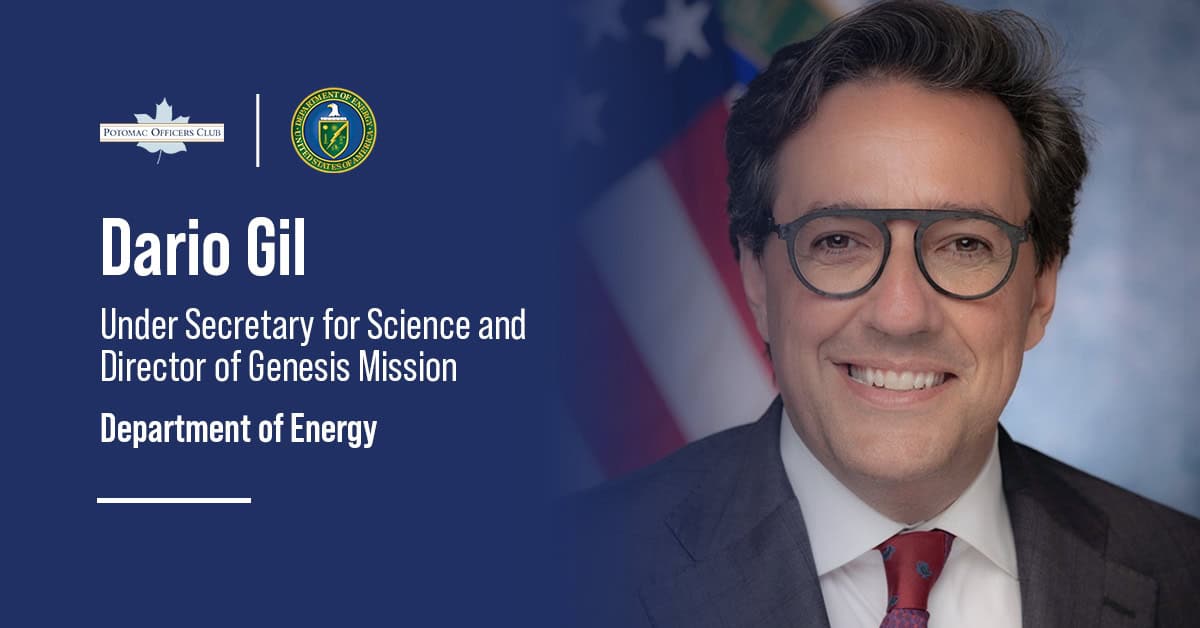
Meet Dario Gil: The Genesis Mission Leader Trying to Revolutionize Science With AI
- Genesis Mission Director Dario Gil previously led IBM Research
- Gil is responsible for mobilizing the national labs and bringing together AI, supercomputing and quantum computing
- Join the 2026 FedCiv Summit on Oct. 29 to learn more about the Genesis Mission directly from federal officials
The United States is embarking on an ambitious effort to revolutionize scientific research and accelerate scientific discovery through artificial intelligence under the Genesis Mission. Established via an executive order signed by President Donald Trump in November 2025, the initiative aims to achieve energy dominance, drive technological innovation and outcompete adversaries in the race for global AI supremacy.
At the helm is Dario Gil, who is tasked with directing and executing the mission alongside his role as under secretary for science at the Department of Energy.
 Industry partnerships will play a pivotal role in achieving the goals set by President Trump in his Genesis Mission EO. Learn about what capabilities the private sector can offer to the initiative at the 2026 FedCiv Summit on Oct. 29. Federal leaders, including top decision-makers at the DOE, will be present at the event to discuss new initiatives and priorities. Sign up here to secure your spot!
Who Is Dario Gil?
Gil is an influential technology leader revered in the industry for his expertise in AI and quantum computing.
He spent the majority of his career at IBM, where he most recently served as senior vice president and director of research. Throughout his more than two decades at the company, he led IBM’s research and development division, which is one of the world’s largest corporate labs, and helped launch the MIT-IBM Watson AI Lab and the public-private COVID-19 High Performance Computing Consortium.
He joined IBM in 2003 as a research staff member, according to his LinkedIn profile.
In 2024, he was elected to the National Academy of Engineering, a nonprofit founded in 1964 to provide leadership and expertise to support engineering projects and advise the president when called upon.
He was also involved in the creation of the International Science Reserve, a global community of scientists who work together to respond to crises, and the AI Alliance, an organization that promotes open source AI agents and models.
Additionally, he served on the President’s Council of Science and Technology Advisors, the National Science Board, the Center for Strategic and International Studies, the New York Academy of Sciences, the Semiconductor Industry Association, and other organizations.
He was officially confirmed as DOE’s under secretary for science and innovation in March. In the role, he provides science and technology leadership at the department and oversees programs in advanced computing, nuclear and high-energy particle physics, fusion, basic energy, biological, and environmental research. His office is the “largest federal sponsor of basic research in the physical sciences” in the nation and supports all 17 national laboratories.
Gil has a doctorate in electrical engineering and computer science from the Massachusetts Institute of Technology.
What Are Dario Gil’s Responsibilities as Genesis Mission Director?
Energy Secretary Chris Wright appointed Gil to oversee the Genesis Mission in November. As director, he is responsible for mobilizing the national laboratories and orchestrating the convergence of AI, supercomputing and next-generation quantum systems to advance the frontiers of science and engineering.
Gil is also responsible for achieving some of the goals laid out in President Trump’s Genesis Mission EO. He said at a January event that the DOE is applying agile implementation methods and working with interagency and industry partners to meet deadlines and achieve steady progress toward mission goals, FedScoop reported.
“We are going to deliver a lot of results on an ongoing basis,” Gil said.
American Science and Security Platform
DOE is expected to demonstrate initial operating capability of a Genesis platform in mid-2026. The department already announced more than $320 million in investments to advance the American Science and Security Platform, described as a discovery engine that will integrate the capabilities of supercomputers, experimental facilities and AI systems with unique datasets.
Gil said in an interview with the Special Competitive Studies Project that the American Science and Security Platform will build on advancements in high-performance computing, AI and quantum computing.
“The platform that we’re building as part of the mission will bring together all three and we’ll create on top of it an agentic framework that will be able to tap on each of those computing modalities,” he explained.
He added that the platform will support scientists and engineers through the entire discovery process, from generating hypotheses to running experiments and analyzing results, and connect them with scientific instruments and manufacturing environments.
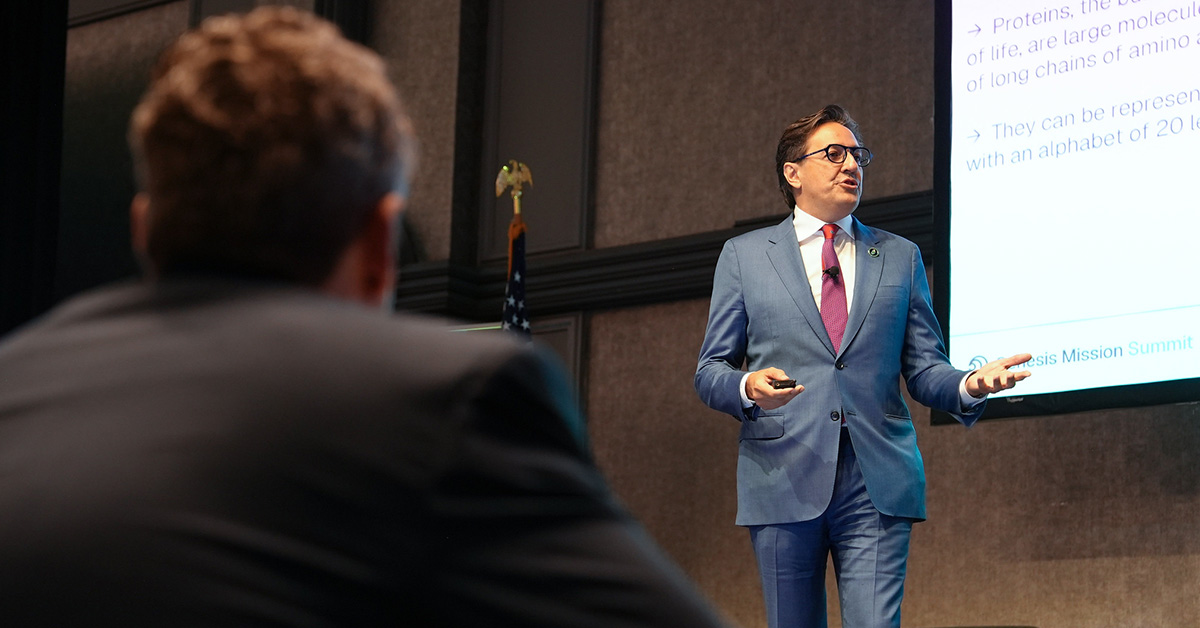
Doudna Supercomputer
DOE, in partnership with Dell, is also aiming to deliver a new supercomputer as part of the Genesis Mission before the end of the year. Called Doudna, the system is designed to provide the power needed for large-scale simulations and training scientific AI models.
Named after Jennifer Doudna, a biochemist who won the Nobel Prize in Chemistry in 2020 for her work in CRISPR, the supercomputer will also support scalable quantum development, modeling and verification. It will be housed at the National Energy Research Scientific Computing Center, the mission computing facility for DOE’s Office of Science, at Lawrence Berkeley National Laboratory.
Doudna is expected to deliver “more than ten times the performance” of NERSC’s current flagship supercomputer Perlmutter.
Will International Partners Join the Genesis Mission?
Gil talked about extending the Genesis Mission to a “limited number of trusted partners” at the U.S.-Italy Trusted Tech Dialogue in April. He also emphasized the importance of international cooperation in achieving the Genesis Mission at a Trillion Parameter Consortium 2026 meeting in June, HPCwire reported.
The Energy Department announced its first international partnership in June. Together with Japan’s Ministry of Education, Culture, Sports, Science and Technology and Ministry of Economy, Trade and Industry, DOE launched a $1 billion research effort that focuses on advancing autonomous laboratory systems, quantum information science, materials science, fusion energy, biotechnology and particle physics.
Under the partnership, the nations will form joint research teams made up of DOE national laboratories, DOE Office of Science User Facility and Japanese research institutions. For the initial project, the nations will work on the development of laboratory systems powered by AI and robotics.
What Does Mission Success for Genesis Look Like?
In an interview with The Power Podcast in April, Gil described what success would look like for the Genesis Mission. He referenced AlphaFold, Google’s AI system, which was trained on data from the Protein Data Bank. The Protein Data Bank, founded at Brookhaven National Laboratory, took 50 years to catalog 200,000 protein structures through experimental and computational work. AlphaFold was able to predict 200 million protein structures within only two years.
Success for the Genesis Mission, he explained, means achieving 50 to 100 comparable breakthroughs across all domains of science within the next three to five years. The initiative should also establish a lasting foundation for AI supercomputers and next-generation quantum computers for scientific discovery and demonstrate practical AI applications for engineering, physics, chemistry and materials science.
The conversation around the Genesis Mission continues at the 2026 FedCiv Summit on Oct. 29. DOE officials and other federal leaders will join industry representatives to discuss the initiative’s next steps and the role the private sector can play in advancing its goals. Tickets are available here!


Category: Articles