
The Pentagon Is Betting Big on Drones. Here’s Why.
- UAS, or drones, have transformed warfare
- They can perform essential missions like ISR and strike at incredibly low costs
- Unpack UAS and network connectivity strategies at the 2027 Defense R&D Summit on Feb. 4!
Unmanned aircraft systems, or drones, have transformed warfare. Battlefields from Ukraine to the Middle East show that drones can perform essential missions, including finding, tracking and striking targets, at low costs that can’t be matched by traditional manned aircraft.
UAS have also moved from the margins of military planning to the center of modern warfare. For the Department of War, UAS are essential to logistics, electronic warfare and intelligence, surveillance and reconnaissance. Countering adversary drones has become an urgent force-protection priority.
The department’s push for drone dominance is reshaping acquisition, budgets and industrial partnerships. Dive into our frequently asked questions to better understand the current status of UAS policy and where it is headed.
The network is not just support infrastructure, it is a target for jamming by adversaries from the first hour of combat. Dive into assured connectivity for UAS operations in the battlespace by attending the Potomac Officers Club’s 2027 Defense R&D Summit on Feb. 4. The Network as a Weapon System panel discussion will examine connectivity engineered to bend, rather than break, degrade gracefully and recover quickly when links are denied. Unpack industry partnership opportunities in resilient network design and secure transport. Sign up now!
Has the U.S. military used one-way attack drones in combat?
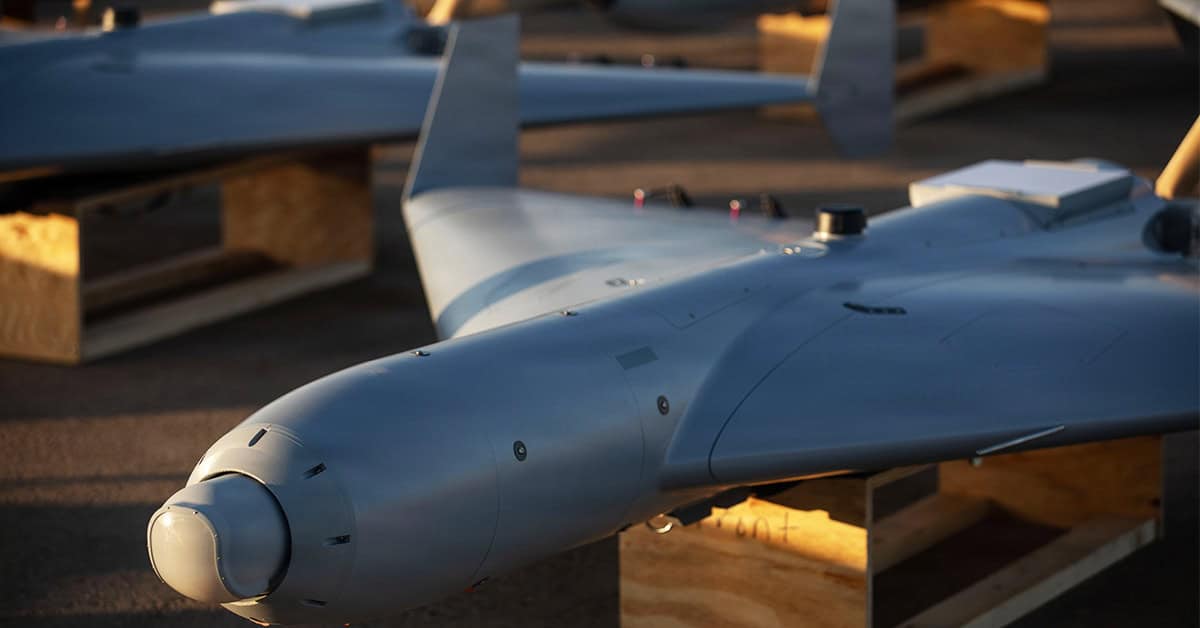
The U.S military has used one-way attack drones in combat. On February 28, U.S. Central Command confirmed that strikes on Iran under Operation Epic Fury included the first combat use of the Low-cost Unmanned Combat Attack System, or LUCAS, a one-way attack drone reverse-engineered from Iran’s Shahed-136, according to Defense News.
LUCAS is built by Arizona-based SpektreWorks and was operated by CENTCOM’s Task Force Scorpion Strike, which Military Times described as a first-of-its-kind one-way attack drone squadron.
LUCAS platforms are significantly cheaper than legacy attack munitions. The Carnegie Endowment for International Peace said LUCAS drones cost around $35,000 each while Tomahawk cruise missiles have a unit price of about $2.5 million.
What is the Pentagon’s Drone Dominance Program?
The Pentagon’s Drone Dominance Program is a two-year, roughly $1.1 billion effort to buy large amounts of low cost, U.S. manufactured one-way attack drones through competitive fly-offs called “Gauntlets,” Breaking Defense reported. It implements War Secretary and two-time Wash100 Award winner Pete Hegseth’s memo “Unleashing U.S. Military Drone Dominance.”
- Who runs it: The Defense Innovation Unit and the Test Resource Management Center execute the program jointly, said DroneLife.
- Gauntlet I: Twenty-five vendors competed between February and March for about $150 million in orders covering roughly 30,000 drones, FedScoop reported. By June, DOW had ordered 20,000 first-person view, or FPV, drones from 10 of the top 11 vendors, according to Breaking Defense.
- Gauntlet II: Gauntlet II tested Deep Strike (9 miles) and Close Quarters Battle scenarios, including night runs and counter-drone lanes. The top five in each category are in line for orders totaling 60,000 drones.
- Phase III: About $450 million was awarded for roughly 60,000 drones at unit prices of $5,000 from the Deep Strike category and $3,000 from Close Quarters Battle. The solicitation closed Oct. 12 with Gauntlet III testing expected in March, DroneLife reported.
- Gauntlet 2.5: This a separate event for reusable “bomber” drones. Seventeen companies were invited and about $32 million is expected for initial orders. The demonstration was pushed to early November.
- End goal: More than 200,000 AI-enabled drones by 2027, with unit cost targets falling from $5,000 to about $3,000.
What is the Autonomous Warfare Command?
Autonomous Warfare Command, or AUTOWARCOM, is a planned four-star combatant command that would lead the joint force in unmanned and autonomous warfare with “service-like authorities” over manpower, budget and acquisition, Inside Unmanned Systems reported. The target stand-up date is October 1, 2027.
Project Agincourt is the interim effort to build the command. It is led by the Direct Reporting Portfolio Manager for Unmanned Systems, a.k.a. DRPM-UxS, with DIU Director and Wash100 awardee Owen West and Navy SEAL Senior Chief Max Strasiser named to run it.
The reorganization started June 29 when Hegseth made DRPM-UxS the single joint integrator for unmanned and autonomous programs, according to AeroTime. That office already oversees DIU, Joint Interagency Task Force 401, a.k.a. JIATF-401 and the Defense Autonomous Warfare Group, or DAWG, DroneXL reported.
How many drones does the DOW have and how many is it buying?
The DOW does not maintain a public and current inventory of its drones. Most published numbers are purchase goals.
The Army said in November 2025 it plans to buy at least 1 million drones over two to three years, up from about 50,000 a year. The DDP is targeting more than 200,000 AI-enabled UAS by 2027.
In comparison, Army leaders have said Ukraine and Russia each produce about 4 million drones a year and China likely more than double that, DroneXL reported.
The Pentagon received $149 billion for research and development funding last year, which included the largest R&D funding increase across the federal government. Unlock exclusive insights from top DOW technology officials into how that will be spent by attending the Potomac Officers Club’s 2027 Defense R&D Summit on Feb. 4. Go beyond the headlines on the essential innovative warfare technologies including unmanned systems, future-generation wireless and 5G, trusted AI and autonomy, and advanced space technologies. Join the conversation during inquisitive question and answer sessions. Secure your seat today!
Can DOW drones pick and attack targets on their own?
U.S. policy does not ban DOW drones from picking and attacking targets on their own. DOW Directive 3000.09, updated January 2023, requires that they be designed to let commanders and operators exercise “appropriate levels of human judgment over the use of force,” and certain systems need a senior-level review,” Congressional Research Service reported.
National Security Presidential Memorandum 11, signed June 5, ordered the Pentagon to update DOW Directive 3000.09 within 90 days and review it annually, according to the Center for Strategic and International Studies think tank. An update has not been published.
This revision has attracted lawmaker scrutiny. Sen. Ruben Gallego of Arizona has pressed Hegseth on how the revised DOW Directive 3000.09 will maintain safeguards, according to DefenseScoop.
What happened to Replicator?
The Pentagon dissolved Replicator in late 2025 and folded it into the new DAWG, according to DefenseOne. The DOW, for DAWG, requested $55 billion for research, development, test and evaluation funding in fiscal year 2027, DefenseScoop reported.
The DOW has new plans for DAWG as it will be folded into U.S. Special Operations Command’s new Task Force Autonomous Warfare, according to DefenseOne.
Can the Pentagon buy Chinese drones?
The Pentagon cannot buy Chinese drones. The Federal Communications Commission on Dec. 22, 2025 added all foreign-produced drones and critical drone components to its Covered List, which blocks new FCC authorizations. Models already authorized can still be sold and flown, Legal500 reported.
Drones on the Defense Innovation Unit’s Blue UAS list, a record of UAS and parts approved for DOW purchase, and products meeting Buy American standards are exempt. Administration of the Blue UAS list transitioned to the Defense Contract Management Agency on Jan. 1, according to DroneRanker.
Who builds drones and counter-drone systems for the DOW?
There is a robust domestic defense industrial base developing drone and counter-drone systems for the DOW.
- Attack and small drones: Neros, Perennial Autonomy, SpektreWorks and the DDP field, which includes AeroVironment.
- Collaborative Combat Aircraft: General Atomics and Anduril, DefenseScoop reported.
- Unmanned surface vessels: HII, Saronic and Galliano Marine Services, among others.
- Counter-drone: RTX, AeroVironment and Dynetics, among others


Category: Articles