From Space Economy Research to a $200M Waterfront Infrastructure: 5 NOAA Contract Opportunities
- NOAA has five active contracts open across research, data, vessels and infrastructure
- Several solicitations are designated as small business set-asides
- Join leaders from NOAA, SBA, DOE and other agencies at the 2026 FedCiv Summit
The National Oceanic and Atmospheric Administration has released a new wave of open contract opportunities to support its critical missions. Active solicitations spanning research, data, vessel and facility modernization provide avenues for government contractors — from small businesses trying to gain a foothold in the market to established primes seeking to expand their federal footprint — to support civilian programs.

Officials spearheading initiatives at NOAA will join panels on modernization, artificial intelligence, shared services and other topics critical to federal civilian agencies at the Potomac Officers Club’s 2026 FedCiv Summit on Oct. 29. James Donnellon, deputy assistant administrator at the National Environmental Satellite, Data and Information Service, or NESDIS, will join The OneGov Effect: Leveraging AI to Accelerate Agency Modernization and Migration panel. Meanwhile, Adam Nemethy, acting director of NOAA network service provider N-Wave, will sit with government and agency leaders on the Observability: The Foundation for Federal Shared Services panel. Secure your seat today!
What Are the Open Contract Opportunities at NOAA?
1. Study on U.S. Space Economy Measurement Metrics RFP
The Office of Space Commerce has issued a request for proposals seeking research support for its study on the U.S. space economy. OSC intends to establish a government-verifiable baseline of metrics for measuring the health and trajectory of the U.S. commercial space ecosystem to support federal policy and government decision-making.
The selected contractor will assess the ecosystem’s economic system and recommend quantitative and qualitative metrics addressing economic activity, business growth, capital and investment, and market access and competitiveness. Work will include assessing metrics that already exist in the private sector and in government and non-government studies of the space economy and identifying gaps in previous metrics.
The government will award a firm-fixed-price contract as a small business set-aside for the requirement. The anticipated period of performance is 180 days.
Proposals are due Sept. 24.
SBA Deputy Administrator William Briggs will deliver a keynote at the 2026 FedCiv Summit. He is expected to discuss changing regulatory requirements, small business capital access and opportunities in federal technology modernization. Sign up today to hear directly from one of the top decision-makers influencing policies and initiatives for small businesses!
2. USNIC SAR Data RFI
The U.S. National Ice Center, also known as USNIC, has issued a request for information on companies that can provide unclassified, all-weather synthetic aperture radar, or SAR, imagery delivered as georeferenced GeoTIFFs with global coverage and near-real-time latency.
SAR imagery is critical to USNIC’s operational Earth observation programs. High-resolution SAR can penetrate heavy cloud cover and function reliably even during the extended darkness of polar winter months.
A primary focus of the RFI is delivery speed. USNIC is assessing industry capability to deliver images no more than approximately four hours after satellite acquisition. The center noted that latency exceeding four hours directly hampers its mission to provide timely snow, sea- and lake-ice forecasts to support marine and naval forces around the world.
USNIC is a tri-agency center that operates under NOAA, the U.S. Navy and the U.S. Coast Guard.
The center is specifically interested in hearing about:
- The chain of operational control over the SAR that the organization intends to use for the program.
- The commercial tasking tiers and the minimum window from urgent request to acquisition.
- The standard dimensions, resolutions and polar limitations of the widest imaging modes the organization offers to support the 60 million square kilometer annual capacity target.
USNIC said it relies on C band dual-polarization imagery for ice stage-of-development analysis, but companies that operate constellations in a different frequency are encouraged to respond to the RFI and explain how their specific capabilities can meet the center’s ice classification and iceberg detection needs. Responses are due on Sept. 25.
3. Hawaii Class II Research Vessel RFP
The Office of National Marine Sanctuaries is soliciting proposals for a NOAA Class II research vessel that can carry science and dive crews of up to nine people. The office said it is seeking a ship that measures no more than 35 feet from bow to aft end of the stern platform and is capable of carrying 2,800 pounds of equipment at deck level.
Other required features:
- 20 knots minimum cruise speed
- No less than 30 knots maximum speed
- 150 nautical miles minimum range
The ship will be stationed in Oahu, Hawaii, to support the Papahanaumokuakea National Marine Sanctuary. It will be deployed for emergency response, whale entanglement response, specimen and data collection, acoustic studies, vessel inspection, dive training, and partner missions.
Proposals are due Sept. 25.
4. AOML HVAC and BAS Controls Upgrade Project RFP
NOAA has posted a combined synopsis and solicitation for the installation of new and upgrades of existing HVAC systems at the Atlantic Oceanographic and Meteorological Laboratory, or AOML, on Virginia Key in Florida. AOML is a decades-old research facility with roughly 78,000 square feet of office, laboratory, workshop, machinery and storage space. The NOAA-owned lab studies hurricanes, climate, coastal ecosystems, global carbon, and how oceans change over time.
The government will award a firm-fixed-price contract as a small business set-aside with a one-year period of performance for the requirement. Proposals are due Sept. 29.
5. USCGC Storis Homeporting Project RFP
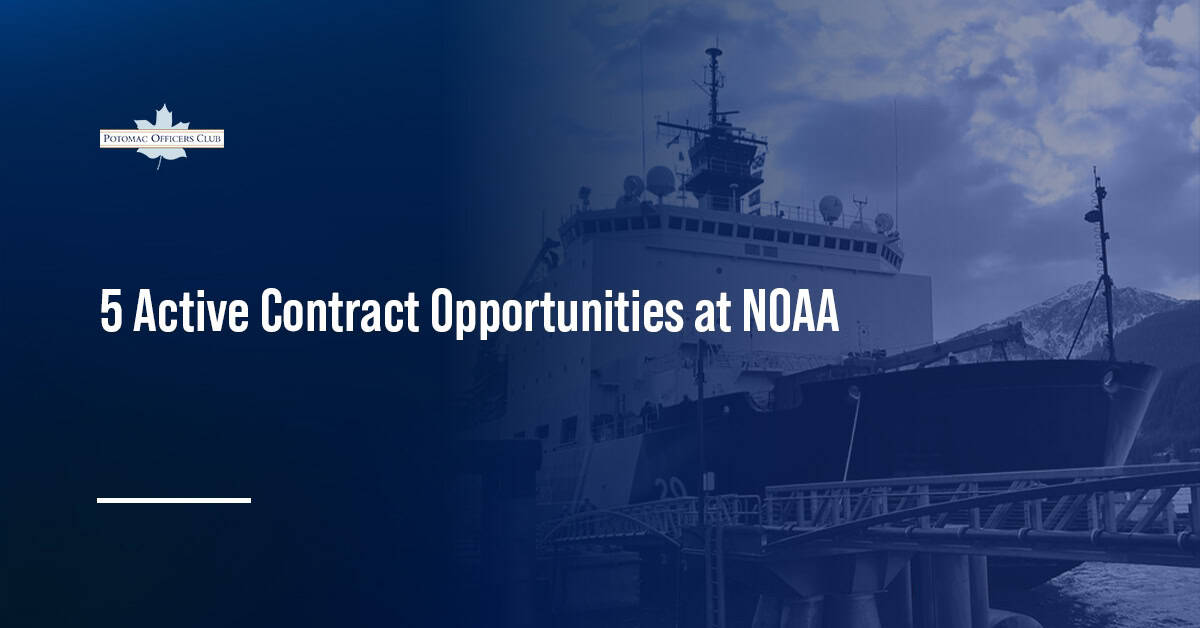
The Office of Marine and Aviation Operations is seeking companies capable of providing integrated design and construction services to modernize the waterfront infrastructure to support the homeporting of the U.S. Coast Guard cutter Storis in Juneau, Alaska.
NOAA is working with the Coast Guard to construct critical maritime infrastructure across the United States. The organizations signed the 10-year, $2 billion agreement in April to jointly plan, design and build infrastructure in shared locations.
For the USCGC Storis homeporting project in Alaska, work will cover the comprehensive redevelopment of waterfront, marine structural, utility, dredging and associated shore-side facilities needed to support Coast Guard cutter classes operating in the region. The project will also include the demolition of deficient marine structures and the construction of a new hybrid berthing system with fixed wharf components and a heavy-duty floating pier.
The effort is expected to create a mission-ready operational waterfront facility that can support simultaneous cutter berthing, heavy mooring loads and long-term service life requirements. It has an estimated project value between $125 million and $200 million. Proposals are due Oct. 16.
Why Should GovCons Attend the 2026 FedCiv Summit?
The 2026 FedCiv Summit on Oct. 29 will explore challenges that federal civilian agencies are facing as they accelerate modernization and adoption of advanced technologies to comply with executive mandates. The White House has proposed a record $75.7 billion budget for fiscal 2027 to support IT projects at FedCiv agencies.
Government speakers will provide insights into how agencies will prioritize technology investments in the coming years. The event’s lineup of keynote speakers includes:
- William Briggs, deputy administrator of the Small Business Administration
- Greg Justice, chief acquisition officer of the General Services Administration and associate administrator for GSA’s Office of Small Business (pending confirmation)
- Mangala Kuppa, chief information officer at the Department of Labor
- Pavan Pidugu, former chief digital and information officer at the Department of Transportation (pending confirmation)
- Dawn Zimmer, chief information officer at the Department of Energy
- More will be announced soon!
Attendees will get to engage with federal leaders and gain a better understanding of the capability needs of FedCiv agencies. Register here!

Category: Acquisition & Procurement