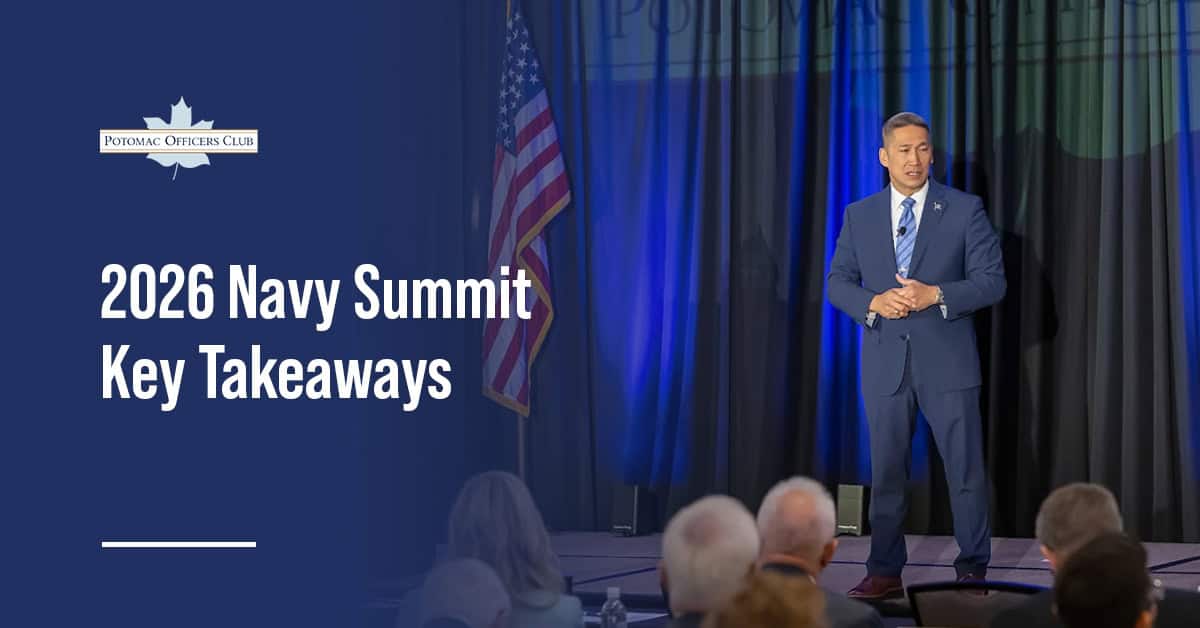
Key Takeaways From the 2026 Navy Summit
Co-authored with Pat Host
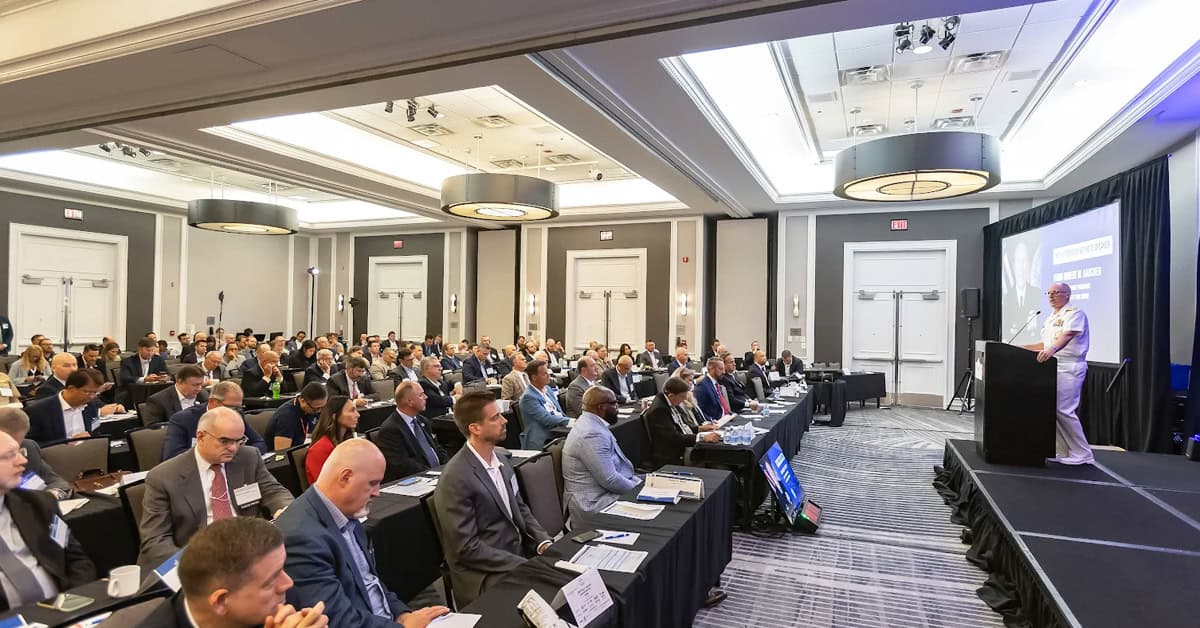
Potomac Officers Club’s 2026 Navy Summit was a spirited and productive day of discussions and insightful talks leading the GovCon industry through the latest U.S. Navy initiatives and technology priority areas. Held on Aug. 27 at the Falls Church Marriott Fairview Park in Virginia, the event featured officials from the very highest echelons of the service — including an opening keynote from none other than Acting Secretary Hung Cao, just days before he was presidentially nominated to lead the Navy Department on a permanent basis.
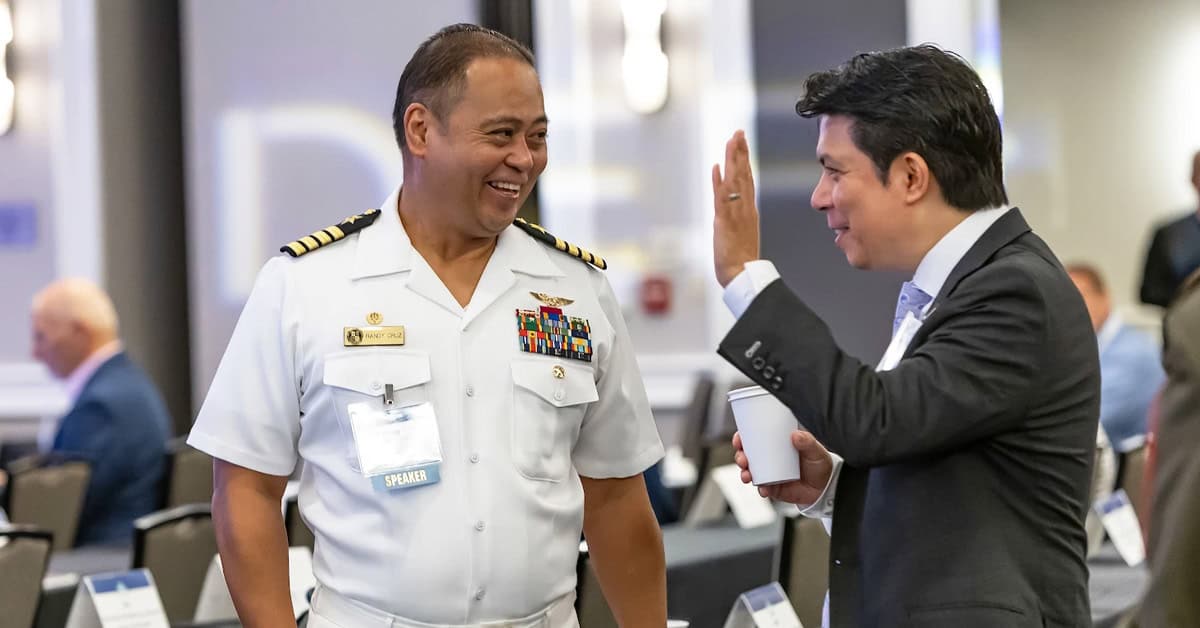
Navy leaders like Chief Information Officer Barry Tanner, the afternoon keynote, listened to their colleagues’ sessions all day and actively engaged with industry guests. We’ve below collected the highlights from the day, which covered an enormous amount of ground, from portfolio acquisition executive innovations, to shipbuilding goals, Project Overmatch and the endless pursuit of faster acquisition and speed to mission.
After a summer of successful defense-focused events, Potomac Officers Club is pivoting to the intelligence community for its first fall GovCon conference: the 2026 Intel Summit. Join us on Sept. 24 to hear from leadership at the CIA, National Reconnaissance Office, National Security Agency (and plenty of defense agencies, such as U.S. Space Force, Department of the Army and others!) speaking on agentic AI, open-source intelligence and much more. Register here now.
What Were the Key Takeaways From the 2026 Navy Summit?
Navy Wants to Treat Industry Better
One persistent theme on the day was the Navy’s desire to treat industry better. Acting Navy Secretary and 2026 Wash100 Award popular vote winner Hung Cao acknowledged during his keynote address that the service has treated industry “like crap” and needs to treat it better so that the two parties can work together both better and faster to achieve technological and warfighting goals.
“I need you guys. We can’t do this by ourselves anymore,” Cao said. “The warfare centers—[the Naval Research Laboratory, the Office of Naval Research], they can’t move as fast as you guys can right now. Industry is moving so much faster than the government can. So that’s why this partnership is so important.”
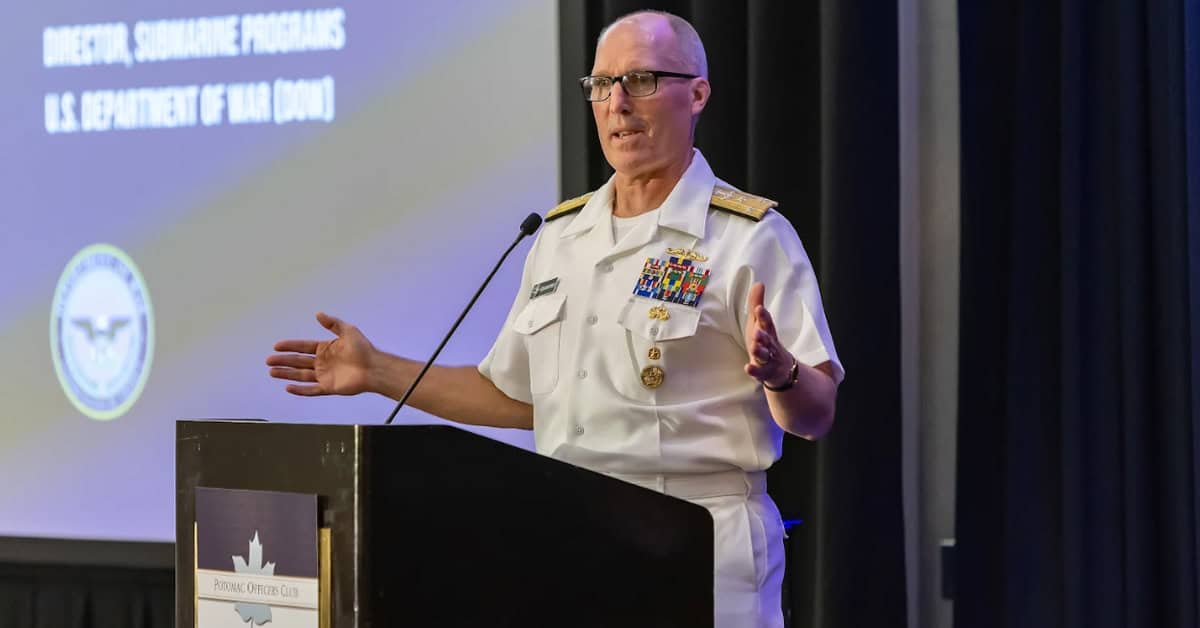
Another key Navy official, Vice Adm. Robert Gaucher, director of submarine programs, said the service needs to better consider industry when contracting for emerging technologies.
“We have to think about the whole package and not just keep jamming capability without understanding the impact on our industrial base’s ability to build it,” Gaucher said during his mid-afternoon keynote. “If we truly need it, then we need to go invest in the industrial base early so that we’re up on ramp early enough to be able to build it.”
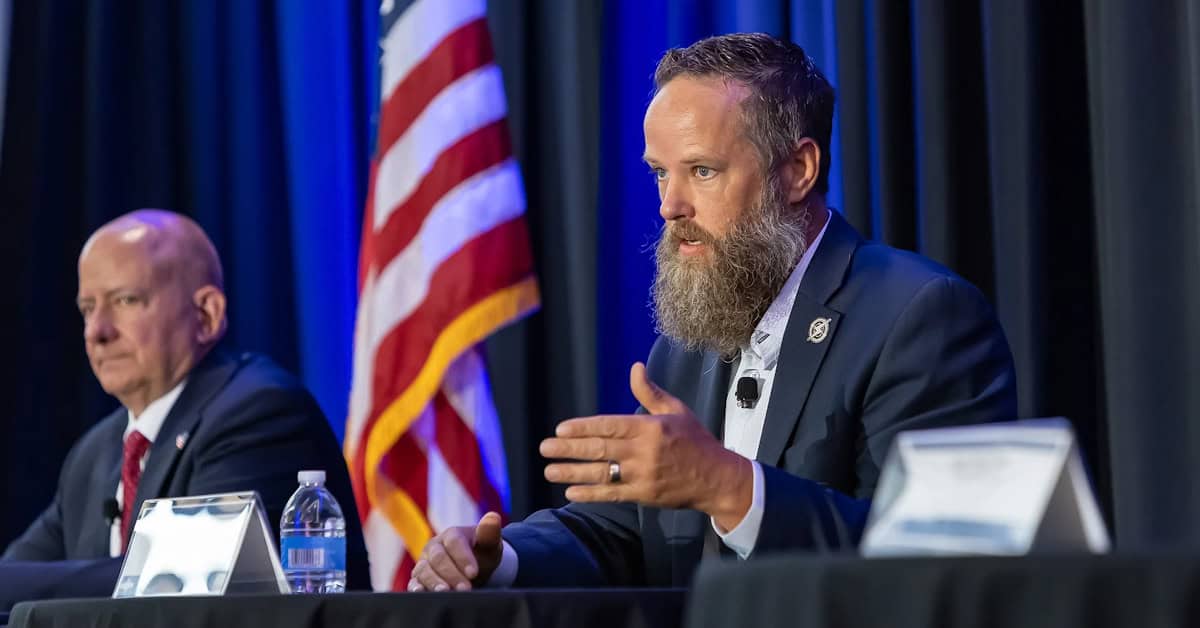
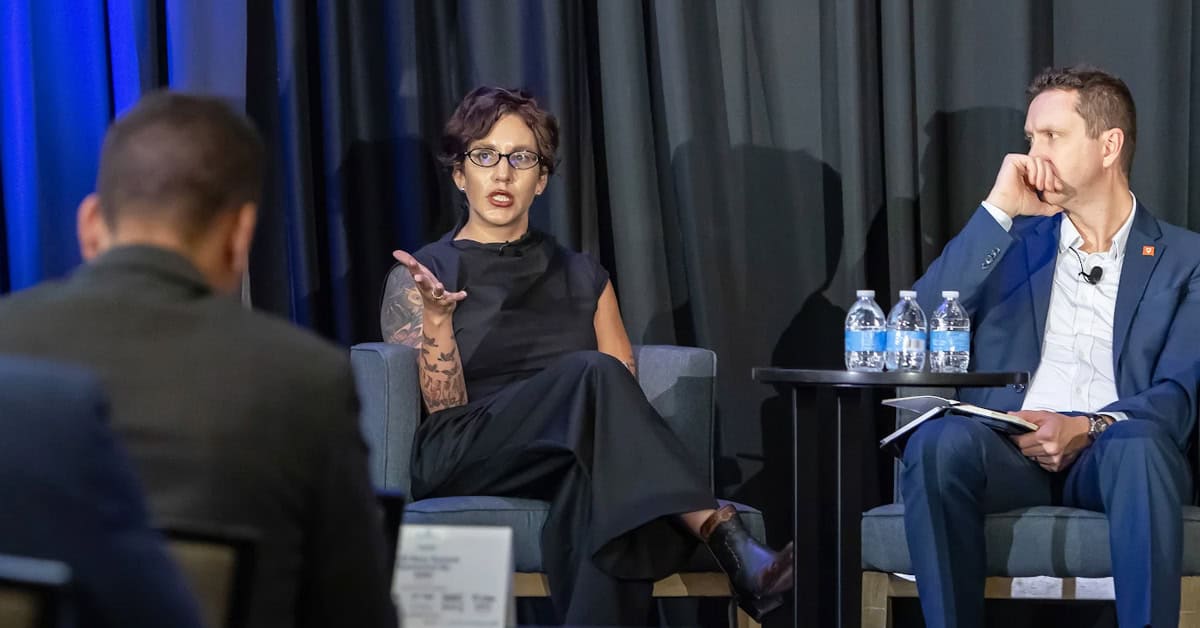
A Marine Corps official, David Raley, Operation StormBreaker chief digital services officer, said during the Hybrid Fleet in Production panel discussion that the Operation StormBreaker mission-focused software initiative is having success because it listens to its industry partners instead of acting like authoritarians.
“We hired them for a very particular skillset, capability and understanding, and we often then ignore their guidance or advice, because we hire them,” Raley said. “I think that’s one thing to kind of say, ‘hey, come to the table,’ and then the industry partner says, ‘hey, don’t do that stupid thing.’ Then we just do it, we keep doing it and [industry is] like, ‘this is the problem.’ So I think we, on the government side, need to be a lot more conscious of that.”
Vice Adm. Michael Vernazza, Naval Information Forces commander, offered that industry is more than professionals simply offering products, services and technologies for use by the U.S. armed services.
“Looking out at this room, I just don’t see a gathering of military and industry leaders. I see our war council,” Vernazza said. “I see the intellectual and industrial foundry of American sea power.” —Pat Host
PAEs — and New Commercial Pathways — Could Be Transformative
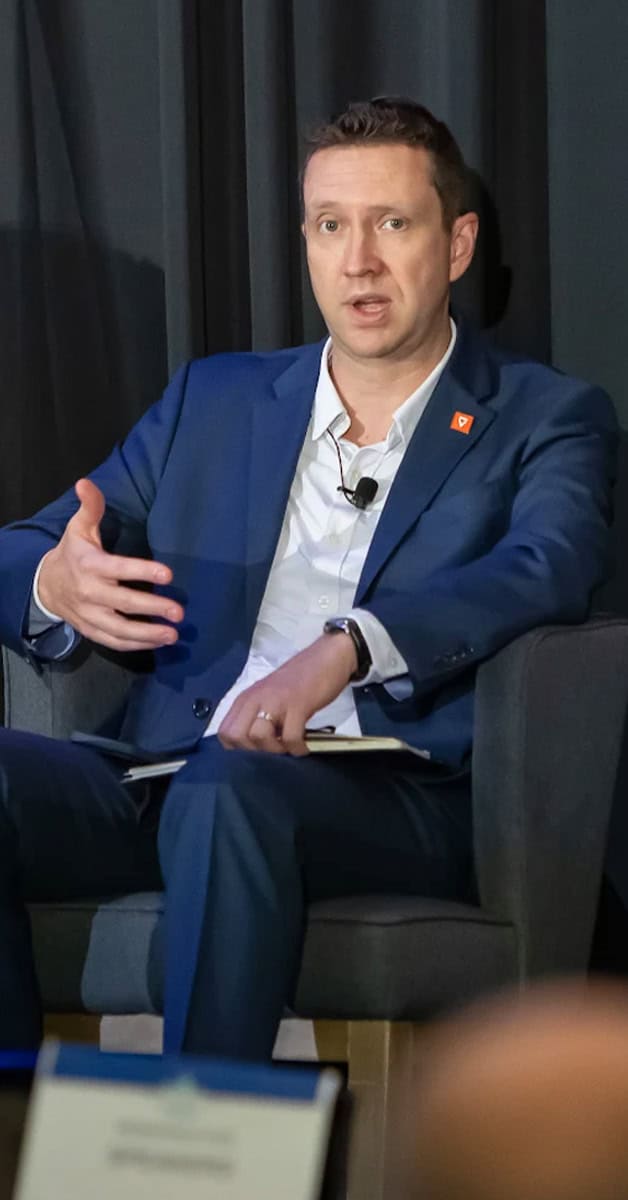
Throughout the 2026 Navy Summit, speakers were united in optimism about the new portfolio acquisition executive structure, which has replaced the former program executive office organizations at the Pentagon.
Speaking about PAEs and the new era the Navy has entered, being much more friendly to commercial technologies, Navy Department Chief Technology Officer Justin Fanelli said that in his 27 years in federal service, he’s “never seen it be more of a top-down, we-are-one-department Navy and Marine Corps.”
“We’re scouting, we’re piloting, we’re piloting wildly right now. We’re wildcat piloting many different things within the PAEs because that’s how portfolios are supposed to operate,” Fanelli, a 2026 Wash100 Award winner, said during the Golden Fleet-focused panel just before lunch.
He attributes this increased productivity not just to the freedoms the PAEs have afforded them, but also to the Innovation Adoption Kit, a framework for hastening technologies across the much-bemoaned “Valley of Death” from inception to implementation.
Fanelli was direct with the GovCon audience: “If you want leverage, if you want a hook to grab onto, between modern service delivery, [the] Innovation Adoption Kit and what we’re doing on modular architecture, this is the way, a common baseline to run through the adoption curve and to get through integration quicker than you have before. I think it’s the best opportunity that I’ve ever seen.”
Later in the day, during the Project Overmatch session, Col. Craig Clarkson, who leads the Rapid Capabilities Cell for Overmatch within PAE Mission Systems, illustrated his vision for what the PAEs could be down the line.
“I would like no-kidding operationalized acquisition in a way that people haven’t, I think, thought about it in quite some time,” Col. Clarkson said when asked what he’d change about the way defense contracting is done now.
He suggested installing a director of operations in each PAE that is dogmatic about enforcing tasks, purpose and deadlines. “No excuses…make it happen, no later than this date…like the way Marines do things…No more should there be like, ‘hey, sorry we didn’t get this done, but we have a holiday weekend’ or ‘we’re going to go do whatever we’re doing for morale’…we’ve got to beat China and everybody needs to move out with a sense of urgency and purpose. And if you can’t keep up with the tempo, do something else.” This answer received thunderous applause in the room.
Anthony Lengerich, vice president of naval programs at Thales Defense & Security and a retired Navy rear admiral, believes that the Navy might be closer to Col. Clarkson’s vision than he realizes.
“If you listen to the earlier speakers, moving to the PAE structure really helps them because now we do have sort of the one guy who can look down across all the systems and say ‘this is more important than that,’” Lengerich said. “What I think industry looks for now is: what missions do you want to perform? The whole movement towards [Medium Unmanned Surface Vessel] and program to build the truck? I applaud that. I think that was really a good move because now we have different size trucks. The question is what do you want to do with it?”
Lengerich’s comments came during the lunch-set panel on unmanned underwater and surface vehicles. —Charles Lyons-Burt
Contractors and End-Users Should Communicate Often
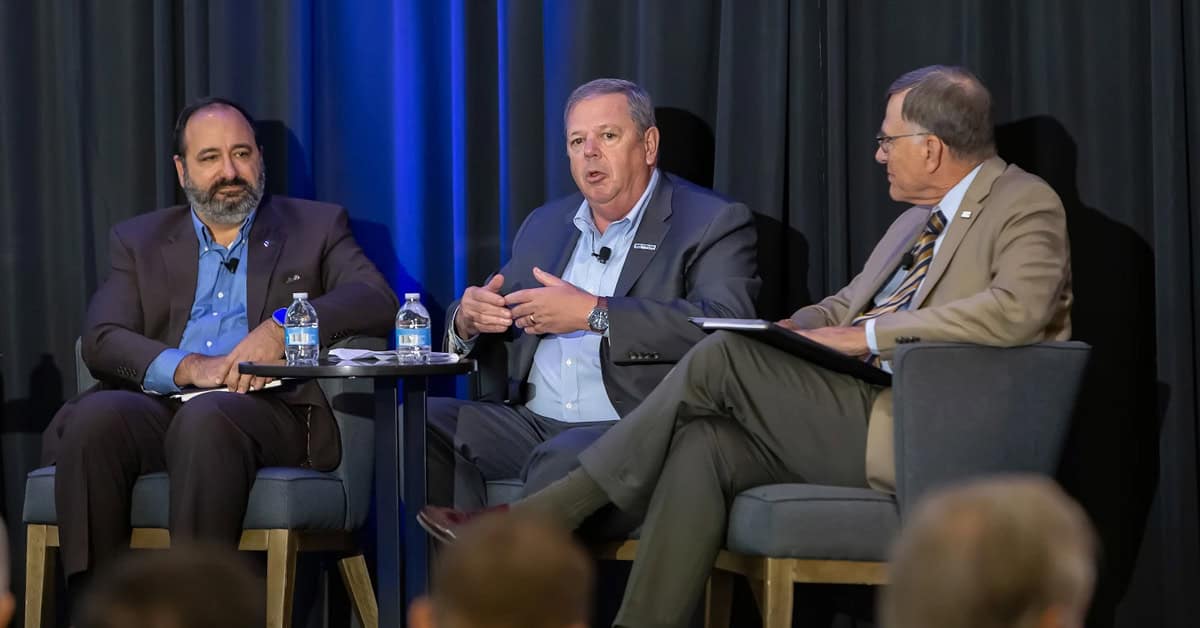
“There’s two things that enable speed for us,” Metron CEO Van Gurley said during the unmanned vehicles panel. “One is dial-in. Are we able to have a conversation with the operators, the sponsors, the acquisition agents?…Where we’ve had the least amount of success is when we go to the kick-off meeting and the government says ‘you will not talk to any end-user, everything comes to the maker.’ And that happens and it’s unfortunate.”
This was a shared sentiment at the event—that constant communication in contracting is key and that contractors’ products function best when they are able to speak with, and work alongside, the actual operators who will be utilizing their tools.
“Having that dialogue and agile mindset…lets us iterate into the software. But also, in hardware, there’s the mindset…about, what is the minimum viable product? And I think…to really do this correctly, you’ve got to have at least one mission thread, one operational mission thread in mind when you have that kick-off between industry and government. You know, we want something that’s going to at least do this, and then iterate,” Gurley continued.
Col. Clarkson agreed, saying that with Project Overmatch, his cohort is regularly “putting engineers in the field with end users.”
“The [program managers] need to be out in the field with the people who are using the thing, watching their engineers do the engineering, with industry, pull it all together, and then get closer to realizing” mission goals, he stated. —Charles Lyons-Burt
National Security Community Spurring Innovation Through Industry Collaboration
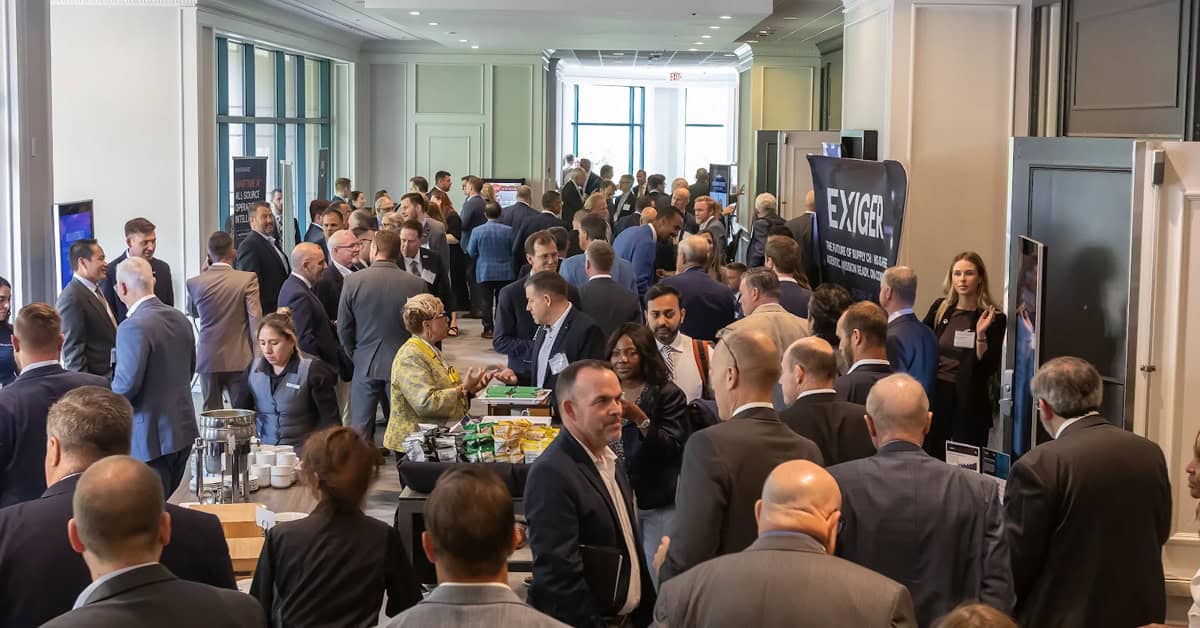
Another common theme during the 2026 Navy Summit was efforts by the Navy and the national security community to spur innovation in industry by having firms work together. The National Geospatial-Intelligence Agency is writing broader solicitations to encourage companies to team and combine technologies, according to an industry official.
Robert Sharp, Windward Maritime AI chief maritime intelligence officer, said during the Hybrid Fleet in Production panel that the NGA’s Luno A commercial data contract had industry provide capabilities to answer questions.
“The way that [NGA is] posing these are such that no individual company can really provide that solution,” Sharp said. “It requires some of this team-building to be able to provide holistic solutions. So on the government side, we may want to pose some of our acquisitions when we’re asking for capabilities so that it prompts industry partners to work together. On the industry side, we can just start doing that.”
The Navy’s “chief financial officer” also discussed service efforts to get firms to work together. Vice Adm. Brad Skillman, deputy chief of naval operations for integration of capabilities and resources, N8, said during his keynote that the new PAE setup, which empowers leaders to made tradeoffs across cost, schedule and performance for a variety of technologies, will encourage industry collaboration.
“I need people to be able to work together. I need to have those portfolios be able to call balls and strikes across and foster that industry working together to come up with solutions that apply to multiple things and multiple domains,” Skillman said. “This group of people specifically working a lot of AI and autonomy has to be applicable across different types of platforms: undersea, surface and air platforms.” —Pat Host
Naval Success Goes Beyond Shipbuilding
The Navy is certainly tied to and dependent on sturdy ships and great hardware to do its job effectively. But during his keynote address, Vice Adm. Vernazza said that intelligence and data is just as important.
“Conversations about naval power [20 years ago] naturally centered on ships, submarines, aircraft and the remarkable sailors who operated them. Those platforms remain the foundation of American sea power and they always will. But warfare has evolved and so has our Navy. Today’s success at sea depends far more than the number of ships we build or the range of the weapons we carry. Increasingly, victory belongs to the force that can sense first, understand first, decide first and act first. It belongs to the force that can connect every platform, every commander and every domain into a single integrated fighting force,” Vernazza said. —Charles Lyons-Burt
The Service Has Identified Ways to Move Faster
The Navy, and the Department of War as a whole, wants to develop and field emerging technologies faster to better counter adversaries like China. A variety of ways to move faster, including reducing design changes early in platform development and slashing paperwork, were suggested at the 2026 Navy Summit.
Gaucher said he locked down the design of the Virginia-class submarines to get the program up and running.
“I wrote a letter said ‘no more design changes without my permission,’ he said. “That doesn’t mean that the worker on the deck plate [can’t] move something a quarter of an inch. They can do that, that’s what we call a minor deviation. I’m talking…[jamming] a new hole in the submarine and I have to do a bunch of engineering and that. No, we’re not doing that.”
Cao, during his keynote held up an inch-thick book which he said was a tech manual the service requires shipbuilders produce. He recommended industry tell the Navy when it encounters unnecessary bureaucracy that distracts it from focusing on its core mission.
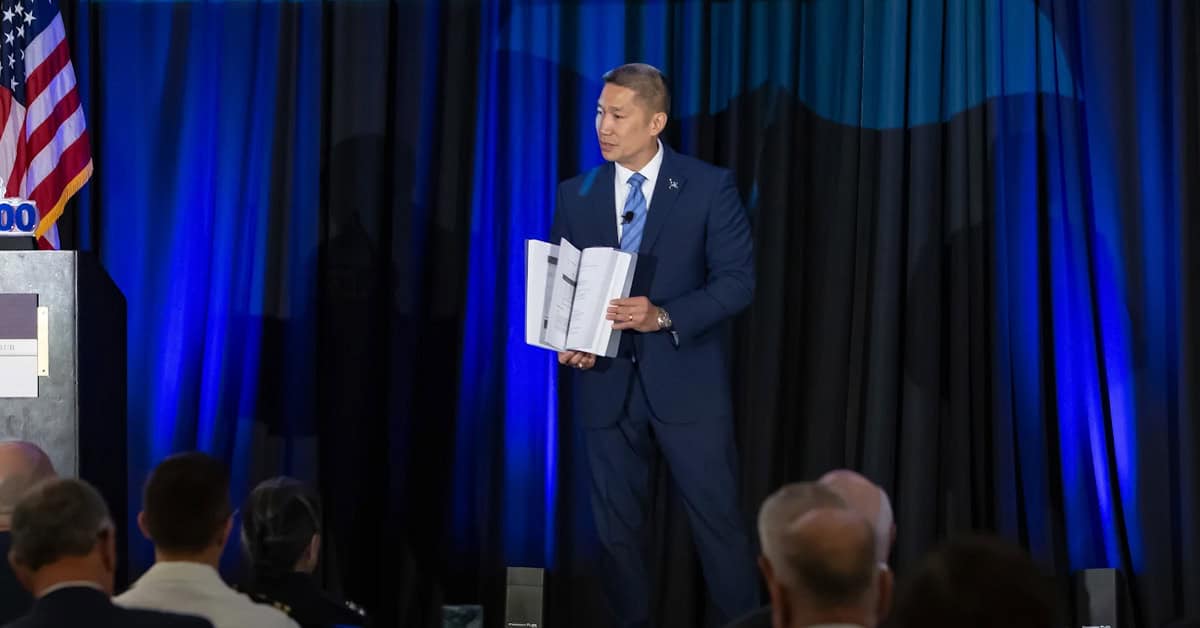
“It’s a tech manual for dot matrix printers, can you believe that? A dot matrix printer,” Cao said. “It probably costs me less to buy new printers than to print this entire manual. How [much] other stupidity is out there?”
One leading industry executive suggested that relationships are foundational to his firm moving faster.
“As a mid-tier company, I am not big enough to even attempt to do this all on my own,” said Van Gurley, Metron president and CEO, during the Future of UUV & USV Navy-Industry Partnership lunch panel, adding, however, that “we can always go faster…We’ve got a healthy string of partner companies and it’s all about relationships. It’s all about transparency. If there’s an issue, the sooner we know it, the sooner we can apply to fix it…We try to take that mindset into all of our partner relationships.” —Pat Host
World War II Is an Important Precedent
Many Navy officials throughout the 2026 Navy Summit invoked World War II in the speeches. Cao brought it up as an example when industry barons like Henry Ford and Henry Kaiser increased production rates to meet the needs of the U.S. war effort.
“We built three every two days and, today, we’re building a destroyer between six and eight years and then a submarine of 11 years and a carrier in 15 years,” Cao said. “We just can’t keep that rate. It’s too slow and we need to move forward.”
Vernazza discussed how Adm. Chester Nimitz in May 1942 prevailed in battle because of a quiet and relentless team of code breakers and intelligence officers while outnumbered in carriers and outgunned in battleships by the imperial Japanese navy. Nimitz’s victory, he said, was enabled by decrypted intercepts that allowed him to predict a Japanese carrier force attack.
“On the morning of June 4th, when the scout planes confirmed the Japanese coordinates, Adm. Nimitz turned to Layton and smiled and said, ‘well, you’re only five minutes, five degrees and five miles off,” Vernazza said. “And, as they say, the rest is history. That single intelligence victory allowed Nimitz to position his scarce carriers at exactly the right place at exactly the right time, turning the tide of war in the Pacific.”
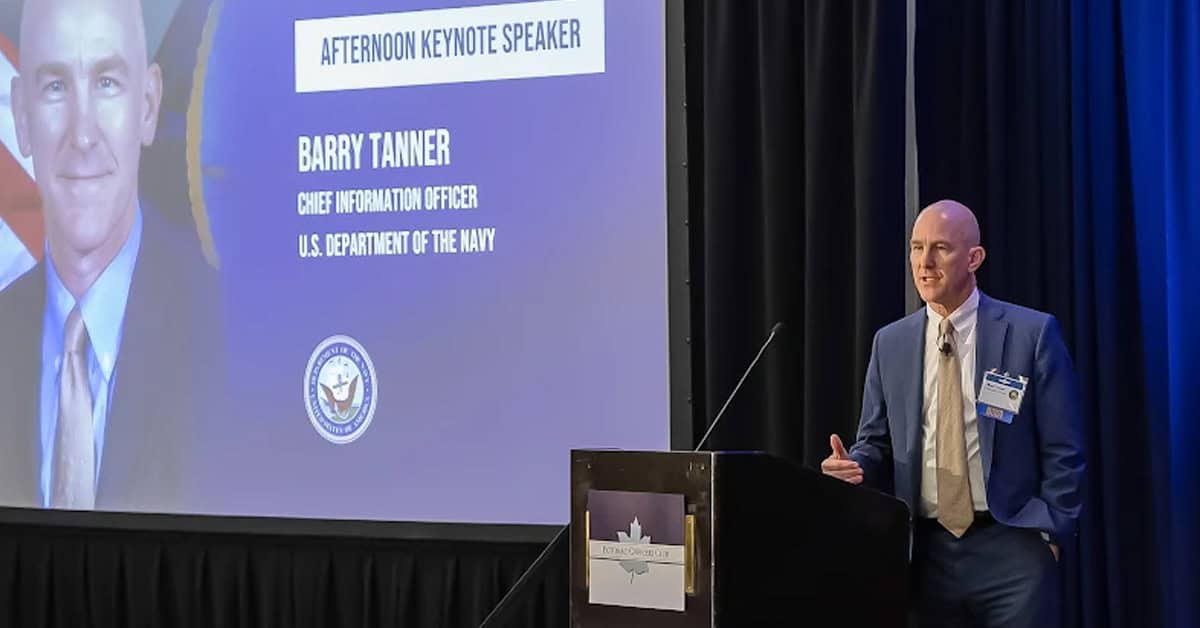
Barry Tanner, Navy chief information officer, brought up World War II by calling today’s emerging technology development similarly existential. He paralleled “our 1939 moment” with an existential crisis suffered by Google in the 2010s when its search engine code suffered cyber attacks by the Chinese in Operation Aurora.
Google, Tanner said, responded in a holistic manner where everyone at every level changed how they operated.
“You talk about culture change, that’s one for the books right there,” Tanner said. “We are facing that same kind of existential challenge, not just in the threat landscape [or] our business as warfighters and the challenge that we face on the world stage. “But technology is presenting us with that same existential challenge.” —Pat Host
Naval Success Goes Beyond Shipbuilding
The Navy is certainly tied to and dependent on sturdy ships and great hardware to do its job effectively. But during his keynote address, Vice Adm. Michael Vernazza, commander of Naval Information Forces, said that intelligence and data is just as important.
“Conversations about naval power [20 years ago] naturally centered on ships, submarines, aircraft and the remarkable sailors who operated them. Those platforms remain the foundation of American sea power and they always will. But warfare has evolved and so has our Navy. Today’s success at sea depends far more than the number of ships we build or the range of the weapons we carry. Increasingly, victory belongs to the force that can sense first, understand first, decide first and act first. It belongs to the force that can connect every platform, every commander and every domain into a single integrated fighting force,” Vernazza said. —Charles Lyons-Burt
Notable Soundbites
“Success means [unmanned] systems are unremarkable because they are so prominent” —Van Gurley, CEO, Metron
“What is the big difference between the way we thought about things six months ago and the way we think about things now? So AI, yes, but AI because time is no longer in our hands. Over the course of years in the acquisition world and in the IT world and in government, we have always said, ‘Okay, I have time to think about this. I can squeeze out uncertainty. I can reduce risk by analyzing this and processing that and checking and checking and checking.’ And that results in 200-page tech manuals for dot matrix printers, right? For those of you here this morning. That’s gone, guys. The luxury of time is no longer ours. We cannot wait to solve the problem because if we wait, then the problem will become the event. And that is what we’re facing right now.” — Barry Tanner, CIO, DON
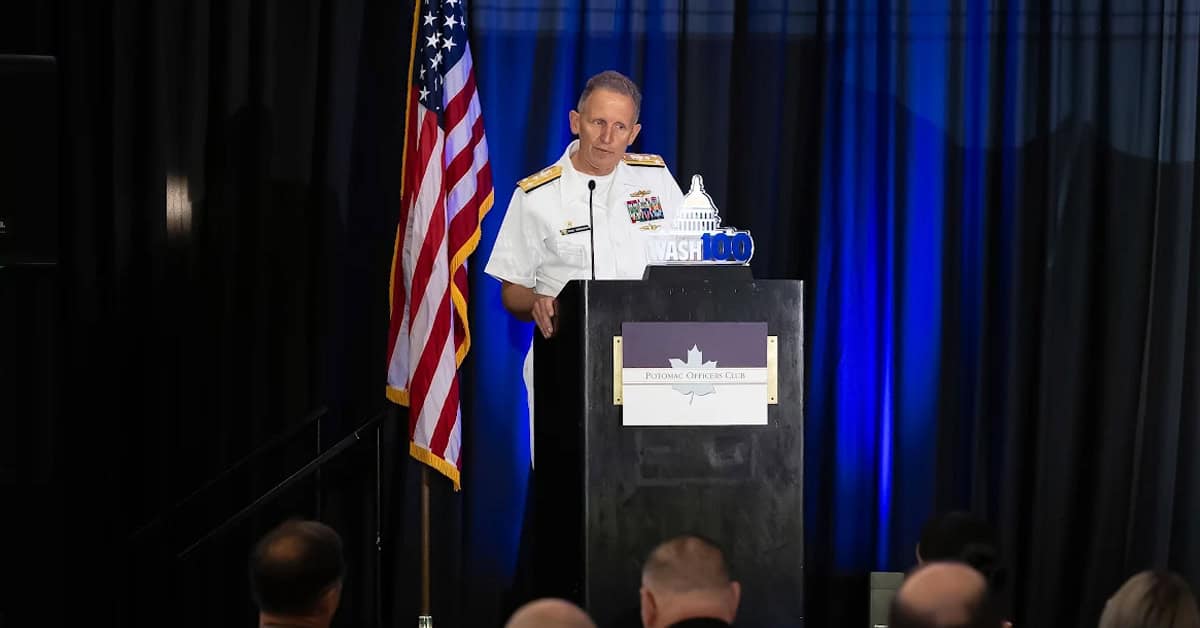
“In the age of sail, signal flags and flashing lights dictated fleet movements. A delayed message, a misunderstood signal or a broken code could determine the outcome of an entire campaign…Today, the flashing lights, signal flags and paper charts of [Admiral] Nimitz’s era have been replaced by fiber optics, satellites and machine learning algorithms, but the fundamental truth remains unchanged: information is power.” — Vice Adm. Michael Vernazza, commander, Naval Information Forces
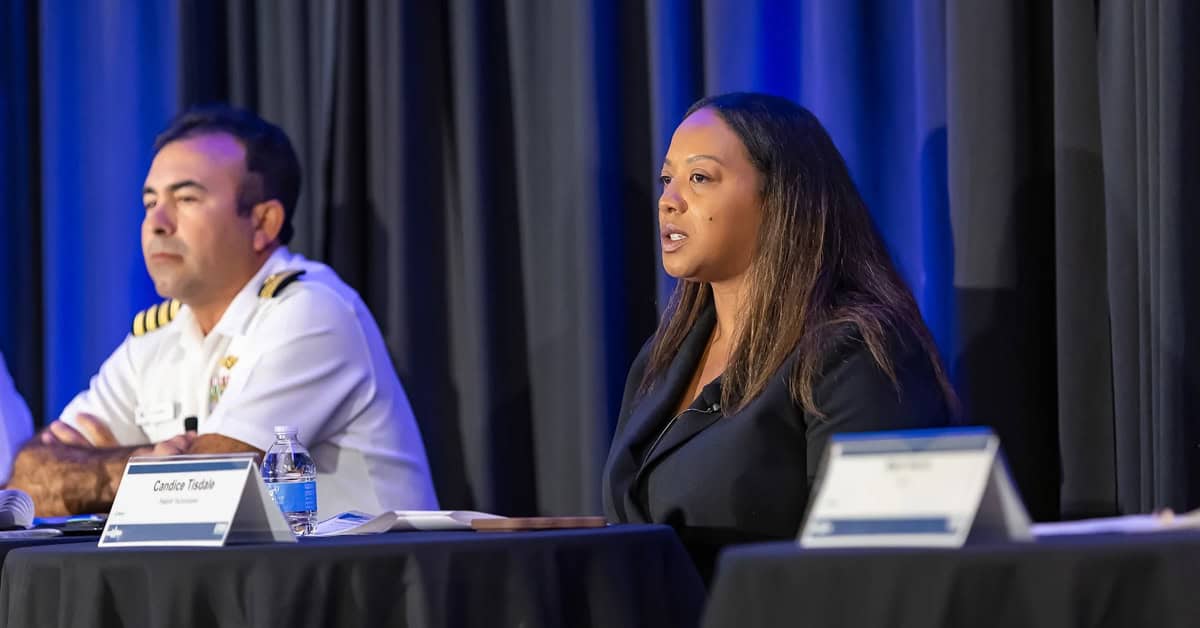
“My core thesis is simple. It’s that AI—commercial capability, specifically AI—should be used to automate the things or do the things that machines are good at so that humans can stay focused on the things that humans should do. I’m not here to argue that we should automate them off. I’m here to say that the right automation in the right place at the right time can be extremely beneficial and still protect the commander’s authority.” — Candice Tisdale of Palantir Technologies
“I recognize there’s a dichotomy between transparency and proprietary solutions, but integrating commercial systems without exhaustive hardware screening risks exposing fleet positions, compromising conditions control standards, protocols and introducing hardware vulnerabilities. So we must keep our adversaries out of our critical tech and supply chains…our [maritime operations centers] operate on secure networks. If your solution…is not actively working towards FedRAMP or the DOD Impact Level 5 authorization, they won’t be able to be deployed on an operational Navy network, regardless of how good your product is. Clearances and authorities to operate are absolutely necessary.” — Capt. Ruth Lane, assistant chief of staff for Maritime Operations Center Type Command, Naval Information Forces
Continue the discussions on public-private partnerships at the 2026 Intel Summit on Sept. 24! Hear from leadership making top tech and budget decisions CIA, NRO, NGA, the Army, the Navy, DHS and beyond. Register now.

Additional Photos
Category: Articles