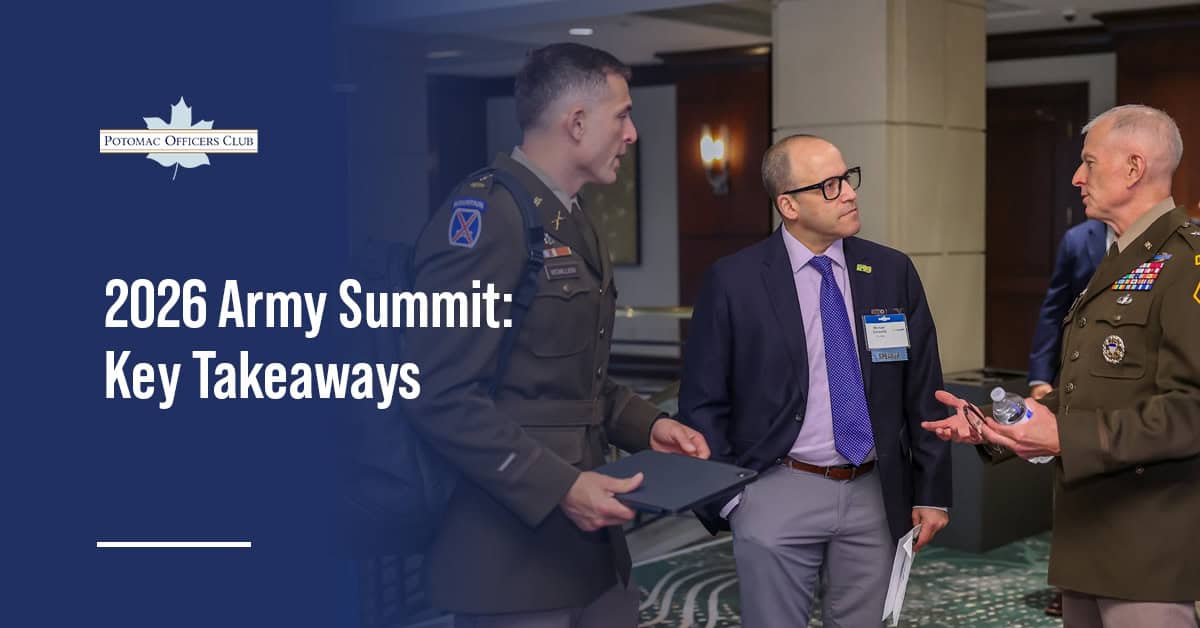
Key Takeaways From the 2026 Army Summit
Co-authored with Pat Host and Gabriella DeCesare
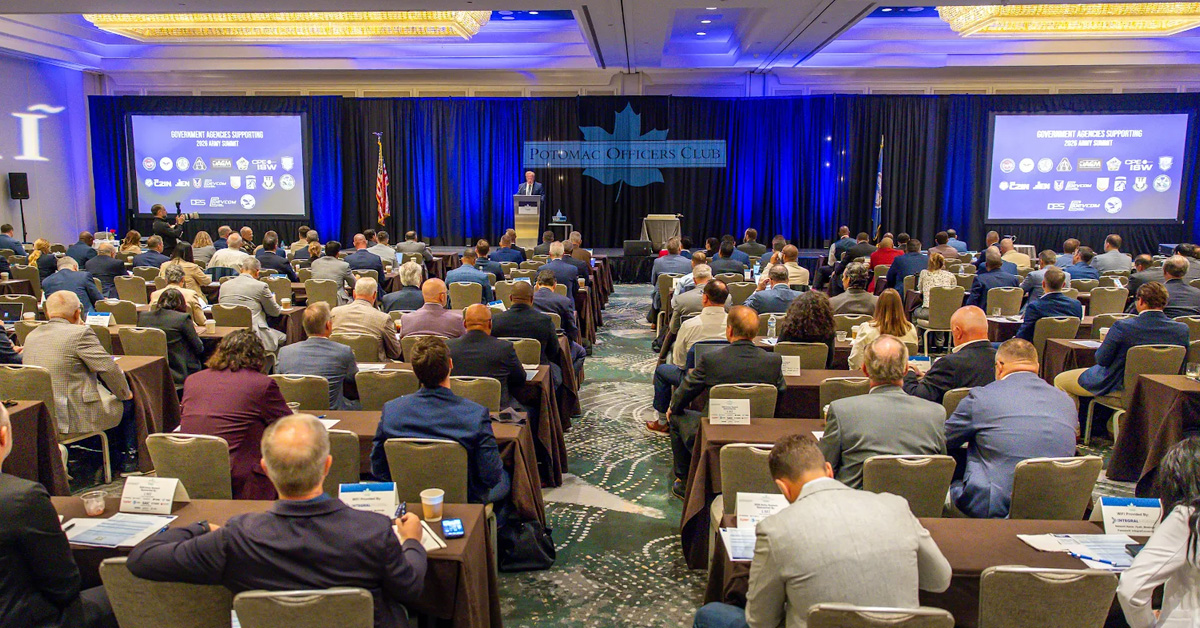
The 11th edition of Potomac Officers Club’s Army Summit was held on Thursday, June 18, at the Hyatt Regency in Reston, Virginia and marked the highest-attended edition of the annual event yet. A crowd of hundreds of GovCon executives and government guests heard from and engaged with leaders across the Army about a range of technology-focused topics. We’ve collected the highlights below.
If you missed the event, there are still two remaining must-attend summits in POC’s 2026 Summer Service Series: the 2026 Air and Space Summit, spotlighting mission priority areas for the Air and Space Forces, is happening July 30, and the 2026 Navy Summit — featuring top naval leadership including Acting Secretary Hung Cao — is convening Aug. 27. Don’t miss these essential defense industrial base conferences!
What Were the Primary Takeaways From the 2026 Army Summit?
Notable Statistics
- Army Enterprise Contracts save 30 percent or more by eliminating “pass-through” costs to get to the commercial software that has already been purchased through other contracts. —Katie Thompson,
- In combination with the revolutionary FAR overhaul, the massive reduction of the AFAR produced a 78-percent reduction on red tape bureaucracy and extra reviews, resulting in crucial time savings (Katie Thompson)
Stand-Out Quotes
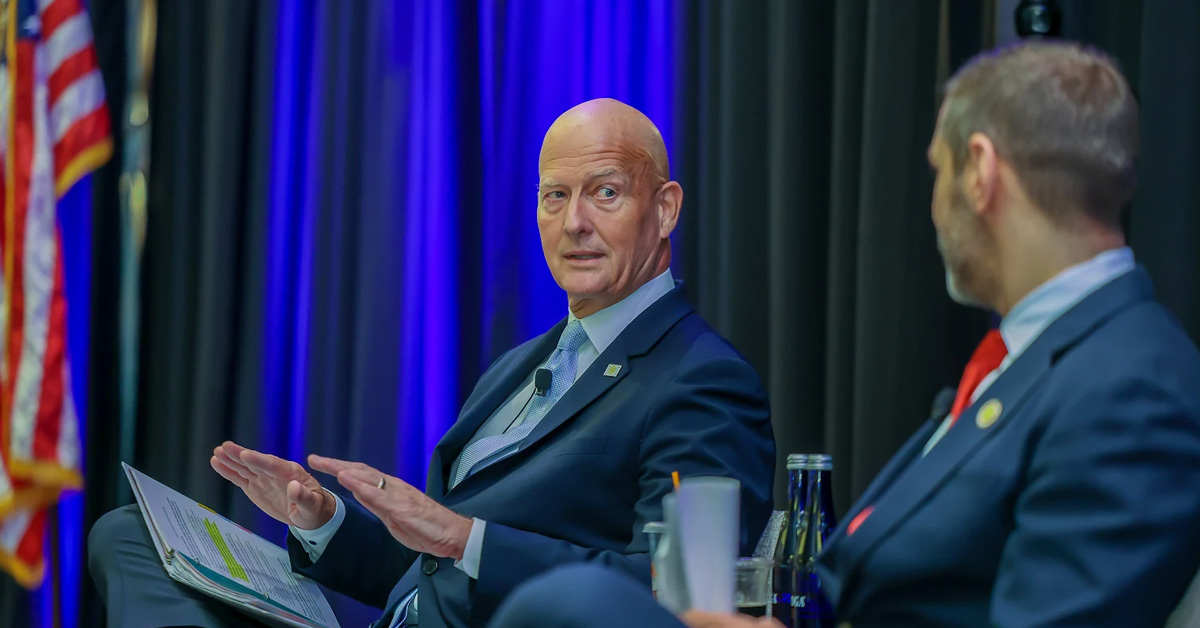
“The fundamental thesis or the premise underneath [the] Strategic Capital [Initiative] is we have a $150 billion shortfall in the organic industrial base that we are not going to make up through appropriations.” —Hon. Marc Andersen, assistant secretary for financial management and comptroller
“This is fundamentally why T2COM exists. It is the connective tissue between concepts and capability; between emerging technologies and operational formations; between future design and today’s readiness. Across the Army, we see the results of this approach.” —MG David Hall, deputy commanding general, Army National Guard, U.S. Army Transformation and Training Command
“Adaptability is really important. As a program manager, you traditionally have always looked at cost, schedule and performance. I’m still looking at all three, but schedule is really important now … it’s really, when does the warfighter need that capability and when can you deliver it?” —Martin Zybura, Army acting deputy for acquisition and systems management
“Back to security, we need revolutionary change…There should be a way we can label data so the right people can see it so I don’t have to create multiple networks to get cross-domain for it to get down the chain. Industry has a chance to think outside the box and use AOS [Army Open Solicitation] or something to bring an innovative idea.” —Clif Basnight, Marconi

Andersen on the latest Strategic Capital Initiative efforts:
“We have an undervalued asset in the context of land—33 million acres. We’ve identified those sets of acres or locations [and] the first set of things we wanted to do…The first was on the compute side. We have two data center deals. One that we’re currently negotiating with Carlyle, one with CyrusOne, they will, inside the fence line, which is also our ability to control execution risk, right? Because it’s Army land versus outside the fence line.
Data centers with power—Army will, in exchange for this lease, get compute. One of the things that’s very important to us in the context of this notion of dual-use technology or dual-use, will be that we’re trying to enter into agreements or create conditions where we are not the sole customer…it’s a healthier business. We see this a lot in advanced manufacturing or other places where, you know, if the Army’s your only customer in a certain way or a certain line, you’ve got to manage the peaks and valleys, which can be difficult.”
Budget Flexibility Is the Missing Link Between Innovation & Fielding
Despite advances in prototyping and experimentation, Army leaders said funding processes remain one of the biggest obstacles to scaling successful technologies. During the From Pilot to Production panel, BG Anthony Gibbs noted that the Army often identifies promising capabilities years before funding can be aligned to support them.
“The fundamentals of successful acquisition have not changed, you have to align really four big things. It starts with a requirement… funding… enabling technologies… and then an acquisition strategy to tie that all together,” Gibbs, who is the Army’s capability program executive for mission autonomy, said.
Gibbs pointed to Next-Generation Command and Control as a model for future modernization efforts because the Army consolidated numerous programs and funding lines into a more flexible structure that allows faster technology insertion. —GD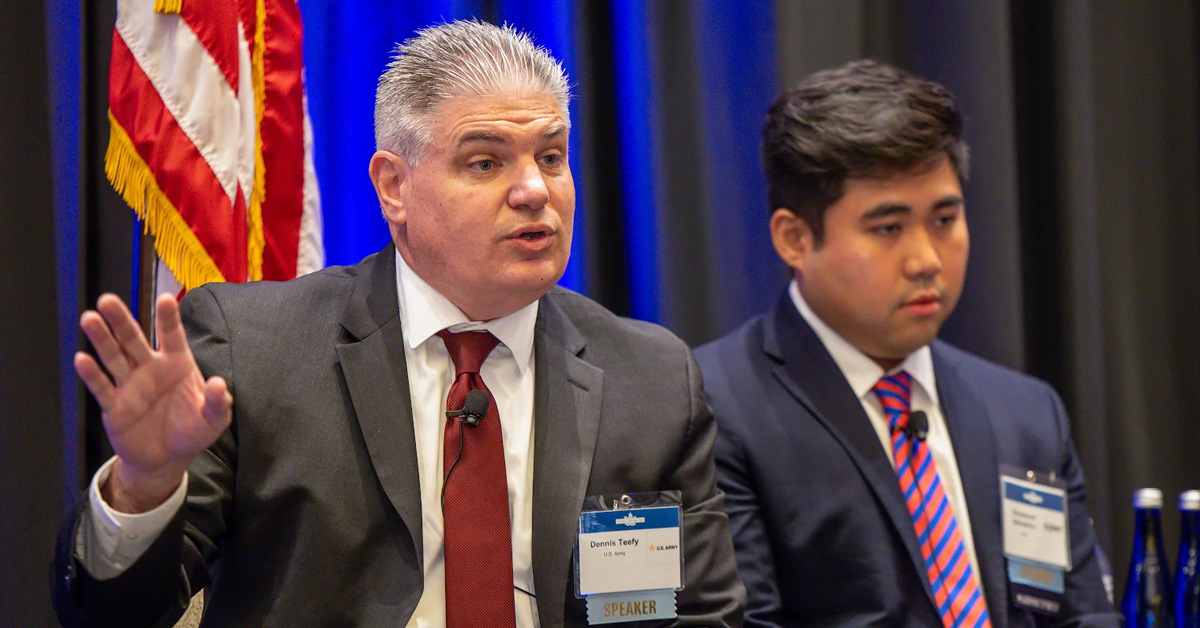
Army’s Dennis Teefy (left) and Kpler’s Emmanuel Belostrino (right) on the From Pilot to Production panel. Photo: EM
NGC2 Is Reorganizing the Army Around Data, Not Programs
One of the most significant modernization shifts discussed at the summit was the Army’s move away from stovepiped systems toward a data-centric architecture under NGC2. Dennis Teefy, project manager for C2 apps within the Capability Program Executive Command and Control Information Network, explained that the Army is restructuring organizations and acquisition programs around four layers: applications, data, infrastructure and transport.
“Fundamentally, what we are working with is data. So the core of it is that data layer and making sure that the Army fundamentally has the ability to use the data across the entire network,” Teefy said.
Rather than waiting years for formal requirements and testing cycles, Teefy said Army teams are prototyping directly with operational units and iterating capabilities in real time.
“We are in the dirt working with our users, requirements communities, the contracting command and most importantly our commercial industry partners,” Teefy said. —GD
Spectrum Availability Is Now More Important Than the Technology Itself

While much of the defense industry focuses on 5G, 6G and advanced wireless capabilities, Heather Edwards, program manager for FutureG at the Office of the Undersecretary of War for Research and Engineering, argued that access to spectrum has become the real challenge. During the Continuous Modernization: Incorporating Wireless Spectrum, SD-WAN, Open Ecosystems and Cybersecurity panel, she pointed to efforts aimed at enabling military and commercial users to operate in the same spectrum bands simultaneously.
“It is spectrum scarcity and the legacy ways that we manage spectrum,” Edwards said.
She highlighted the Advanced Spectrum Coexistence Demonstration Program, which seeks to prove that dynamic sharing can work at scale.
“The idea is to prove that military and commercial can simultaneously and dynamically share spectrum without interference,” Edwards said.
For contractors, the discussion reinforced growing opportunities in spectrum management, FutureG and wireless network modernization. —GD
New Approach to Calculating True Value of Weapon Systems
Evolving warfare capabilities and effects are causing operators to consider new and modern ways of calculating the value of weapons and weapon systems. Militaries can no longer afford to use high-value weapons like munitions against low cost weapons systems such as innovative unmanned aircraft systems.
“There’s a new operational reality going on where low-cost unmanned systems and loitering munitions are outpacing traditional defense models,” said Mike Tomlinson, SAIC vice president for Army aviation, missiles and fires during the Reconfigurable Air Defense and Cost-Effective Fires panel discussion. “We’re all seeing the high cost interceptors against these low threats, which [is] no longer sustainable, driving the urgent need for a different cost-effective approach.”
The Army is reconsidering how it calculates the value of munitions as the term de jour “affordable” has many different meanings and contexts, Tony Garcia, Office of the Under Secretary of War for Research and Engineering director of munitions technologies, said during the Cost-Effective Fires panel.
“We’re really trying to make sure that conversation includes other forms and flavors of cost, for example, depth of your tactical magazine,” Garcia said. “Even if the thing is really, really cheap, if I only have one in my formation, it becomes really expensive to expend it.” —PH
Continuing Value of Operational Testing in Speed-First Weapon System Development
The Pentagon is prioritizing speed to field new weapon system development, accepting 80 percent solutions and iterating them as they progress instead of waiting for 100 percent solutions. But Tony Garcia, Office of the Under Secretary of War for Research and Engineering director of munitions technologies, said during the Reconfigurable Air Defense and Cost-Effective Fires panel discussion that operational testing remains a critically important part of weapons development to ensure safe, and effective, systems, despite the new need for speed.
“We can’t get rid of qualification and go fast for fast’s sake,” Garcia said. “It doesn’t do me a lot of good to have a super capable weapon if I push the “go” button and the Apache [helicopter] explodes, rather than the adversary. There is a certain level of qualification and safety we must figure out how to assure.” —PH
Emerging Surveillance Technologies Are Changing Battlefield Strategies
Reconfigurable Air Defense and Cost-Effective Fires panelists discussed lessons learned from warfare in Ukraine and Iran in 2026. One panelist on the Reconfigurable Air Defense and Cost-Effective Fires panel said a lesson from both Ukraine and Iran is that operators can no longer hide on the battlefield due to advancements in surveillance technologies.
“When I was in the Army, you put up your camo nets and you used terrain…and you weren’t worried about being watched all the time,” said Martin Zybura, Army acting deputy for acquisition and systems management. “[Now] you’re being watched all the time. UAS are everywhere. One-way attack drones, electronic warfare.” —PH
Enterprise Contracts and AOS Are Changing Army Procurement
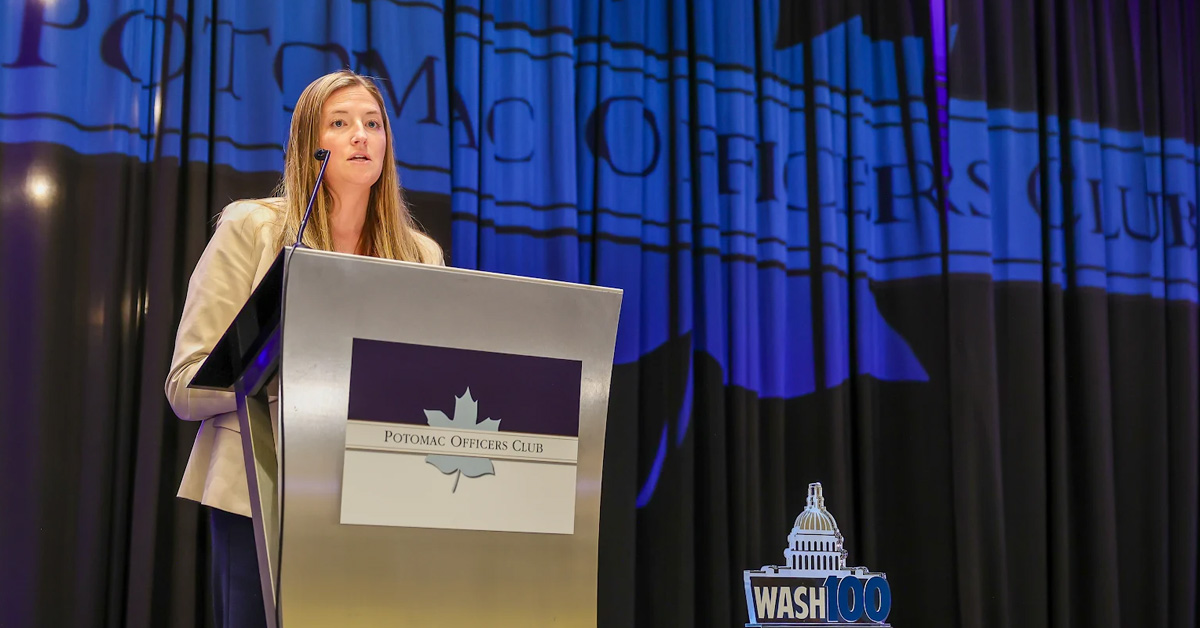
Katie Thompson, deputy executive director of the Army Contracting Command–Aberdeen Proving Ground, highlighted two acquisition initiatives that are changing how the Army buys technology: enterprise-wide commercial contracts and the Army Open Solicitation. Thompson said the Army has already awarded 16 enterprise software contracts and is expanding the effort into hardware, generating significant savings while providing better visibility into technology spending.
“One of our big focuses right now is standing up enterprise-wide contracts for commercial software and we’re recently expanding that to hardware,” Thompson said.
She also encouraged companies to leverage the Army Open Solicitation’s Active Capability Gap pathway to bring forward innovative technologies the Army may not yet be seeking.
“It’s a really easy way for you to bring your technology to the Army, even if we haven’t issued a formal solicitation for it,” Thompson said.
Together, the initiatives reflect the Army’s broader push toward commercial-first acquisition, outcome-based contracting and faster capability delivery. —GD
Fresh Perspectives Needed for Improved Battlefield Connectivity
One industry executive yearned for new perspectives in the discussion about improving connectivity in combat. Clif Basnight, Marconi vice president for mission technology adoption, said during the What’s Still Needed to Enable a Hyperconnected Battlefield panel that it feels like the same people working on the notorious Joint Tactical Radio System, or JTRS, program 25 years ago are the same people working on modern connectivity programs.
“It would be great, from an industry perspective, if you knew of up-and-coming, energetic and very intelligent industry partners, to [have them] come to these meetings and bring new things to the table so that we can do integration at pace. Because we’re not,” Basnight said. “When I tell you what we’re doing, we’re having the same conversations we had 25 years ago. We need to change that.”
Basnight said reconfigurability is a technological advancement that would most help the Pentagon achieve a hyperconnected battlefield.
“The platform should be easier for me to ‘pop on’ and ‘pop off’ something. That is something I haven’t seen in the last 12 months,” he said “If there was investment there to enhance network, [it would be] reconfigurability of those platforms.” —PH
Army Needs Industry to Think Differently About Solicitations
The Army wants contractors to think creatively about responding to solicitations and not just offer what the service is asking for to maximize technological potential. Michael Schwartz, Army chief engineer and systems engineering division chief, said during the What’s Still Needed to Enable a Hyperconnected Battlefield panel discussion that contractors should tell the Army about what it needs that the service isn’t considering.
“We need you to come to us [with] what you have that we’re not thinking about, not ‘hey, this matches your requirement,’ he said. “What aren’t we thinking about? That’s where I think the revolutionary piece is because we think we’re smart, but we don’t think of everything.” —PH
Don’t Overwhelm Soldiers With Technology
Representatives from both the Army and industry agreed that the best technological advancements are the ones barely noticed by the operator. The Army’s Schwartz said during the What’s Still Needed to Enable a Hyperconnected Battlefield panel discussion that a positive and barely-noticed user experience is absolutely essential.
“It should be behind-the-scenes to the soldier,” he said. “They shouldn’t even know that there’s something driving this new thing that they can do. They should just see the same thing, either faster, better or more efficiently, whatever it is.”
Basnight agreed, saying he would hear fellow soldiers grumble about having to use new technologies when he was in the Army, like having to wait four hours for an operating system to perform a function.
“If industry can come back and say, ‘we have this vision, this thing we watch on TV is what everybody’s looking for,’ and we start thinking like that…It is a thought change across everyone that allows us to integrate these emerging capabilities without overbearing,” Basnight said. —PH
Janus Program Success Is About Robust Commercial Nuclear Power
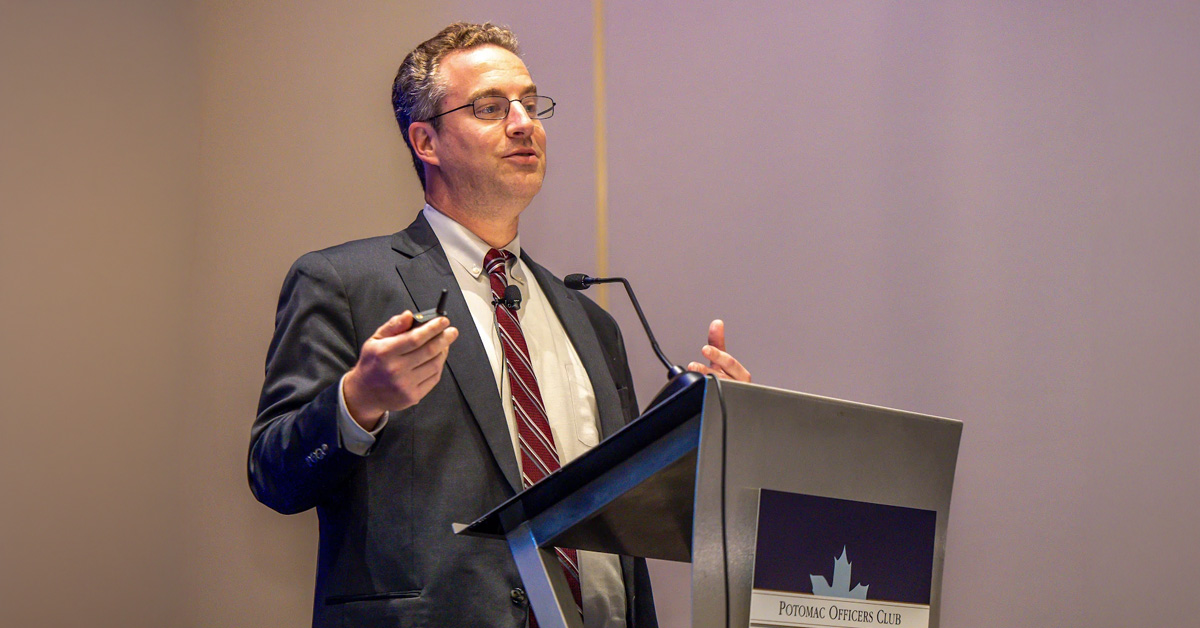
A senior Army official is defining success of the Janus Program nuclear microreactor effort as a robust commercial nuclear energy industry. Dr. Jeff Waksman, principal deputy assistant secretary for installations, energy and environment, said during his afternoon keynote that he is modeling the Janus Program in the image of NASA’s Commercial Orbital Transportation Services, or COTS, effort from 20 years ago, which laid the foundation for a growing commercial space industry and SpaceX from a fledgling startup into a leading provider of launch services.
“This is about transitioning nuclear energy from one-off science projects to an actual commercial product,” Waksman said “So success at the end of this means that we have created a commercial industry in the same way that NASA was able to nurture commercial space companies like SpaceX that now can sell to the commercial sector. We would like to do the same thing with advanced nuclear [power].” —PH
Army Acquisition Reform Efforts Are Ever-Evolving
The Army continues its efforts to improve how it acquires weapon systems and services from industry. A senior Army official discussed how the service is considering changing its characteristic of needs statements to be less rigid and give contractors more flexibility to offer high-potential technological capabilities.
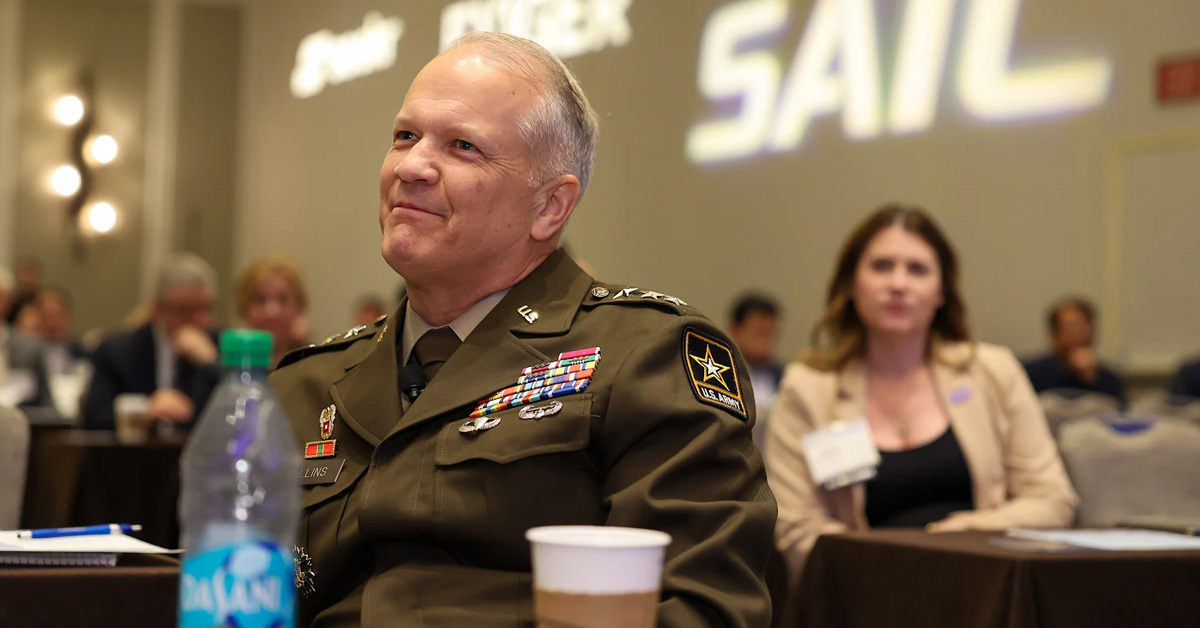
“We in the Army are starting to look at characteristics of needs statements,” Lt. Gen. Robert Collins, principal military deputy to the assistant secretary for acquisition, technology and logistics, said during his opening keynote. “How do we make them shorter? How do we look at potentially describing what it is that we would like to give industry the flexibility to come back, [instead of] prescribing the things that [you must do]?” —PH
AI Use Cases Are Advancing, Evolving
Army Aviation is experimenting with AI to improve how it performs everyday tasks, said CW4 Reggie Oliver, Army chief digital transformation officer for Capability Program Executive Aviation during the Cost Effective Fires panel discussion. Army Contracting Command, he said, has an AI platform that helps automate contract generation.
“Something that we’re trying to do here at CPE Aviation is leverage some of these machine learning models or LLMs…to streamline every single process that we have based upon each specific workflow,” CW4 Oliver said. “What we’re working towards is a fully autonomous agent that can do those monotonous and mundane and repetitive tasks.” —PH
Definitions of AI Vary Wildly
Artificial intelligence can’t be pinned down to one use case, definition or purpose. During the From Data to Decision: How AI is Transforming the Army Today panel, CW4 Reginald Oliver said: “I would be willing to bet…if I asked 50 of you your definition of artificial intelligence, I would probably get 50 different answers.” (CW4 Oliver is chief digital transformation officer for Capability Program Executive Aviation.) Meanwhile, in his fireside chat with Exiger CEO and Wash100 winner Brandon Daniels, Army Comptroller Marc Andersen interrogated the idea of “what we mean when we say AI,” answering decisively and affirmatively when Daniels asked him if he thought AI had a place in decision-making. —Charles Lyons-Burt
Additional Photos
All images by Executive Mosaic


Category: Articles