Army Acquisition in Reverse: What Contractors Should Know About Emerging Opportunities
The Army is rethinking how it acquires and fields technology as military leaders seek to keep pace with rapid innovation across the commercial sector. Rather than relying exclusively on traditional acquisition processes and lengthy development cycles, the service is increasingly looking to partner with industry earlier, leverage private-sector investment and rapidly scale emerging technologies across operational formations.
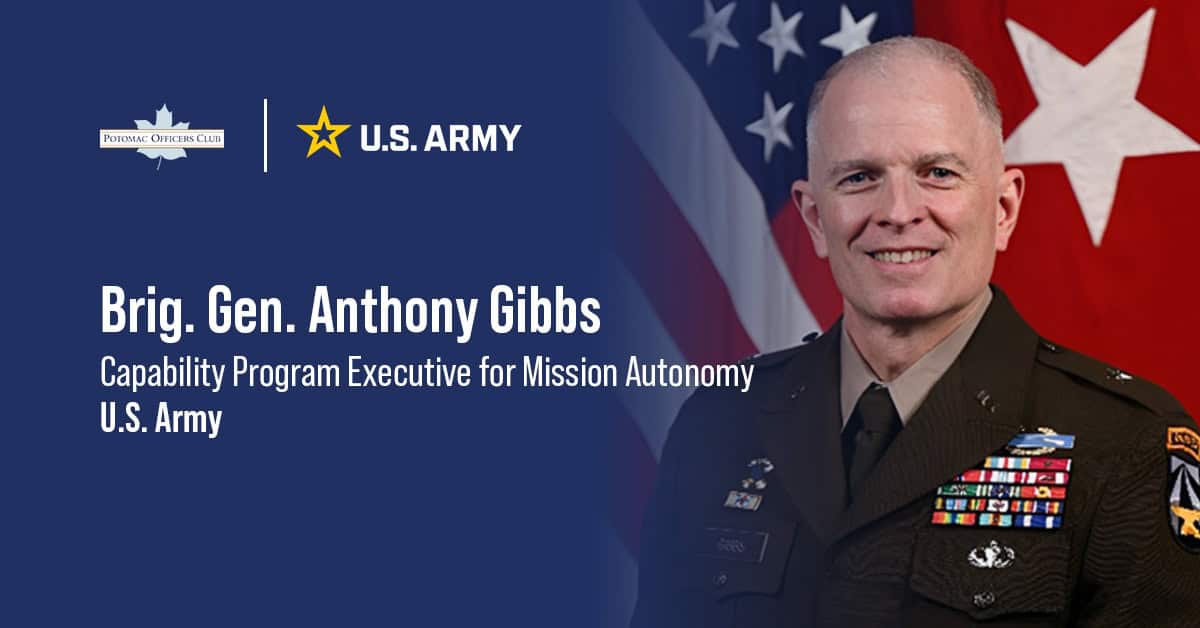
Brigadier General Anthony Gibbs recently sat down with Potomac Officers Club ahead of his appearance at our 2026 Army Summit on June 18, where he’ll bring his expertise to the panel discussion, From Pilot to Production: Accelerating Commercial Capabilities at Scale.
During the conversation, Gibbs, capability program executive for mission autonomy, discussed his organization’s mission, the Army’s evolving approach to acquisition, the growing role of venture-backed defense technology companies and the importance of interoperability as the service modernizes for future conflict.

The Army’s push to modernize its force structure is creating new opportunities for companies developing advanced technologies in areas such as autonomy, electronic warfare, counter-UAS and battlefield networking. At the 2026 Army Summit, Gibbs and other high-ranking Army leaders will discuss the challenges of transitioning promising commercial solutions into deployable capabilities, the importance of interoperability and the role private-sector investment is playing in accelerating innovation. Register today to join the conversation and better understand the technologies and acquisition approaches shaping the future battlefield.
How Is the Army Reversing the Traditional Acquisition Model?
Gibbs said one of the key themes of his upcoming panel discussion will be what he describes as “acquisition in reverse.”
Traditionally, the Army has developed highly specific requirements and then sought industry solutions to meet them. Gibbs explained that his organization is taking a different approach.
“We’re starting with the problem and then actively partnering with industry to develop those capabilities, to find those capabilities that we need to solve those problems,” he said.
The strategy focuses on delivering formation-based capability packages rather than isolated technologies while addressing critical operational challenges such as breaching operations, sustainment and mobility. By identifying operational problems first, Army leaders hope to accelerate capability delivery and leverage commercial innovation more effectively.
Why Should Industry Pay Attention to Defense Venture Capital Investment?
One area Gibbs believes deserves greater attention is the unprecedented level of private investment flowing into defense technology companies.
Looking back at 2025, Gibbs noted that approximately $49 billion was invested in defense and dual-use technologies through venture capital firms, more than double the amount invested the previous year. He added that 2026 is already on pace to surpass those levels.
“That’s a source of investment that we are working hard to shape and leverage so that we have available industry solutions to choose from to solve our problems versus developing from scratch,” Gibbs said.
According to Gibbs, the defense sector is seeing the emergence of new companies attracting top engineering talent and developing technologies at a pace rarely seen in traditional defense acquisition environments.
“We’re seeing the rise of these new companies,” he said. “New founders are really focused on defense in a way that they haven’t been earlier in my career.”
The rapid advancement of autonomous systems has been particularly notable.
“I am really blown away at how quickly technologies are moving, not just at the unmanned platform level in terms of their autonomy, but in terms of collaborative autonomy and this concept of orchestration across multiple systems, be they ground, air, even maritime,” Gibbs said.
Why Is Interoperability Becoming a Top Army Priority?
As innovation accelerates, Gibbs warned that the Army faces a growing risk of fielding disconnected technologies that cannot work together at scale.
“The biggest thing—it goes back to integration and interoperability. That has to be absolutely at the forefront,” he said.
The Army is seeing increased experimentation across operational units, innovation centers and direct industry partnerships. While that innovation is valuable, Gibbs cautioned that it can create fragmented ecosystems if technologies are not designed to operate within a common framework.
“The risk we have there is you have an Army full of solutions that are niche capabilities, but they’re not interoperable across our larger Army,” he said.
To address that challenge, Army leaders are developing what Gibbs described as a unified command and common control architecture built around open application programming interfaces, or APIs, and a common reference architecture.
“That’ll allow us to quickly onboard new technologies and integrate seamlessly into the Army’s larger C2 system, Next Generation Command and Control,” he said.
GovCons interested in learning more about the Army’s interoperability priorities and modernization roadmap can hear directly from Gibbs and other senior leaders including Assistant Secretary of the Army, Financial Management and Comptroller Hon. Marc Andersen, and Army Contracting Command Deputy Executive Director Katie Thompson at the 2026 Army Summit on June 18.
How Will the Army Modernize for Future Warfare?
Looking ahead, Gibbs believes future battlefield dominance will depend on the Army’s ability to move beyond a reliance on a small number of expensive platforms and instead leverage large numbers of interconnected autonomous systems.
“The biggest thing I’m thinking about here is how do we move away from exquisite expensive platforms towards adoption of what I call attritable mass,” he said.
That vision centers on scalable autonomy operating in contested environments and integrated through common command-and-control frameworks.
“We need scalable autonomy that can operate intuitively in contested environments,” Gibbs said. “Building that mission autonomy ecosystem is what will ultimately give us the dominance we need over adversaries.”
Gibbs emphasized that technology alone will not be enough. Success will also require stronger partnerships between the Army and industry.
“We need the traditional defense industry partners, and we need them to be great industry partners, but we need them to evolve their business model right now,” he said.
He argued that future competitiveness will depend on increased investment in research, development and engineering talent capable of delivering next-generation technologies.
What Problems Is the Army Trying to Solve Next?
According to Gibbs, the Army’s modernization efforts remain firmly focused on operational challenges rather than predefined programs.
Among the priorities he highlighted are mobility and counter-mobility operations, sustainment across multiple echelons, accelerating kill chains and integrating autonomous systems into maneuver operations.
“We are working to quickly close our kill chains,” Gibbs said, while also exploring how the Army can “make and maintain first contact with robots rather than soldiers.”
Additional focus areas include counter-UAS technologies, electronic warfare and autonomous systems applications across multiple mission sets. These challenges are shaping the Army’s science and technology investments and will influence prototyping efforts for years to come.
Learn More at the 2026 Army Summit
The themes Gibbs discussed—commercial innovation, scalable autonomy, interoperability and acquisition transformation—are among the most important issues facing the Army and the defense industrial base today. As military leaders seek to accelerate capability delivery and maintain battlefield overmatch, collaboration between government and industry will be critical.
The 2026 Army Summit will bring together senior Army leaders, acquisition officials, technology innovators and government contractors on June 18 to examine the modernization priorities shaping the future force. Register now to hear BG Gibbs and other Army leaders discuss how the service is moving commercial innovation from pilot programs to production at scale.


Category: Articles