
How Commercial Space and Proliferated Satellite Architectures Are Transforming the Intelligence Community
- Proliferated satellite architectures deliver near-constant surveillance capabilities
- Commercial SAR, RF and imagery augment intelligence capabilities at NRO, NGA and U.S. Space Force
- Register here for the 2026 Intel Summit to hear from keynote speaker Maj. Gen. Brian Sidari, USSF’s deputy chief of space operations for intelligence
Threats around the world are evolving, fueled by growing geopolitical tensions and rapid advancements in technology. To keep pace, the U.S. intelligence community is rethinking how it collects intelligence, surveillance and reconnaissance from space, restructuring decades-old approaches to match the speed of modern threats. Agencies are increasingly leaning on proliferated satellite constellations and commercial partnerships to maintain an edge over rivals.

Intelligence leaders from government and industry will explore the changing threat landscape and identify the new capabilities the IC needs to combat adversaries and maintain an information advantage at the Potomac Officers Club’s 2026 Intel Summit on Sept. 24. Secure your tickets here!
Why a Proliferated Architecture?
The National Reconnaissance Office began its shift from fewer, more capable satellites to a proliferated structure of smaller, cost-effective spacecraft in 2024 with the launch of the NROL-146 mission.
The shift mirrors a trend in the commercial space sector, where companies such as SpaceX and Amazon maintain expansive networks in orbit, according to Newsweek. The intelligence agency said the proliferated design is expected to increase revisit rates, meaning the constellation can photograph the same location at shorter intervals and provide near-constant surveillance capabilities.
The proliferated architecture also increases the timely delivery of data to analysts, warfighters and agency partners, wherever they may be in the world. Proliferated low Earth orbit satellite constellations deliver more capacity and give forces access to connectivity in dispersed and disconnected regions, DefenseScoop reported.
Moreover, an infrastructure of hundreds of small satellites spread out across vast distances increases resilience by multiplying potential targets, making the system more challenging and expensive to take down.
Commercial Launch
Troy Meink, the NRO’s former principal deputy director who now serves as secretary of the Air Force, explained that the shift to a proliferated design resulted from several factors, including lower launch costs.
“These variations in launch opportunities help us both from a cost perspective, but they also give us a lot of flexibility,” the 2026 Wash100 winner stated.
How Do US Intelligence Agencies Leverage Commercial Space Capabilities?
NRO designs and operates its own fleet of satellites to support various missions, but over the years, the agency has adopted commercial services to augment its capabilities.
At a House Armed Services subcommittee space posture hearing in 2025, then-NRO Director Chris Scolese, a five-time Wash100 awardee, emphasized that commercial capabilities are “absolutely critical” to the agency’s mission, Breaking Defense reported.
Scolese also shared the extent to which the agency relies on commercial capability, noting that NRO uses commercial imagery, radio frequency and phenomenology. He added that commercial buses are “also capable of doing a lot of what our missions require, and they’re available at a much lower cost.”
The agency, for instance, partners with commercial satellite imagery providers under its Electro-Optical Commercial Layer program. In 2022, Maxar Technologies secured a $3.24 billion contract for shortwave infrared, theater direct downlink, non-Earth imaging and foundation, nighttime imaging, and intelligence area and points collection support.
The agency also works with industry for synthetic aperture radar data collection. NRO recently awarded Radar Commercial Augmentation contracts to Capella Space, ICEYE and Umbra to provide global discovery and monitoring, intelligence analysis, and disaster response and humanitarian mission support.
In a press release, NRO said the contracts enable the integration of commercial SAR with national systems to increase ISR capacity and flexibility.
“This approach allows the NRO to leverage the rapid innovation occurring in the commercial space sector to augment its cutting-edge space-based intelligence systems,” the agency added.
Hawkeye 360, which operates a satellite constellation that collects and analyzes RF data, is at the center of NRO’s commercial RF program. The company has been providing RF data and analytics support to the intelligence agency since 2022, and in 2025, the organizations expanded their partnership. Military Embedded reported that Hawkeye 360 secured 23 months of additional funding from NRO that covers a broader range of RF signals and frequencies and artificial intelligence integration.
NGA Commercial Partnerships
The National Geospatial-Intelligence Agency, which delivers GEOINT for military and national security missions, has increasingly leaned on commercial providers to meet Department of War and IC requirements.
The agency said its Commercial Operations group, established in 2018, acquires commercial data and services and identifies new products to ensure that the U.S. maintains GEOINT supremacy.
“We focus on solutions that can be leveraged to meet operational requirements for multiple needs and multiple partners around the globe — as efficient stewards of GEOINT resources we want to maximize the mission value of commercial capabilities,” Devin Brande, director of NGA Commercial Operations, explained.
Space Force’s TacSRT
The Space Force has developed its own mechanism for tapping into commercial ISR to support defense applications. The Tactical Surveillance, Reconnaissance and Tracking program, or TacSRT, serves as the service’s marketplace for commercial suppliers of data.
According to Brig. Gen. Anthony J. Mastalir, director of global space operations for the Space Force, TacSRT fills in gaps in coverage, supporting “some task force that’s planning a low-level op that wouldn’t think they could get that kind of imagery.”
Maj. Gen. Brian Sidari, deputy chief of space operations for intelligence at the Space Force, will keynote the 2026 Intel Summit. Sidari currently oversees policy and guidance for the Space Force’s ISR capabilities. Register today to hear his perspective on how the Space Force is evolving its approach to intelligence to keep pace with a rapidly changing threat environment.
Increased Data
Building a proliferated satellite architecture in orbit and embracing commercial space services have dramatically expanded the volume of intelligence data generated to support various missions.
William Adkins, principal deputy director at NRO and a 2026 Wash100 recipient, shared that the agency’s proliferated architecture made more than 400,000 collections in 2025.
“We are delivering unprecedented levels of persistence, timeliness and resilience—providing a clear information advantage to our stakeholders,” Adkins said at the annual Space Symposium in April.
“Simply put, we are making it harder for adversaries to hide—and harder for them to disrupt our capabilities,” he added.
AI Integration
The growth of data generated by a proliferated architecture has made AI a necessary tool. Space Force Maj. Gen. Chris Povak, deputy director at NRO, pointed out that automation is needed to process data and meet strict timelines.
“The days of having people in the loop, on the loop, doing manual processes are gone,” he commented.
Where to Learn More About Space-Based ISR
The Potomac Officers Club’s 2026 Intel Summit on Sept. 24 is a premier gathering of experts from government and industry to talk about issues that matter to the IC. Attendees will get to hear directly from Maj. Gen. Brian Sidari, deputy chief of space operations for intelligence at the Space Force, who will deliver the mid-morning keynote at the event.
Sidari’s career is marked by leadership roles across the Air Force, Joint Staff and Space Force. He began building his career in intelligence in 2005, when he was appointed as operations team chief of intelligence at the National Airborne Operations Center at Offutt Air Force Base. He also served as director of operations for the 390th Intelligence Squadron in Japan, commander of the 6th Intelligence Squadron in South Korea, counter-terrorism operations officer on the Joint Staff at the Pentagon and assistant deputy director for ISR operations within the Joint Staff’s Operations Directorate.
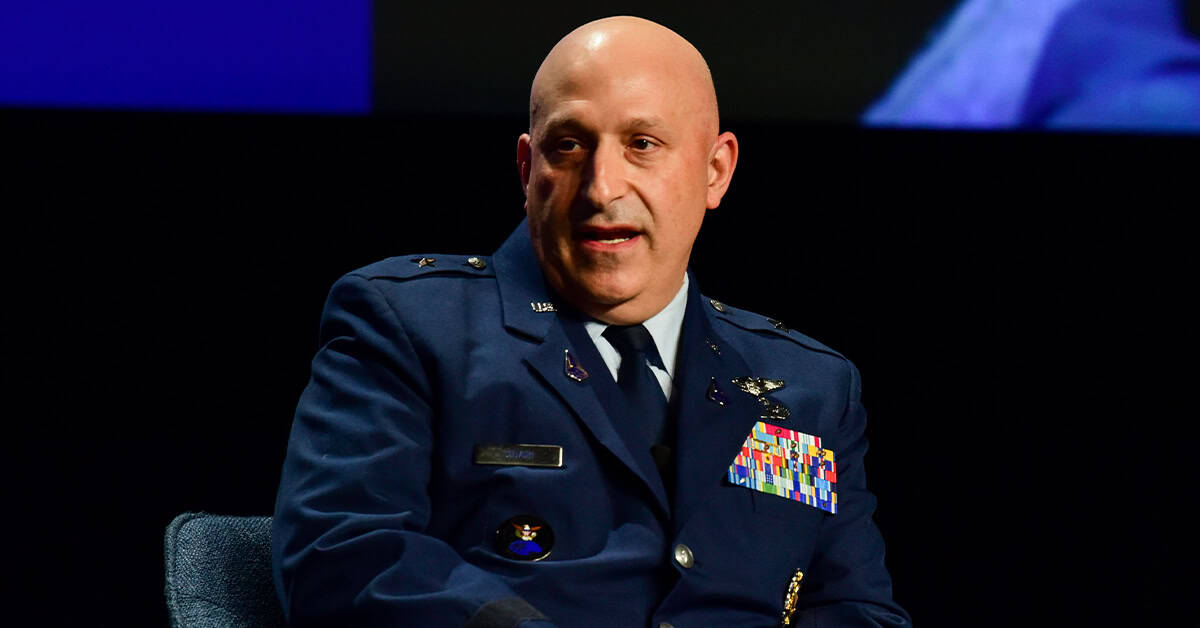
He transferred from the Air Force to the Space Force in June 2021. Before assuming his current post, he served as director of intelligence at U.S. Space Command.
The summit’s keynote speakers also include:
- Ryan Lewis, chief architect of NRO’s Systems Acquisition and Operations Directorate
- Matthew Fodor, operations director for the FBI’s National Security Branch
- Vice Adm. Thomas Henderschedt, director of intelligence, Joint Staff
- Tim Kosiba, deputy director of the National Security Agency
- Matthew Kozma, under secretary for intelligence and analysis at the Department of Homeland Security
- Carrie Thompson, chief of intelligence at the Drug Enforcement Administration
Panels will cover some of the most critical topics and trends within the IC, including the use of AI and open-source intelligence to enhance operations and how to strengthen cybersecurity amid evolving digital threats. Tickets are available here!


Category: Articles