Is User-Centered Design the Missing Link in Federal Digital Transformation?
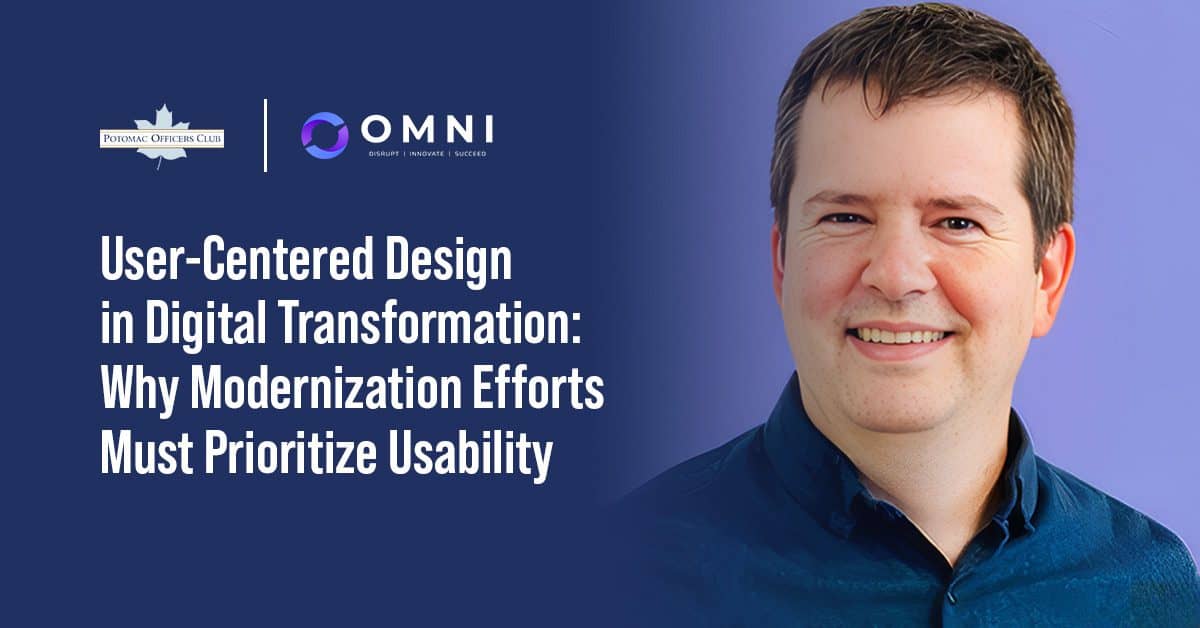
As federal agencies push forward with AI adoption and modernization initiatives, OMNI Federal Chief Technology Officer Rob Gordon is calling attention to a critical gap in digital transformation: user-centered design.
 Achieving effective digital transformation requires a renewed focus on user experience to ensure technologies deliver real mission outcomes, according to Gordon, who discussed the topic in an interview with Potomac Officers Club ahead of his appearance at our 2026 Digital Transformation Summit on April 22. Don’t miss the opportunity to hear from Gordon and other federal and industry leaders during his panel, Operationalizing AI in High-Security Federal Environments — register now!
Why Put Users at the Center of Digital Transformation?
As federal agencies accelerate digital modernization and AI adoption, Gordon told POC that leaders should refocus on a critical and often overlooked element: user experience.
Gordon said the conversation around digital transformation has become too focused on technology alone, at the expense of usability and mission impact.
“We focus a lot on the technology aspects of digital transformation in terms of DevSecOps and cloud migration, and these are certainly important, but I find that we don’t spend as much time on the user-centered design aspect of digital transformation, which is arguably more important,” he said.
Drawing from his commercial background, Gordon emphasized that user experience is non-negotiable in the private sector, and should be treated the same way in defense environments.
“In the commercial world, user experience is table stakes. It’s mandatory. If you make a system that’s hard for people to use… people will just use a different service or buy a different product,” he said.
That same principle, he argued, could carry even greater weight in Department of War environments, where outcomes directly impact mission success.
“In the DOW… you would think that it would be even more so that way… it’s life and death scenarios or billions of dollars being spent optimally versus not,” Gordon added.
Avoiding the ‘Modernization for Modernization’s Sake’ Trap
Gordon warned that agencies risk losing sight of mission objectives as they modernize legacy systems and adopt new technologies.
As organizations migrate from on-premises systems to cloud-based architectures, they often prioritize performance gains and scalability without validating whether those improvements actually enhance mission outcomes.
“We get lost in the sauce of, ‘Look, we’re moving to the cloud, look how much better it can perform,’” Gordon said. “But if we don’t know that it’s actually doing the mission thing that it was built to do… we’re not really helping solve a problem.”
He stressed that modernization efforts must preserve and improve the core functionality that legacy systems were originally designed to support.
“If we lose sight of that as we’re modernizing… we’re not actually improving as part of transformation,” he said.
How Can Agencies Ensure User Experience Is Prioritized in Digital Transformation?
To address this gap, Gordon highlighted the importance of real-user monitoring and continuous feedback loops as part of a user-centered approach to modernization.
“Conducting user research, identifying key personas and their ‘pain-points’ and ‘must-haves,’ and creating a data-driven, continuous feedback mechanism for improvement via real-user monitoring are critical components of a successful digital transformation,” he said.
He pointed to work with the U.S. Air Force as an example of how agencies can measure success beyond technical benchmarks.
“We do a lot with the Air Force to put in real user monitoring capabilities… so that their stakeholders can actually tell this exact story… [their users] can get through three times as many [workflows] as they used to,” Gordon said.
This shift allows agencies to demonstrate tangible mission impact not just cost savings or infrastructure upgrades.
“It’s not just like, we’re saving you money… it’s like our people are able to do more work more efficiently,” he added.
Attendees of the 2026 Digital Transformation Summit on April 22 will gain critical insight into technology priorities across the federal landscape from industry leaders like Gordon, and top federal information officers like Pentagon CIO Kirsten Davies and Transportation CDIO Pavan Pidugu. Register before it’s too late.
Why Should Technology Environments Be Designed for AI-Enabled Experiences?
As artificial intelligence becomes more embedded in federal systems, Gordon said user-centered design will become even more critical.
“AI is already revolutionizing the way we interact with technology… and we need to adapt our way of designing interfaces, applications, and digital experiences for this new reality,” he said.
However, he cautioned against deploying AI tools without thoughtful design and usability considerations.
“Just making a chatbot and saying, ‘Hey, ask me anything… I’ll give you the answer’… that’s not a path for success,” Gordon said. “People are going to ask, ‘What do I do with this?’”
Without intuitive interfaces and clear guidance, users may struggle to adopt AI tools or even become less efficient as they attempt to navigate them.
“They’re going to end up taking even longer… because they have to figure out how to be a prompt engineer… because we’re not giving them the right usability cues,” he added.
Connecting User Experience to Secure AI Adoption
While user-centered design is foundational, Gordon also tied it directly to broader efforts to operationalize AI in secure federal environments.
“As AI usage proliferates across more and more mission-critical use-cases across the DOW, there is a need for a new set of enterprise services that enforce governance, security and observability without sacrificing agility,” he said.
He noted that capabilities that “secure our AI applications, control the scope of data and agentic actions… and provide cyber operators with the visibility they need” are essential to moving AI from prototype to production.
Gordon will expand on these themes at the 2026 Digital Transformation Summit, where he will speak on the panel “Operationalizing AI in High-Security Federal Environments.” The summit will convene government and industry leaders to explore how agencies can scale AI securely while maintaining mission effectiveness and user trust.
Who Is Rob Gordon?
Rob Gordon serves as chief technology officer at OMNI Federal, where he leads the company’s technical strategy and ensures alignment with customer mission objectives. He brings more than 25 years of experience across commercial and federal sectors, specializing in enterprise cloud architecture, cybersecurity, identity, credential and access management, and zero trust.
Prior to joining Omni Federal, Gordon led architecture and technical delivery teams at Akamai’s Defense group, supporting major programs for the U.S. Air Force and Army. His career reflects a consistent focus on applying innovative technologies to address the Department of War’s most complex challenges.


Category: Articles